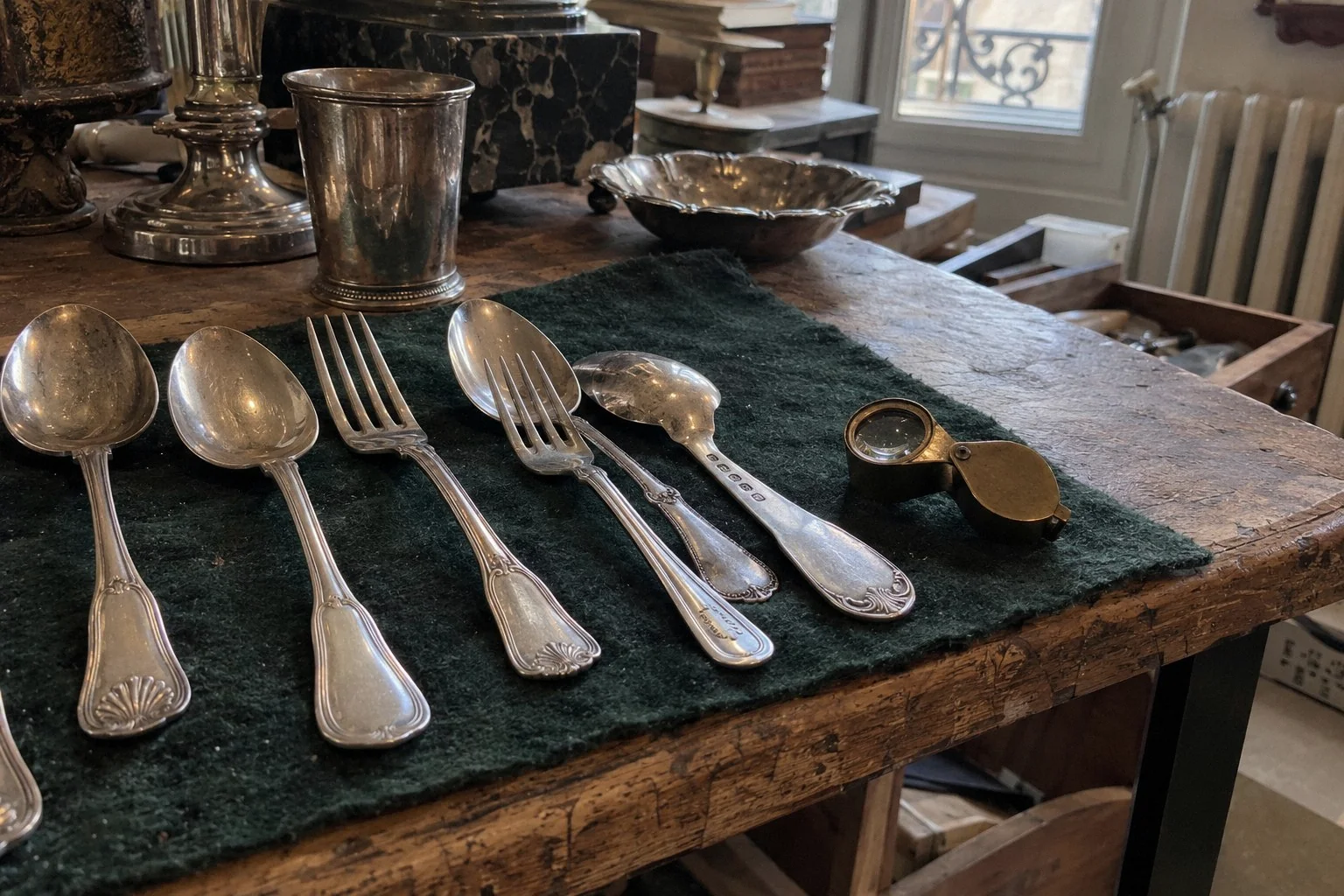
By Baptiste Murier, antique and second-hand dealer in Île-de-France.
The short answer: a piece of French solid silver carries two marks. The first is a small Minerva (Minerve) head, the guarantee hallmark used since 1838, with a number 1 (950 thousandths) or 2 (800 thousandths). The second is the maker's mark, that is the silversmith's mark, in a lozenge (a diamond shape). If the maker's mark is in a square, or if you read "métal argenté" (silver plated metal), it is generally a base metal covered with a thin layer of silver, not solid silver.
Here is how to read these marks at home, with a simple magnifying glass, and what is best avoided.
Where do you find the hallmarks on a piece of silver?
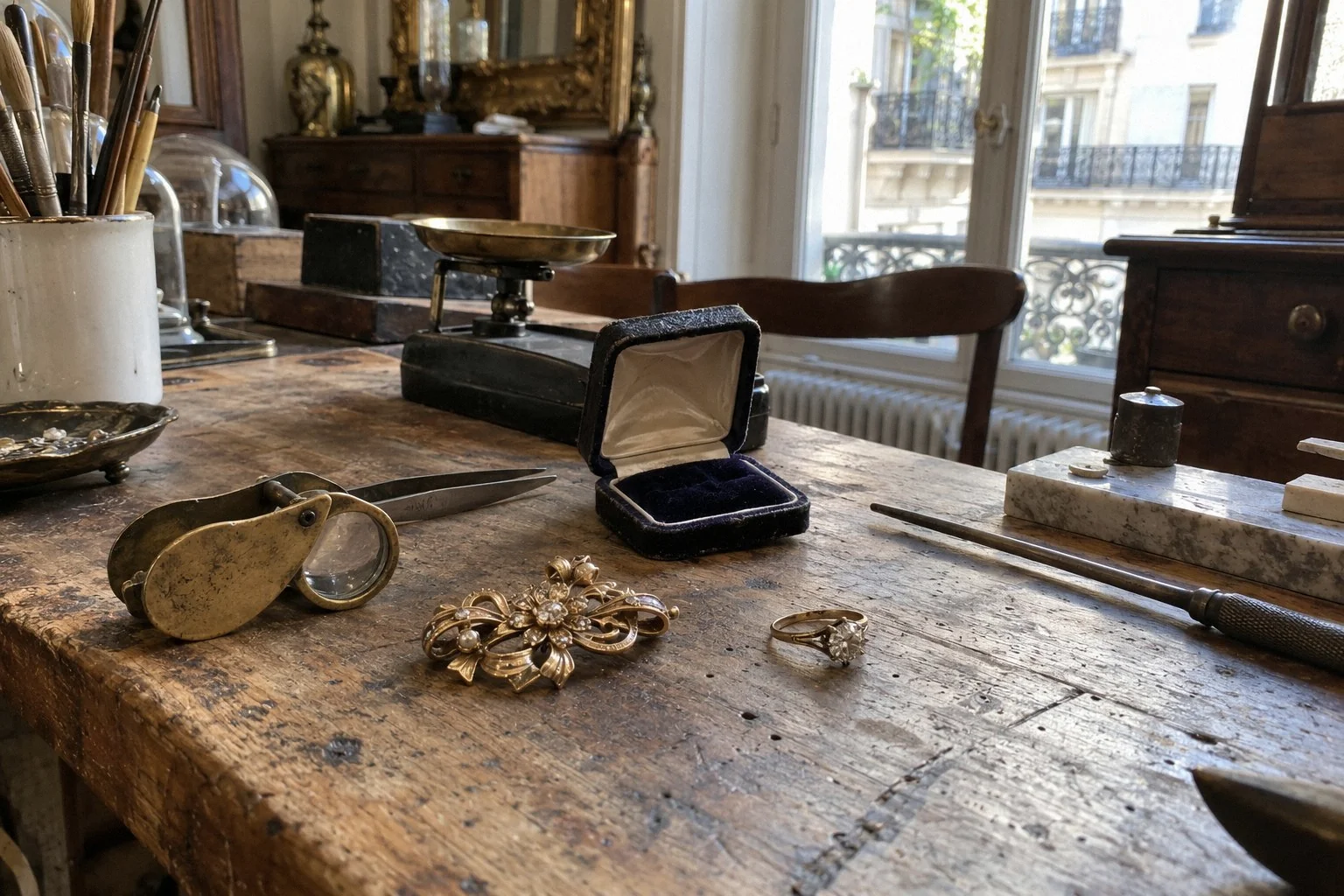
Hallmarks are small, and sometimes worn. You need good light and a magnifying glass, ideally a jeweller's loupe. Your phone camera, in close-up mode, also helps a lot.
Where to look:
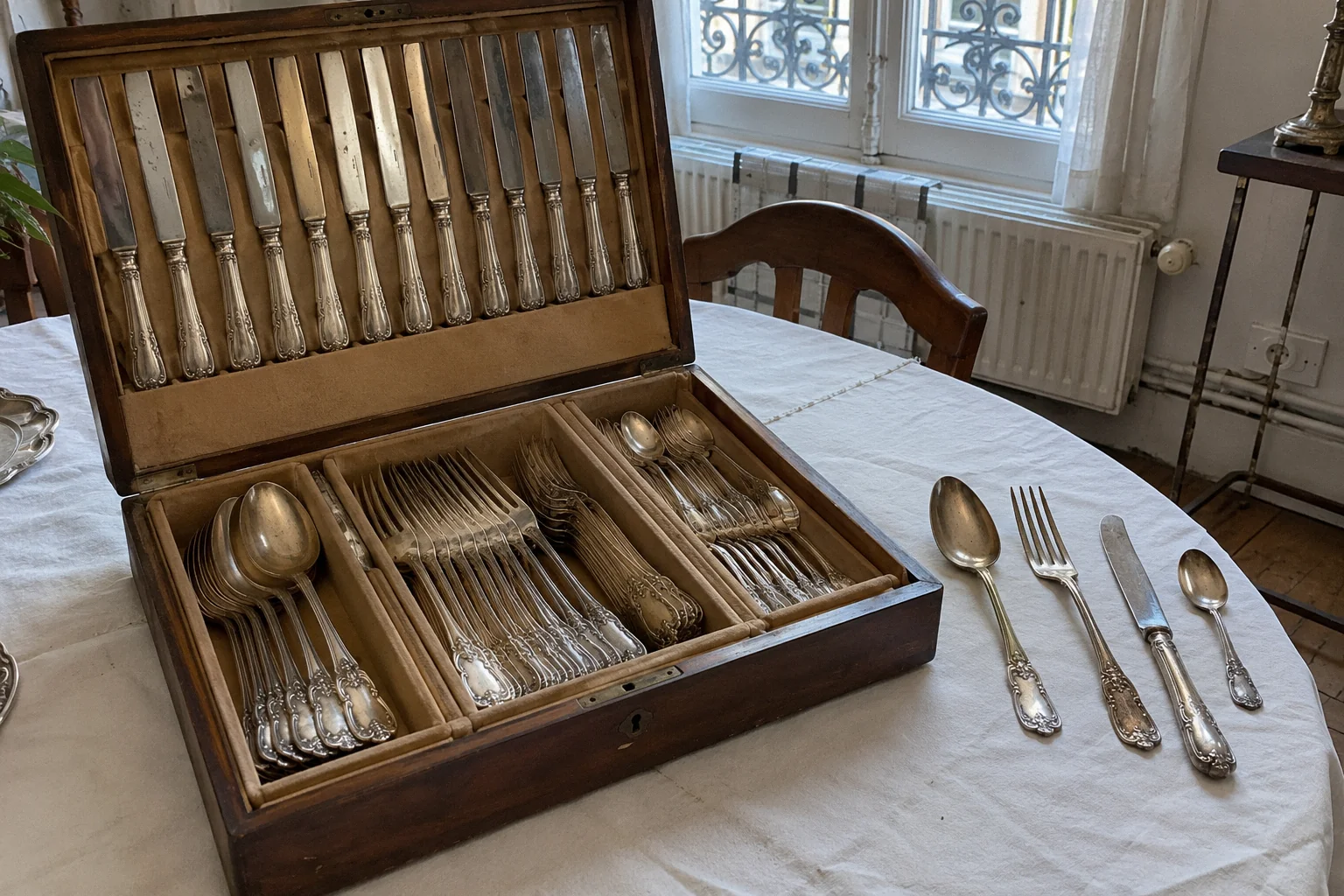
- Cutlery: on the back of the handle, often near the wide part.
- Dishes, trays, plates: under the base or near the rim, on the underside.
- Teapots, coffee pots, sugar bowls: under the base, and also on the lid, which is often marked separately.
- Beakers and egg cups: under the foot or near the rim.
- Small items: on the clasp, the ring or the edge.
Wipe gently with a soft cloth, with no product. Cleaning too hard can erase a hallmark that is already worn.
The Minerva head: the mark of French solid silver since 1838
Since 1838, French solid silver has been marked with a Minerva head, the helmeted goddess, seen in profile. This hallmark is the French State's guarantee: it says the metal has been tested.
The number next to the profile shows the standard, that is the share of pure silver in the metal:
- Minerva 1, first standard: 950 thousandths, meaning 950 grams of pure silver per kilo of metal.
- Minerva 2, second standard: 800 thousandths.
The rest is another metal, usually copper, which makes the silver stronger. The outline of the hallmark is not the same for each standard. A small sign inside the hallmark, called the "différent", also lets specialists tell which assay office it came from.
Before 1838, other hallmarks were used, under the Ancien Régime, the Revolution, the Empire and the Restoration. Reading them takes practice, and a piece from those periods always deserves a serious valuation. The Minerva is still in use today, and French law also recognises other standards for silver, such as 925 thousandths. Under French law, silver must be at least 800 thousandths to be called silver.
The maker's mark: a lozenge for silver, a square for silver plate
Next to the Minerva, look for the silversmith's mark. For makers of gold or silver items, it is lozenge-shaped, with initials and a small symbol chosen by the silversmith. Imported items carry an importer's mark instead, which is oval.
Silver plate is something else. It is an ordinary metal, often a copper alloy such as brass or nickel silver (maillechort), covered with a thin layer of silver. On these pieces, the maker's mark is generally in a square, sometimes in a rectangle, with letters, numbers or a name. There is no Minerva.
Other words point to an item that is not solid silver:
- "métal argenté" or "plaqué" (silver plated);
- "EPNS", an English mark for silver plate;
- "Alpacca", an alloy with no silver in it.
Vermeil is a special case. It is solid silver covered with a layer of gold. So it carries the Minerva, just like silver.
Small items: a different hallmark
On small silver items, there is not enough room for a large Minerva. Instead you find a smaller hallmark, with another design. On silver made after 1838, you often see a boar's head for Paris or a crab for the rest of France. These are common marks on coffee spoons, thimbles, boxes, buttons or chatelaines.
For very light modern items, there is another rule. In France, since 2001, silver items weighing under 30 grams have been exempt from the guarantee hallmark. They must still meet a legal standard and carry the maker's mark. So the lack of a Minerva on a small modern item does not prove it is not silver.
Foreign silver: other marks
Many pieces sold in France come from elsewhere. Each country has its own marks:
- in England, a walking lion marks sterling silver, at 925 thousandths;
- in Germany or Italy, you often see the number 800;
- in the United States, the word "Sterling".
A number on its own, such as 800 or 925, is a good clue. But it can also be imitated on silver plate. For an old foreign piece, a full reading requires knowing the marks of each country.
What not to do at home
- Do not scratch the piece to see what is underneath.
- Do not use acid: the tests sold online leave a stain and reduce the value.
- Do not file an edge or the underside, however discreetly.
- Do not rub too hard with an abrasive product: hallmarks fade and the patina disappears.
- Do not split up a canteen of cutlery before having it valued, and keep its case.
A magnet can give a clue: silver is not attracted. But copper, brass and many alloys are not either. So it proves nothing on its own.
Solid silver or silver plate: what difference does it make?
A solid silver piece is worth at least the value of its metal. The weight of pure silver depends on the standard: a first standard piece contains more silver than a second standard piece of the same weight.
Watch out for a common trap: knives with silver handles. The handle is often hollow and filled with another material. So the total weight does not match the weight of silver.
Beyond the metal, the value depends on the workmanship: a well-known silversmith, fine decoration, a sought-after period, a complete service in its case. Two pieces of the same weight can be worth very different amounts.
Silver plate sells for its style and its maker, not for its metal. Some silver plate sells well, other pieces very little. Either way, it is better to know what you have before you sell.
To go further:
- our antique silverware valuation, at home or from photos;
- selling antiques to us, with immediate payment;
- gold hallmarks, in the article selling antique jewellery;
- if the silver comes from an estate, the article what to do with the furniture and contents of the home.
Not sure? Show us the hallmarks
Send us two photos per piece on WhatsApp at 06 24 56 38 58 (+33 6 24 56 38 58 from abroad): one of the whole item and one sharp close-up of the hallmarks. We will tell you what we read, and whether it is worth a closer valuation. The valuation is free and with no obligation, from photos or at your home, in Paris and the Ile-de-France.