Asian art
Chinese antique and Asian art valuation
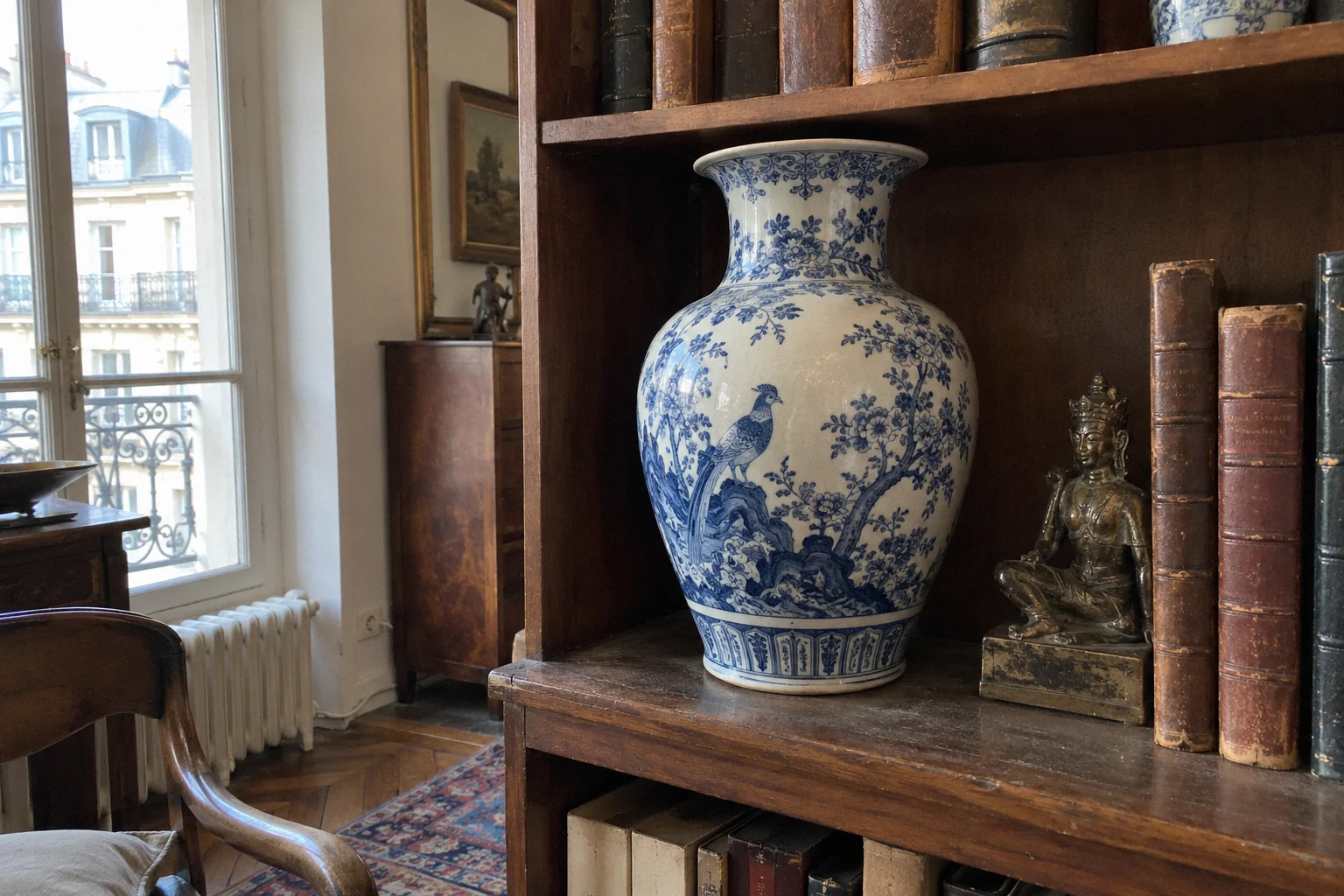
A Chinese vase brought back by an ancestor, a Japanese bronze, a lacquer box? We look at the body, the decoration, the mark under the base and the quality of the work, and tell you honestly what we see.
4,6/5 · 53 Google reviews · Free valuation and free travel
Many French families keep an object from Asia: a vase from China, a dish from Japan, a small bronze. Some are old and of fine quality. Others are more recent decorative pieces. Telling them apart means looking at several things at once.
The Asian objects we value
- Chinese and Japanese porcelain: vases, jars, dishes, bowls, cups;
- bronzes and cloisonné enamels;
- lacquer: boxes, trays, small furniture;
- jade and carved hardstones;
- paintings on silk or paper, Japanese woodblock prints;
- stands, boxes and small scholar's objects.
What we look at to value an old Chinese object
Body and foot
We always turn the object over. Under a vase or a bowl, the foot ring is often unglazed: you can see the body, its fineness, its colour, and the wear. Old wear is irregular, where the object has rubbed. Wear that is too even, or a sanded foot, calls for caution.
Decoration and enamels
The decoration helps to place a piece. A few well known families:
- blue and white, painted in cobalt blue under the glaze;
- famille verte, with mainly green enamels, linked to the reign of Kangxi, between the late 17th and early 18th century;
- famille rose, which appeared in the early 18th century;
- so-called Canton porcelain, richly decorated, largely made for export in the 19th century;
- for Japan, Imari, in blue, red and gold, and Satsuma, an earthenware with a crackled cream glaze, often highlighted with gold.
We look at the fineness of the brushwork, the quality of the enamels, the accuracy of the drawing. A fine piece is often recognised by these details.
The mark under the base
Many Chinese porcelains carry a reign mark under the base, in four or six characters, naming an emperor. Be careful: it is very common for a piece to carry the mark of a reign earlier than when it was made. This is called an apocryphal mark. Kangxi or Qianlong marks, for example, are found on 19th or 20th-century pieces. So the mark is a clue, never a proof.
For Japan, we look at the signature of the artist or workshop, and at the original wooden box when there is one, often inscribed in ink.
Bronzes, lacquer and jade
For a bronze, we look at the weight, the patina and the fineness of the casting and chasing. Japanese bronzes from the Meiji era (1868 to 1912) are often very finely worked. For lacquer, we look at the thickness of the layers, the gold decoration and the condition. For jade, we first check the stone: many green stones, and even glass, imitate jade.
Caution about copies
In China, old objects have been copied for centuries, out of respect for the models. Today there are also many recent imitations, with fake marks and artificial ageing. That is why we never rely on a single sign. We cross-check the body, the decoration, the mark, the wear and the quality of the work.
No ivory
We do not buy ivory objects. The trade in elephant ivory has been banned in France since the decree of 16 August 2016, with rare, tightly controlled exceptions.
Mistakes to avoid before selling
- Do not wash a bronze or a lacquer piece, and do not put any product on it: the patina does not come back.
- Do not separate an object from its wooden stand, its lid or its pair.
- Keep Japanese wooden boxes, even empty, and old collection labels.
- Do not glue a broken vase back together yourself. Keep all the pieces.
- Do not trust the price of a "similar" object found online.
How the valuation works
For an Asian object, we prefer to see the piece in our hands: the home valuation is free and does not oblige you to anything. We travel at no cost to your home in Paris and Île-de-France. You can also send us photos on WhatsApp: the whole object, the underside and the mark, details and flaws.
If you sell, we buy with immediate payment, by bank transfer. We also buy the other antiques and curiosities in the home, and value paintings at the same visit. For an estate, we can look at everything together.
A photo of the whole object and one of the mark under the base are the best place to start: send them on WhatsApp to 06 24 56 38 58 (+33 6 24 56 38 58 from abroad), or give us a call.
Frequently asked questions
Read next
A question about an item?
Send us a photo on WhatsApp or give us a call. Free valuation and free travel.