
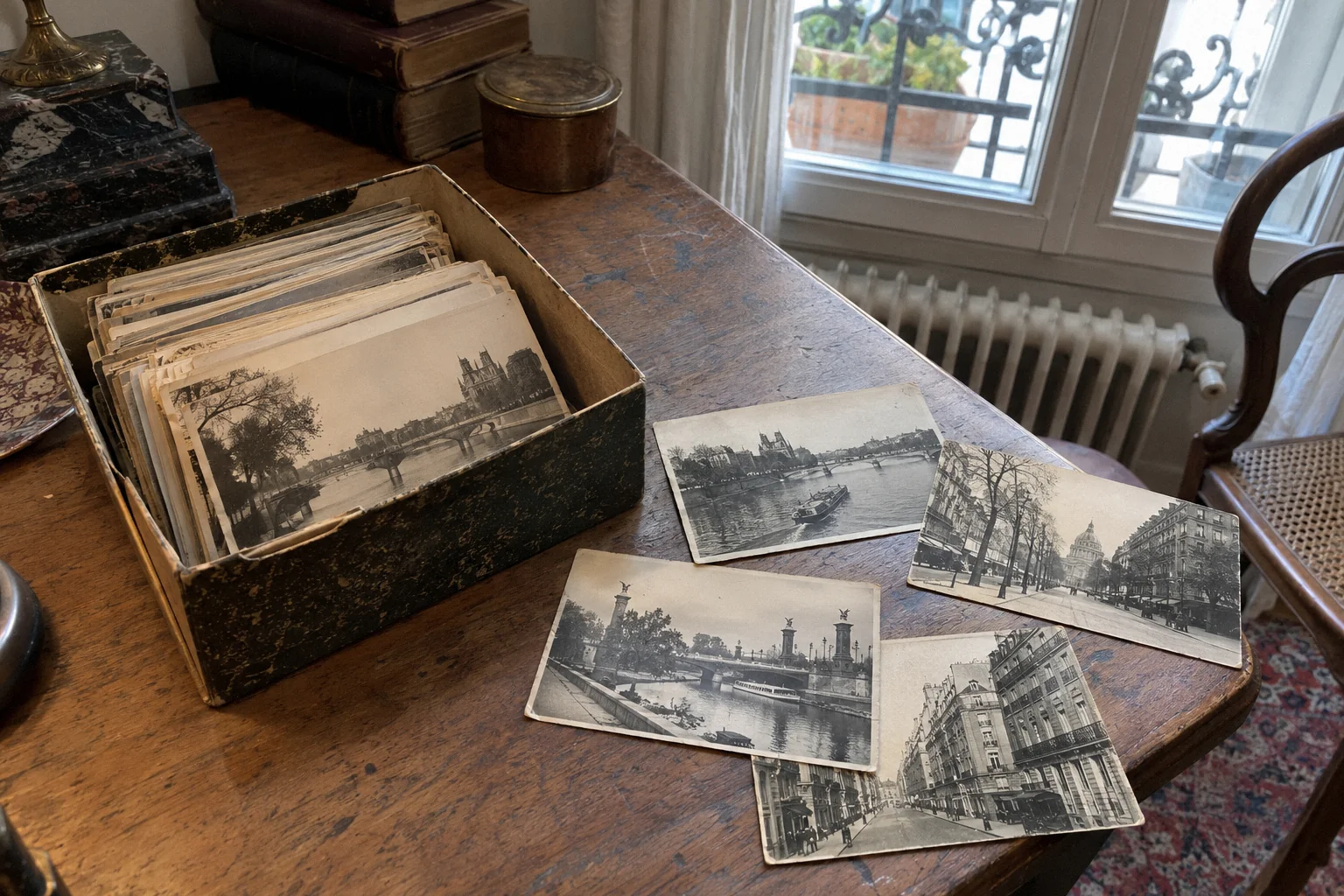
Old postcards
Valuation of old postcards and postcard collections
A family album, a shoebox full of cards, a grandfather's collection? We look at the subjects, the period and the condition, card by card if needed, and give you a free valuation.
4,6/5 · 53 Google reviews · Free valuation and free travel
Old postcards often sleep in a cupboard or in the attic. They are light, people forget them, and sometimes they get thrown away. Yet postcard collecting still has its enthusiasts. Before you part with them, have them looked at.
CPA, CPSM, CPM: what do they mean?
French collectors sort postcards into three families:
- CPA, old postcards: roughly up to the interwar years. The golden age of the postcard runs from the early 20th century to the First World War.
- CPSM, semi-modern postcards: roughly from the 1940s to the 1960s, often with deckled edges and glossy photos.
- CPM, modern postcards: after that, in colour.
It is mainly the CPA that interest collectors, but some semi-modern cards also have their buyers.
What we look at to value your postcards
The subject
This is the first criterion. A view of the Eiffel Tower or the Sacré-Cœur was printed in huge numbers. A village street, a railway station, a café, a shop with the shopkeeper in front of the door, a local festival: these are often rarer and more sought after.
Collectors also like:
- animated cards, meaning cards with people in the street;
- street trades, such as travelling sellers, water carriers or knife grinders;
- old Paris: streets, vanished neighbourhoods, markets, trams;
- events, such as the Seine flood of 1910;
- signed illustrated cards, Art Nouveau cards, embroidered silk cards from the 1914 to 1918 war.
Views of Île-de-France towns from before the great changes of the 20th century also have their fans. A street in Issy, in Vanves or in a Seine-et-Marne village, with its residents in front of the houses, speaks to collectors of that town and to local people.
Period and technique
The back helps with dating. In France, until the end of 1903, the back was reserved for the address: the message was written on the front, next to the picture. The divided back, message on the left, address on the right, came after. The postmark also gives a date.
We look at the printing process. Many old cards are printed by collotype: the image is matt, with no screen of small dots. Real photo cards, actual photographic prints, were often made by a local photographer in small numbers.
Condition
We look at corners, creases, stains, tears and pin holes. A card that has been written on and stamped is not damaged for all that: it is normal for a card that has travelled.
The collection as a whole
A collection sorted by department, by town or by theme is often of more interest than a loose pile. We also look at the albums themselves, when they are old.
Mistakes to avoid before selling
- Do not throw away cards that look ordinary to you. A small village view can be the most interesting card in the lot.
- Do not take the cards out of the albums, and do not peel off the stamps.
- Do not break up a sorted collection to sell it in pieces before having it valued.
- No sticky tape on a tear.
- Keep the cards somewhere dry. A damp cellar or attic makes them curl and stain.
We explain in more detail what makes the value of old postcards in one of our guides.
How the valuation works
We leaf through the collection at your home, at your pace. The valuation costs you nothing and does not commit you to anything. For a few cards, photos on WhatsApp are enough: front and back. For a collection of several albums, we travel to your home in Paris and Île-de-France for free. We take the time to look through them. Do not sort anything before we come: we prefer to see the whole collection as it is.
If you sell, we buy with immediate payment, by bank transfer.
Postcards often turn up while sorting out a family home. If that is your case, see also how we help with estates. You can also find us at weekends on our stand at the Puces de Vanves flea market.
Call us on 06 24 56 38 58 (+33 6 24 56 38 58 from abroad), or send a few photos on WhatsApp to the same number.
Frequently asked questions
Read next
A question about an item?
Send us a photo on WhatsApp or give us a call. Free valuation and free travel.