By Baptiste Murier, antique and second-hand dealer in Île-de-France.
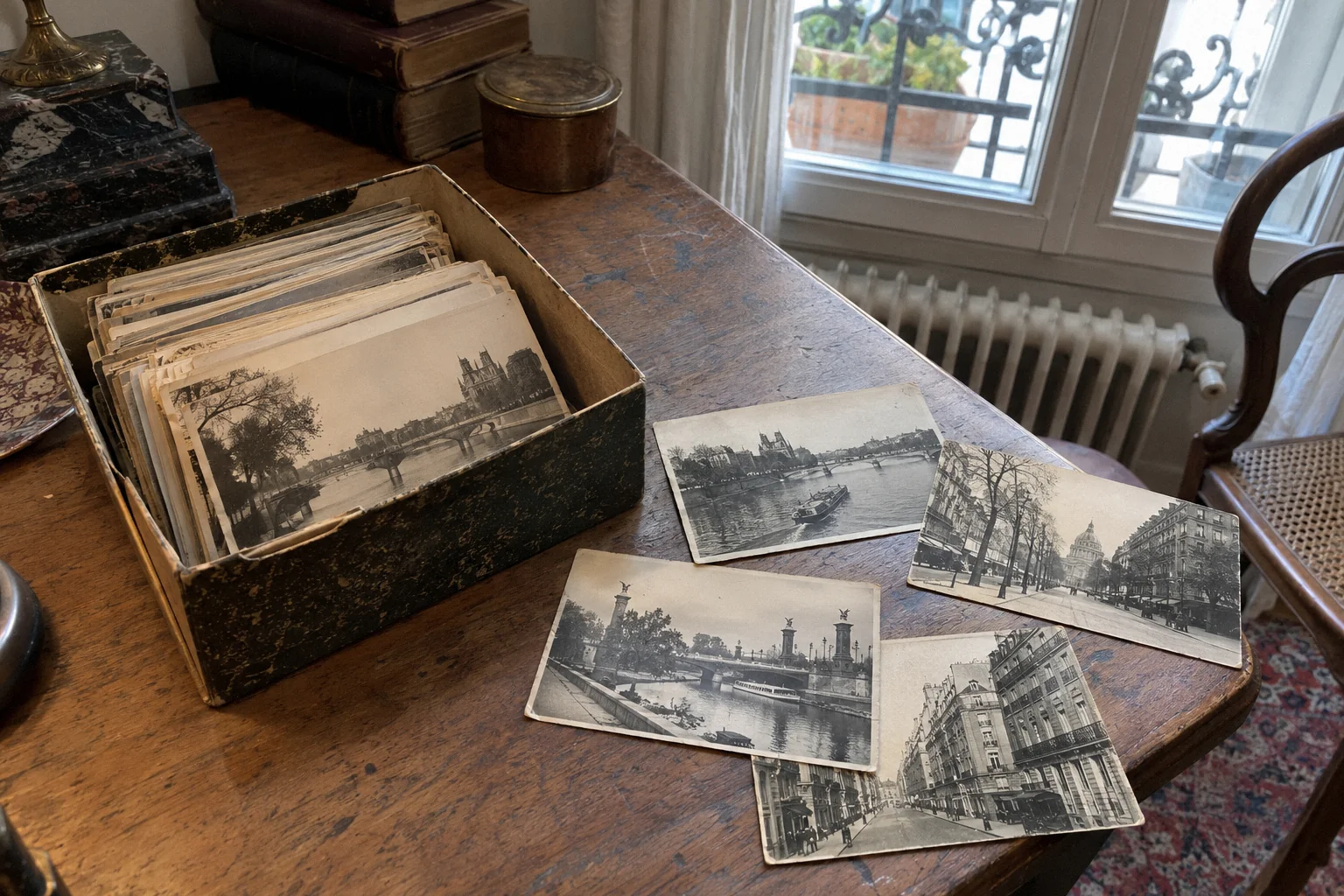
The value of old postcards depends first on the subject, then on the condition, and finally on rarity. Views of famous monuments and landscapes were printed in huge numbers and attract little interest. Busy village scenes, street trades, events and some photo postcards are far more sought after. And a collection kept whole is often worth more than the sum of its cards sorted one by one.
What is postcard collecting?
Postcard collecting (deltiology in English, cartophilie in French) is the collecting of postcards. Collectors usually focus on a theme: a French département, a town, a trade, transport, an illustrator.
On French cards and in French listings, you will often see three abbreviations:
- CPA, carte postale ancienne, for the oldest cards;
- CPSM, carte postale semi-moderne, often with a deckled edge;
- CPM, carte postale moderne.
Collectors mostly look for CPA, and especially those from the early 20th century.
Why are postcards from 1900 to 1920 sought after?
This was the golden age of the postcard. Around the 1900 Paris World's Fair, publishers printed cards by the million. Photographers went to every town and village: the station, the church, the school, the café, the high street, the wash house. For many small towns, these cards are the only pictures of the period.
A useful clue for dating: in France, until about 1904, the address side was used only for the address. The message was written next to the picture. After that, this side was split in two, with the message on the left and the address on the right.
The First World War also brought its own cards: patriotic cards, embroidered cards, soldiers' letters sent free under military postage.
Street scenes or landscapes: which are worth more?
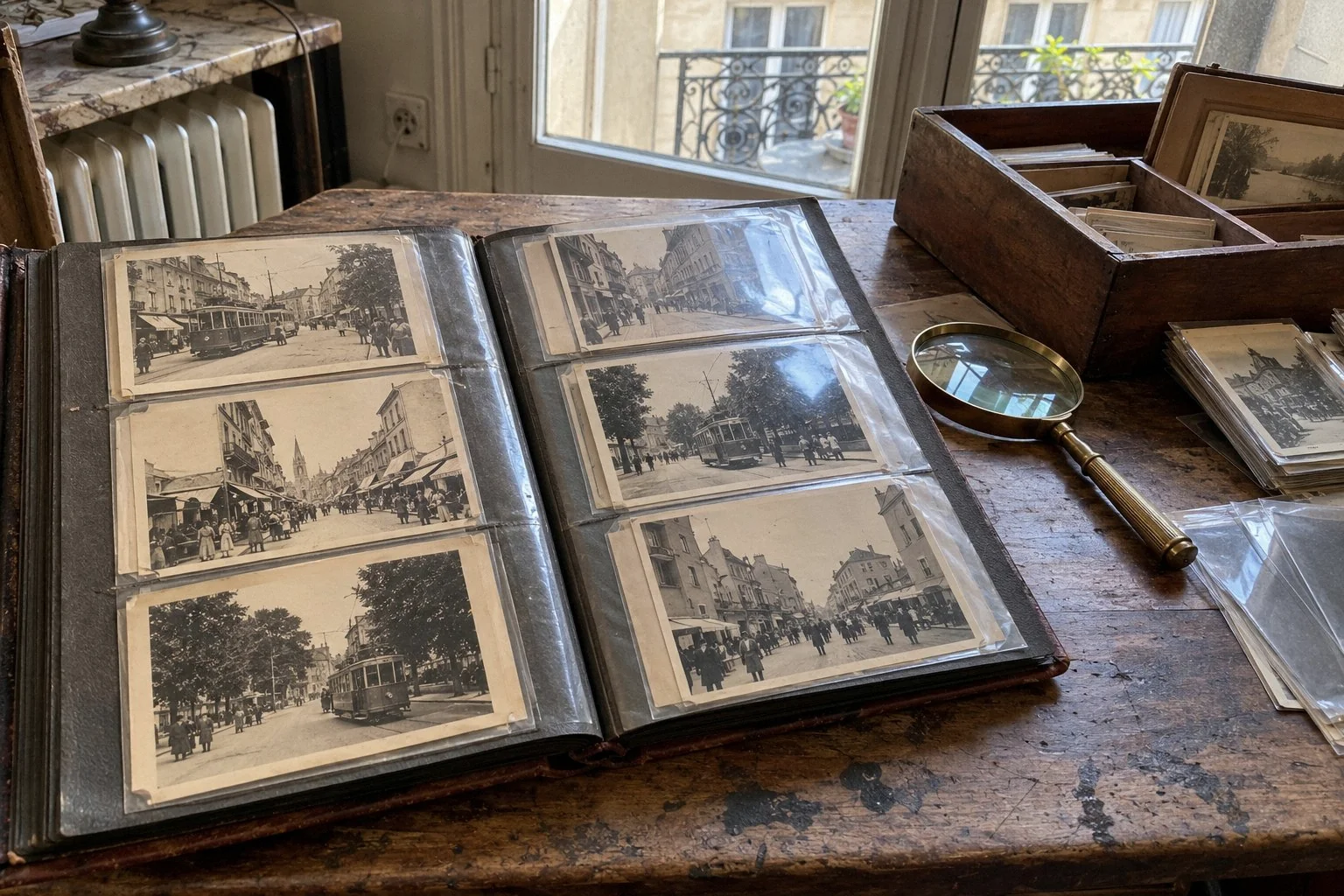
An "animated" card shows people: a market, children leaving school, a festival, a shop front with the shopkeeper in the doorway, a station with its train. These scenes of daily life are what collectors look for.
On the other hand, a view of the Eiffel Tower, a cathedral or a famous beach was printed in very large numbers. It rarely has much value, even when very old.
The place matters too. A small village that was rarely photographed is scarcer than a big city. And each card mainly interests collectors from its own département or town.
Street trades, events, transport: the themes collectors want
Street trades
Knife grinder, bread carrier, street vegetable seller, rag-and-bone man, travelling glazier: cards of small street trades, in Paris and in the provinces, form a category of their own. They show gestures and clothes that have disappeared.
Events
A flood, a strike, a fire, an opening ceremony, a local fête, an air show. The 1910 Seine flood in Paris, for example, produced a great many cards. The more local the event and the less it was photographed, the rarer the card.
Transport and old trades
Trams, stations, early buses, mills, factories, workshop interiors: anything that shows the work and traffic of the time is of interest.
Illustrators and novelty cards
Some cards are the work of illustrators, such as Art Nouveau cards signed by Mucha or Raphael Kirchner. Others have a mechanism: a moving part, a cut-out, embroidery. They are collected for their own sake.
Are photo postcards worth anything?
A photo postcard is a real photograph printed on paper with a postcard back, often in very few copies. A family portrait with no name or place is of little interest. On the other hand, a shop front, a village street, a school class or a workshop, with the place written on it, can interest collectors a lot. What is written on the back, a name, a place, a date, helps to identify them.
Condition: what lowers the value?
These are the faults that count:
- bent or rounded corners;
- creases and cracks;
- tears, pin holes;
- stains, damp marks;
- traces of glue or sticky tape;
- a torn-off stamp, a card that has been cut.
On the other hand, a card with writing and a stamp is not damaged. For an old card, that is normal. The postmark even helps to date it.
Should you keep the collection whole?
Yes, at least until it has been valued. A collection was often built by one person, by region or by theme, over years. The whole set tells a story, and a buyer wants to see all of it.
Taking out the "best" cards to sell them separately can lower the interest of the rest. Also keep the album, the boxes and the order of the cards, even if it seems messy to you.
How should you store old postcards?
- Suitable sleeves: polypropylene or polyester, with no PVC, which ends up damaging the paper.
- A box or a binder: cards stored without being squeezed or bent.
- A dry place at a steady temperature: not a damp cellar or a hot attic, and out of the light.
- Clean hands: hold the cards by the edges.
What not to do
- No sticky tape, either to mend a tear or to hold a card in place.
- No glue, no writing, no stamps on the cards.
- No hasty sorting: do not pull cards out of old albums. If a card resists or seems stuck, leave it in place.
- Do not peel off stamps.
- Do not sort into the bin: do not throw away "duplicates" or cards that look ordinary to you before the valuation.
How is the price of an old postcard set?
There is no fixed price. Price guides exist, but they give pointers, not a guaranteed price. The real price depends on the collectors looking for that subject at that moment.
Be careful with online listings too: an asking price is not a selling price. A card listed at a high price can sit for months without a buyer. For a fair idea, you have to look at the subject, the condition and the rarity, card by card, then at the collection as a whole.
How can you get your old postcards valued?
Old postcards are one of our specialities. For a first opinion, send a few photos: the collection as a whole, a few album pages, and a few cards front and back. Also tell us roughly how many cards there are, and the regions or themes.
The valuation of old postcards is free and with no obligation, from photos or at your home. Collections often turn up when a house is being emptied: if that is your case, see also our page on the antique dealer for estates and the guide to clearing a flat in Paris. You can also show us a photo at our stand at the Puces de Vanves flea market, at weekends.
Do you have old postcards to value? Send us three or four typical cards, front only, on WhatsApp at 06 24 56 38 58 (+33 6 24 56 38 58 from abroad): we will tell you if the collection is worth a visit. We travel free of charge in Paris and the Île-de-France.