By Baptiste Murier, antique and second-hand dealer in Île-de-France.
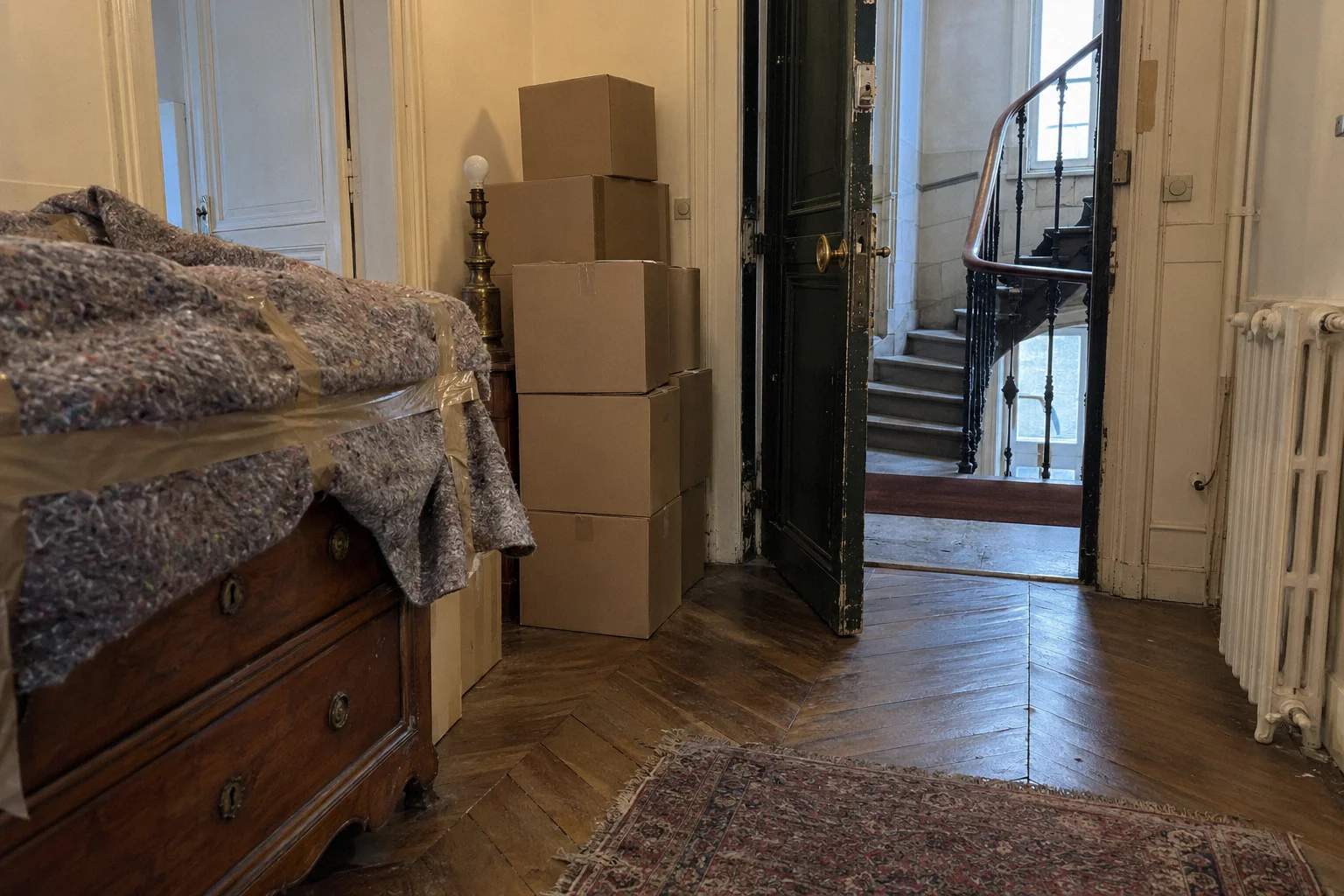
An apartment clearance in Paris is prepared in four stages: sort what you are keeping, arrange a visit, organise access (building and van), then empty the place. The quote depends mainly on the volume, the floor, the lift and the distance to the van. And when some items have value, the amount we pay for them is deducted from the cost. Here is how to go about it, step by step.
Where do you start with an apartment clearance in Paris?
The reasons are often the same: an inheritance, a move into a care home, a sale, the end of a tenancy. In every case, the order of the steps is the same.
- Set aside what the family is keeping, and the papers.
- Throw nothing else away until a professional has seen the apartment.
- Arrange the visit: we come free of charge, look at the rooms, the cellar and the access, and value what can be bought.
- Set the date and tell the building.
- On the day of the clearance: final sorting, purchase, removal, and cleaning if needed.
How should you sort things before a clearance?
Make three groups, without rushing:
- What you are keeping: keepsakes, family photos, items promised to someone.
- The papers: deeds, bills, statements, official letters. Keep them apart, especially when there is an estate to settle.
- Everything else, which you leave in place for the visit.
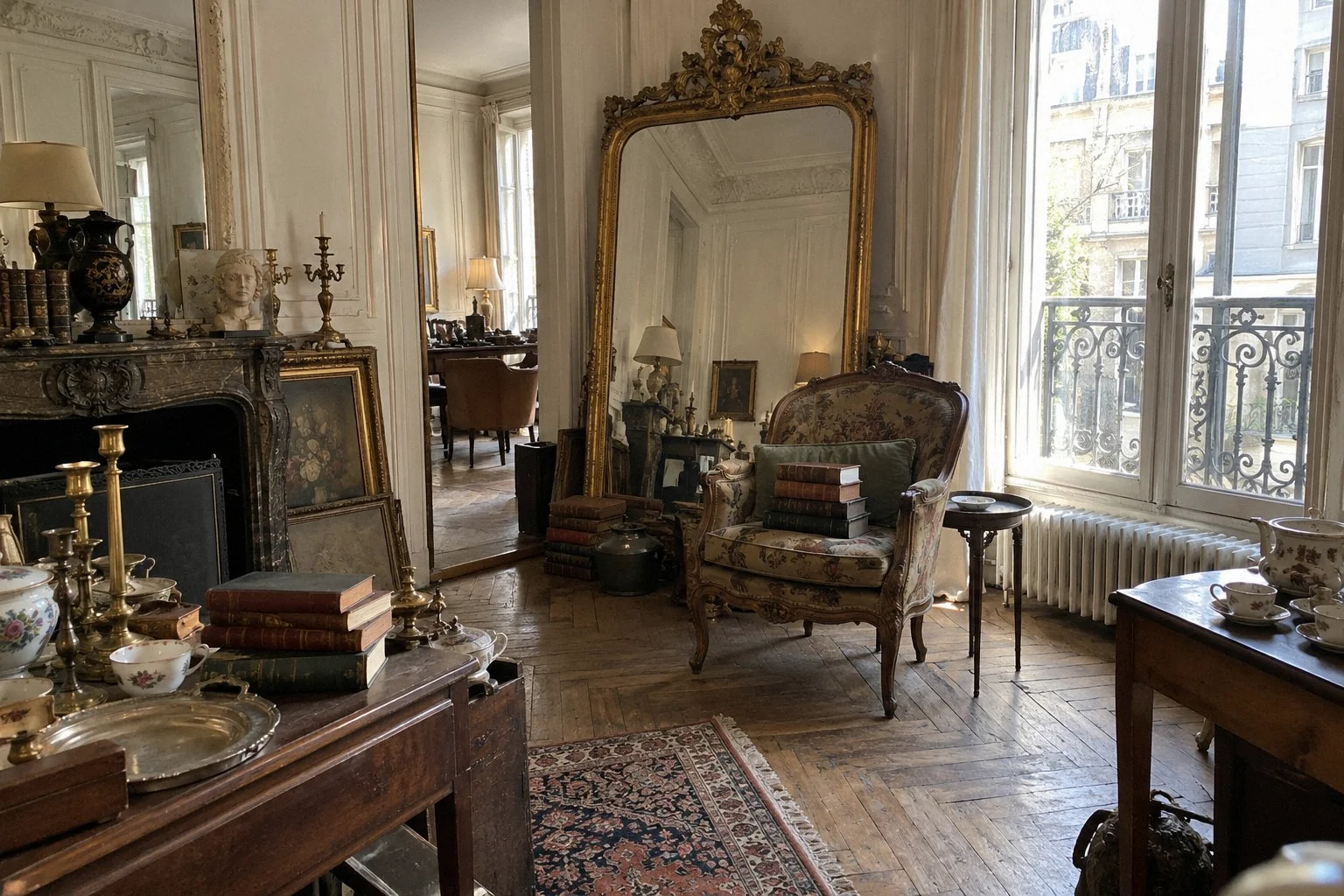
The classic trap is throwing things away too early. An old biscuit tin may hold coins or jewellery. A box of postcards may interest collectors: we explain why in what your old postcards are worth. Also check the tops of wardrobes, the backs of drawers, the cellar and, if there is one, the chambre de bonne (former maid's room under the roof).
Items not to throw away before the visit
- old watches, clocks and alarm clocks, even if they have stopped;
- jewellery, even broken or odd pieces;
- coins and medals;
- silver plated or silver cutlery and dishes;
- postcards, engravings and old illustrated books;
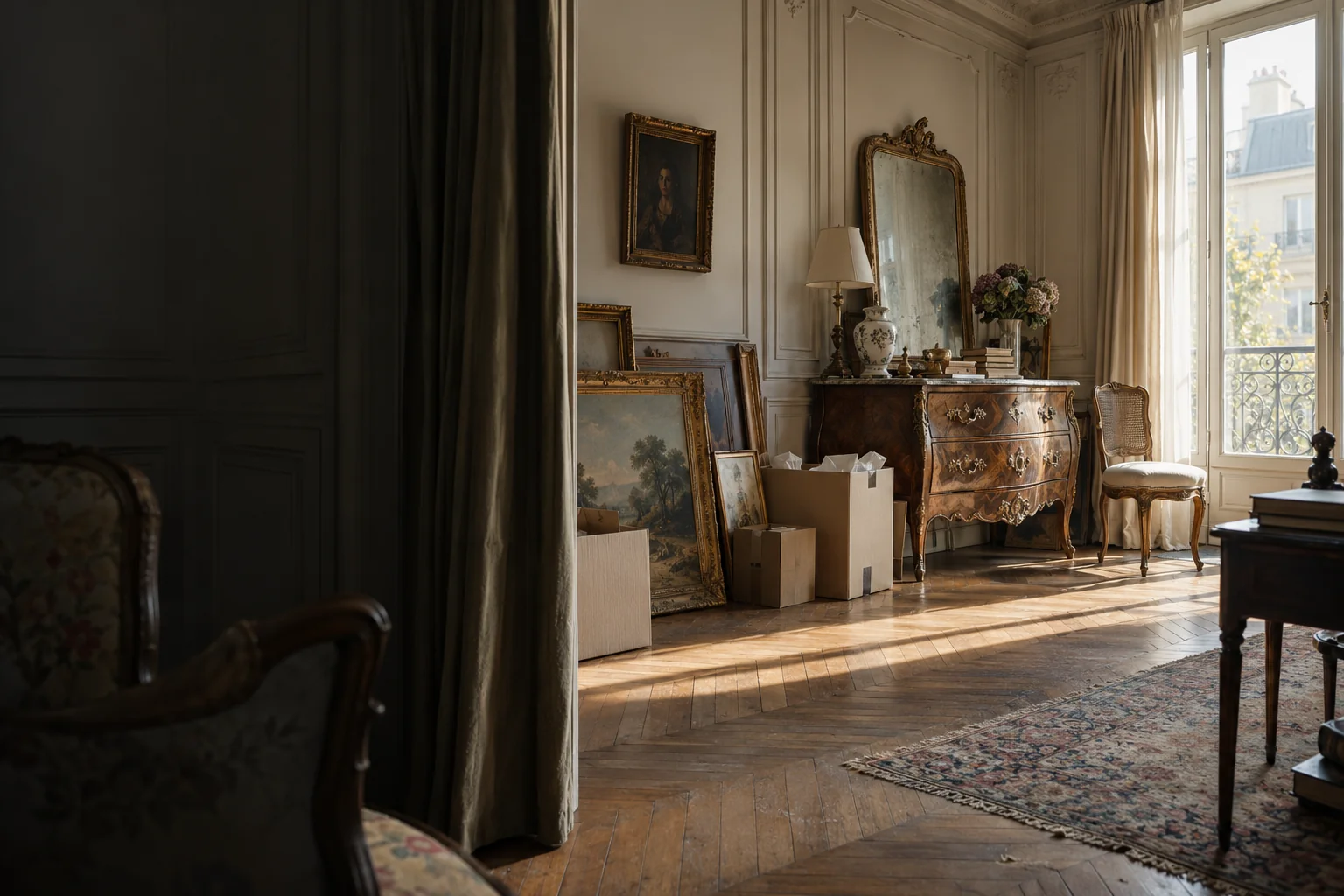
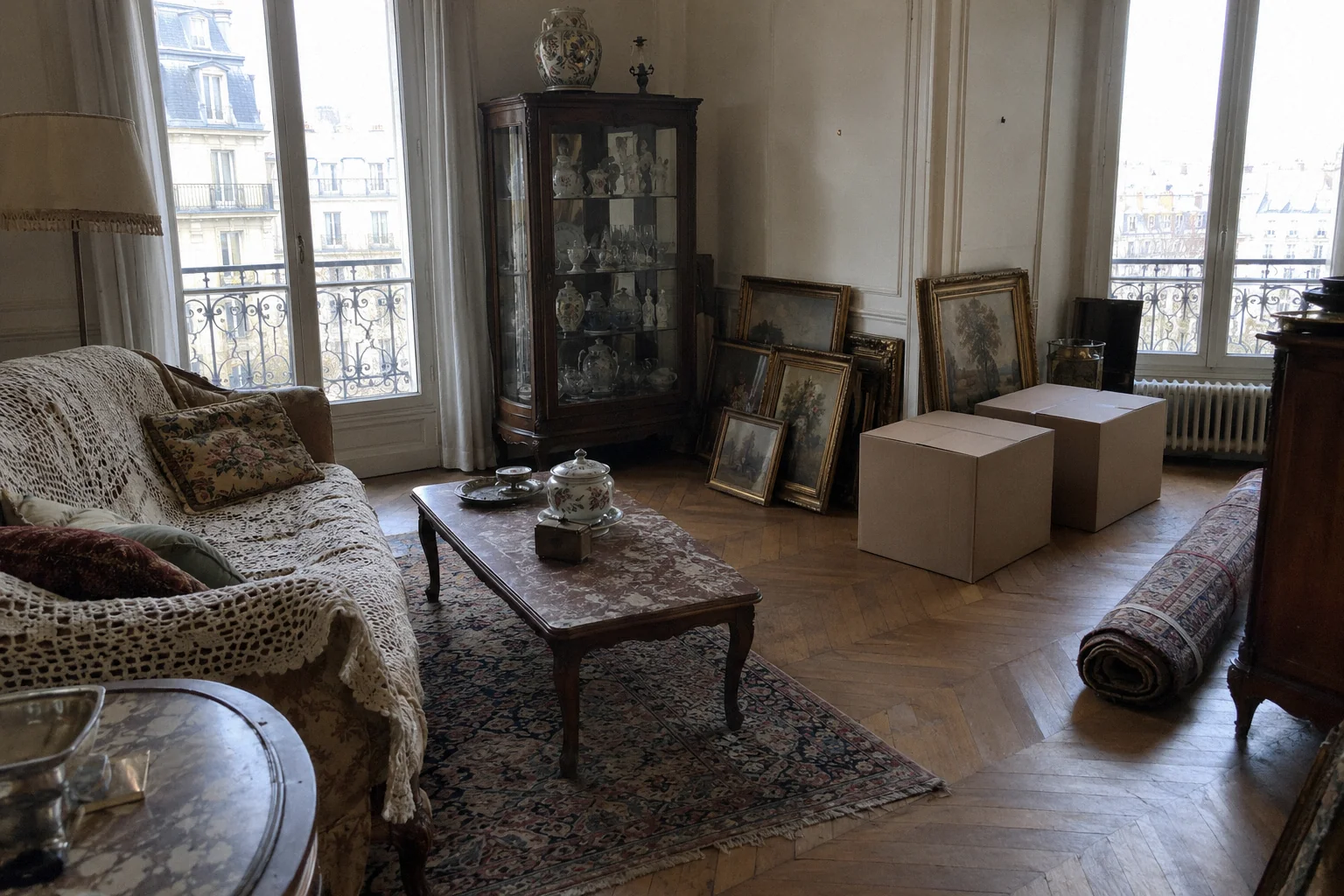
- paintings, even unframed, and empty old frames;
- porcelain and objects from Asia.
For each of these, a free valuation tells you what is worth selling before you decide.
What changes the quote for a clearance in Paris?
Every apartment is different, which is why the visit matters. Here is what changes the quote.
The volume
The number of rooms matters less than what is in them. A very full two-room flat can take more work than a large, almost empty apartment. The cellar and the maid's room add to the volume.
The floor and the lift
Without a lift, everything is carried down by hand. With a lift, it all depends on its size: in many older buildings it is too small for a wardrobe or a sideboard, which then go down the stairs.
Access
A courtyard to cross, a narrow service staircase, a corridor with a bend, furniture to take apart: all of this takes time.
The distance to the van
In Paris, this is often the deciding point. If the van can park outside the door, the carrying is short. If it has to stay round the corner, every piece of furniture makes the journey on foot.
What can be bought
The amount for items we buy is deducted from the cost, and it can sometimes cover the whole clearance.
Do you need a permit to park the van in Paris?
Not always. For removals, the City of Paris issues a temporary occupation permit called an AOT (autorisation d'occupation temporaire). According to the City, it is needed when the vehicle must:
- park outside paid parking spaces (delivery bay, bus lane, pavement);
- stay more than six hours in a row in the same place;
- use a furniture lift.
The application is made online, with a "Mon Paris" account, at least 15 days before the date. The permit is not free, it covers a time slot between 7 am and 8 pm, and it does not reserve a specific space. To hold a particular spot, a separate application is needed, which is not free either.
These rules are written for removals. For a clearance, the same question arises as soon as the van has to park for a long time or outside the usual spaces. We look at the street during the visit, and work out with you whether an application is useful. Outside Paris, each town hall has its own rules.
Which building rules apply during a clearance?
Each building has its own habits. The règlement de copropriété (co-ownership rules) and the house rules often specify:
- the times allowed for heavy carrying, sometimes not in the evening or on Sundays;
- use of the lift, often with compulsory protection of the walls, or a ban on moving furniture in it;
- protection of the common areas: entrance hall, stairwell, courtyard;
- a ban on leaving bulky items in the bin room.
The simplest thing: tell the gardien (caretaker) or the syndic (managing agent) one or two weeks ahead, and ask whether there are any instructions. Neighbours also appreciate a short note in the entrance hall.
Can the buy-back pay for the clearance?
Yes, that is the whole point of using an antique and second-hand dealer. During the visit, we value free of charge whatever has value: period furniture, clocks, silverware, jewellery, paintings, porcelain, postcards, curiosities.
What we buy comes off the bill for the clearance. When it covers it, the clearance can be free. The items we buy are paid for immediately, by bank transfer. If the apartment is part of an estate, the page on our antiques service for estates explains how we work with the heirs, and the article what to do with furniture from an estate gives some pointers to help you decide.
What happens to the items that are not bought?
Nothing goes into the skip just because it is easier. We sort in three ways:
- Anything still useful is given to Emmaüs, the Secours catholique, the Armée du Salut (Salvation Army) or nearby ressourceries (reuse centres).
- Broken furniture and household appliances go to their recycling channels.
- The rest goes to the tip.
Good to know: if you only have a few bulky items, the City of Paris offers residents a free collection, booked online.
On the day of the clearance: how does it work?
The clearance starts at the time agreed with the building. The items we are buying are put to one side, then the rest is carried to the van room by room, with the common areas protected. At the end, the apartment is empty, and cleaned if you asked for it.
If you are handing the apartment back to a landlord, remember to take the meter readings and a few photos of the empty rooms.
Are you preparing an apartment clearance in Paris? For a first opinion on your apartment, a few photos of each room sent on WhatsApp to 06 24 56 38 58 are enough. You can also call us on +33 6 24 56 38 58 from abroad. The visit and the valuation are free and with no obligation, in Paris and across the Île-de-France.