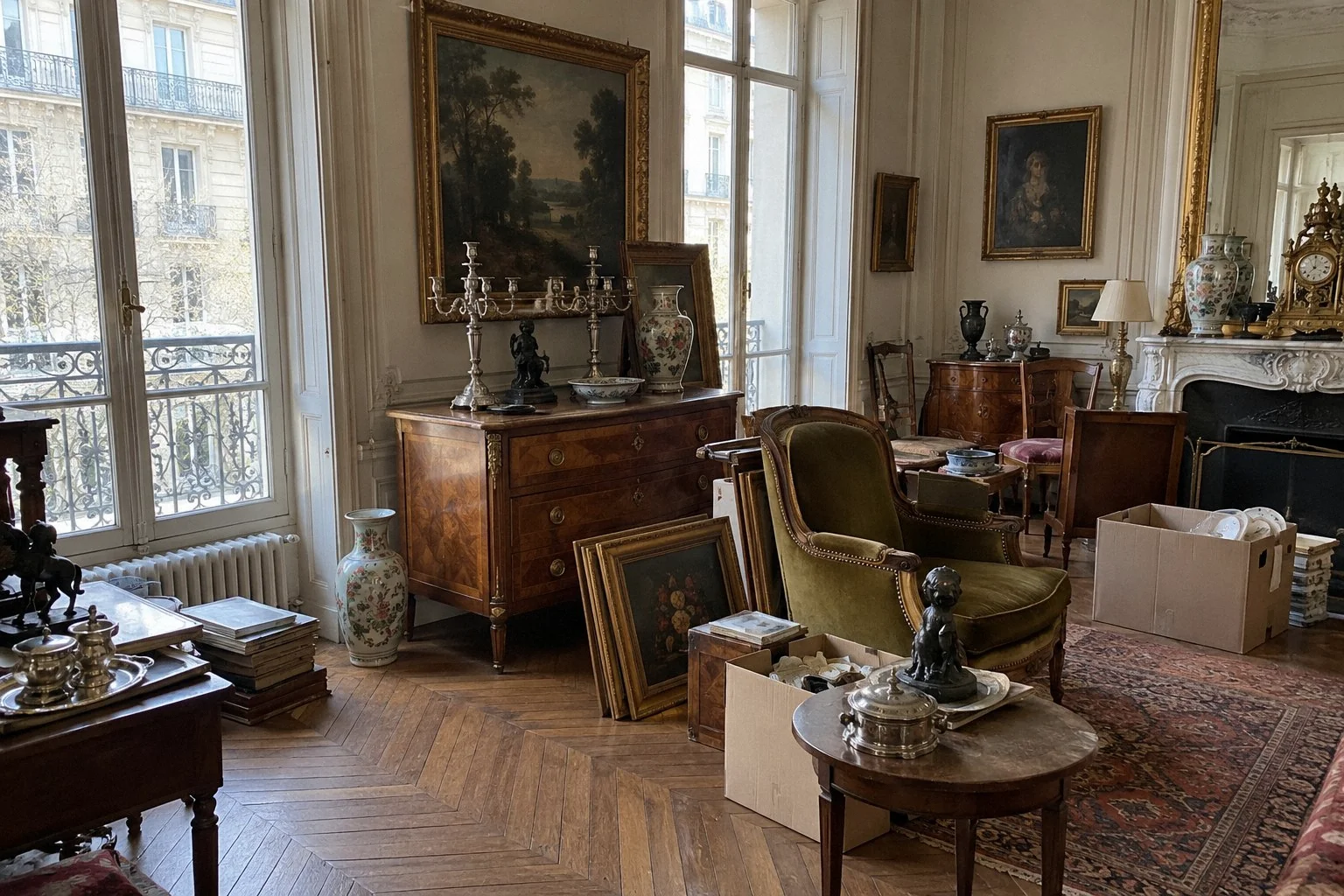
By Baptiste Murier, antique and second-hand dealer in Île-de-France.
The short answer: do not touch anything important before you have spoken to the notaire (the French notary who handles the estate). Take photos, put the papers and valuable objects somewhere safe, have things valued, then decide together what is kept, shared, sold, given away or cleared. In that order, you avoid the two big regrets: throwing out something that had value, and selling too early without the other heirs' agreement.
We are antique and second-hand dealers in the Île-de-France. We often meet families who want to move fast, because the home has to be handed back or sold. That is normal. But a few days of method at the start save a lot of time later.
Should you wait for the notaire before touching the furniture?
If you have any doubt, yes. There are two simple reasons.
First, under French law, selling or sharing out the deceased's belongings can be seen as accepting the estate. The French Civil Code calls this tacit acceptance (article 782). But an estate can also contain debts. As long as you do not know whether you accept, keep to what are called protective acts: securing the home, paying an urgent bill, putting valuable objects in a safe place. Article 784 of the Civil Code lists these acts. The notaire will tell you what you can do without risk.
Second, when there are several heirs, the belongings are owned by all of them until they are shared out. This is called indivision (joint ownership). To sell, you need in principle everyone's agreement (article 815-3 of the Civil Code). So one heir alone should not sell the chest of drawers or the silverware on their own.
One last point: if you find a handwritten will among the papers, do not open it as a group and do not keep it. In France it must be handed to a notaire (article 1007 of the Civil Code).
First step: photograph the home room by room
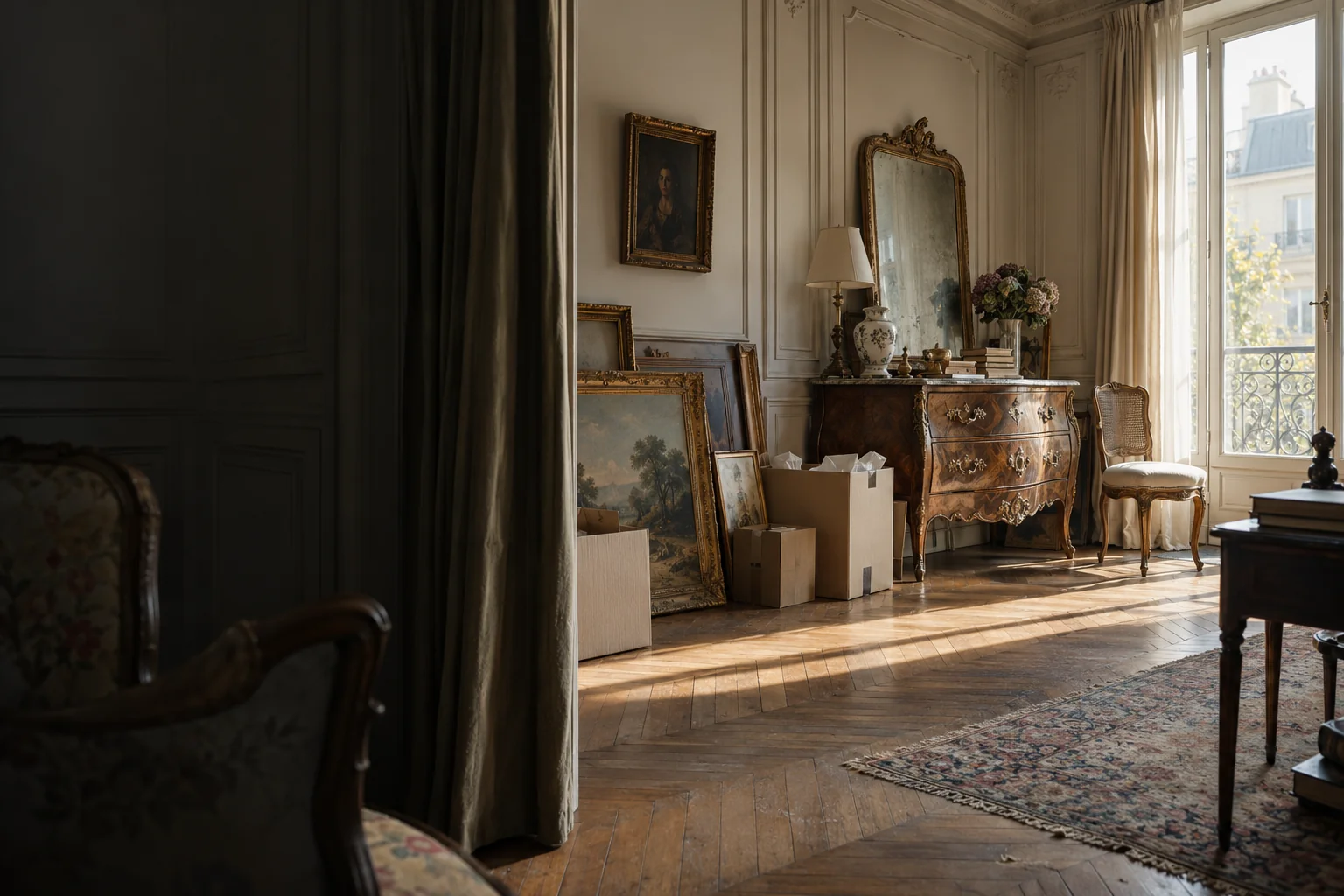
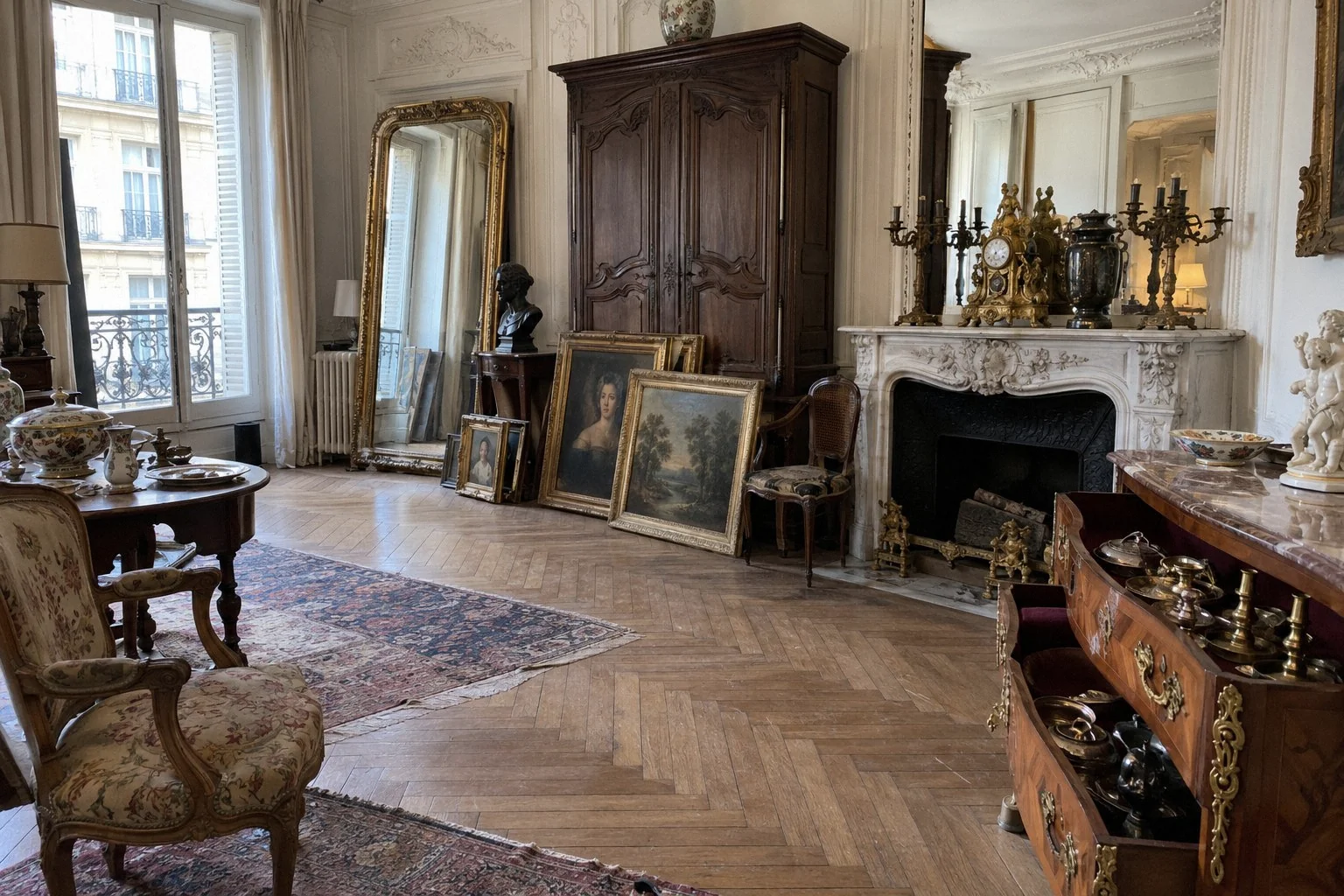
Before moving anything, walk round with your phone.
- A wide photo of each room, then of each wall.
- A photo of each piece of furniture, from the front, then the back and the drawers.
- Paintings from the front and the back (labels, stamps, writing).
- The underside of vases, clocks and porcelain, where the marks often are.
- Close-ups of the hallmarks on silverware and jewellery.
Do not clean, repair or take things apart. A clock someone tries to wind, a silver dish rubbed too hard or a frame that has come unstuck often lose value. These photos will be useful for everything: for the notaire, for the other heirs who live far away, and for the valuation.
Keep the papers and valuable objects safe
In a house or flat lived in for a long time, papers are everywhere: in drawers, books, shoe boxes. Before any sorting, gather them in a closed box and throw nothing away.
Papers to keep for the notaire:
- bank statements, savings books, life insurance contracts;
- property deeds, notarial deeds, leases;
- home insurance contracts, which sometimes list valuable objects;
- invoices and certificates for jewellery, watches, paintings;
- letters from the tax office and the latest tax returns.
Valuable objects to put in a safe place: jewellery, watches, coins and medals, silverware, small items that are easy to carry off. Write down who keeps them and where. This avoids misunderstandings between heirs, which are very common and very painful.
Make a simple inventory, then get a valuation
A home-made inventory is enough to start. A table with four columns: the room, the object, the photo number, a note (signature, mark, condition). This document has no official value, but it is the basis for every decision.
Then comes the valuation. What has value is not always what you think. A large wardrobe may be worth little, while a box of postcards, a mantel clock or a few silver forks and spoons can count for more. To get an idea, you can read our advice on valuing an antique clock or on recognising solid silver.
We provide a valuation of antiques and old objects free of charge and with no obligation, at the home or from photos. We tell you what has resale value, what mainly has sentimental value, and what deserves a specialist's opinion.
Please note: our valuation is not an inventory for tax purposes. For the French inheritance tax return, furniture is valued under the rules of article 764 of the French tax code (Code général des impôts). Without a public sale or an official inventory, the tax office takes at least 5% of the other assets of the estate. We explain this rule in our article on the 5% furniture allowance. If you are thinking of having an official inventory, do not empty the home before.
How do you share the furniture between heirs?
There is no single method, but this one works well:
- Each person lists the objects they would like to keep, starting with keepsakes.
- You put the lists together and spot the objects that several people want.
- You use the valuation to balance the shares: a valuable object taken by one heir can be balanced by other objects, or by a sum of money.
- You write down the result, dated and signed by everyone.
For valuable objects, talk to the notaire: they can take them into account in the division. And if two heirs want the same object, the valuation at least gives a neutral basis for discussion.
Selling, giving, clearing: what to do with the rest?
Once the sharing is decided, there are often many things left. The order matters: sell first, give next, clear last. Otherwise, valuable objects end up in the skip.
Selling
You can sell to a professional who buys on the spot. With us, the purchase is paid straight away, by bank transfer. You can also go through an auction, which takes longer. In France, a public sale held within two years of the death can also serve as the basis for the tax value of the furniture: ask the notaire if this is useful in your case.
Giving
Things with no resale value but that can still be used get a second life. We give this kind of object to Emmaüs, the Secours catholique, the Salvation Army (Armée du Salut) or nearby reuse centres.
Clearing
For the rest, a house or flat clearance empties the home completely. When we take it on, the amount of our purchase is deducted from the price of the clearance. Sometimes the clearance is free, when the purchase covers it. What cannot be given away goes to the proper channels.
Common mistakes to avoid
- Throwing papers away too soon, before the notaire has seen them.
- Letting someone leave with a box of objects without a list or a photo.
- Rubbing silverware, winding a clock, gluing a broken object back together.
- Selling without the other heirs' agreement.
- Emptying the home before everyone has been able to visit it, or before a planned official inventory.
- Accepting the first offer for "the whole lot" without a valuation.
How much time do you have?
For the furniture itself, there is no single deadline. But in France the inheritance tax return, when one is due, must in principle be filed within six months of the death if it took place in mainland France (article 641 of the French tax code). If the home is rented, every month counts too. The right reflex: do the photos and the valuation early, so the notaire and the family decide with clear information.
You can also read the page on how we support estates in the Île-de-France.
A first idea, without leaving home
Send us a few photos on WhatsApp at 06 24 56 38 58 (+33 6 24 56 38 58 from abroad): a view of each room and the objects you have questions about. We reply with a first idea, then we can come to the home for a free valuation with no obligation, in Paris and anywhere in the Île-de-France.