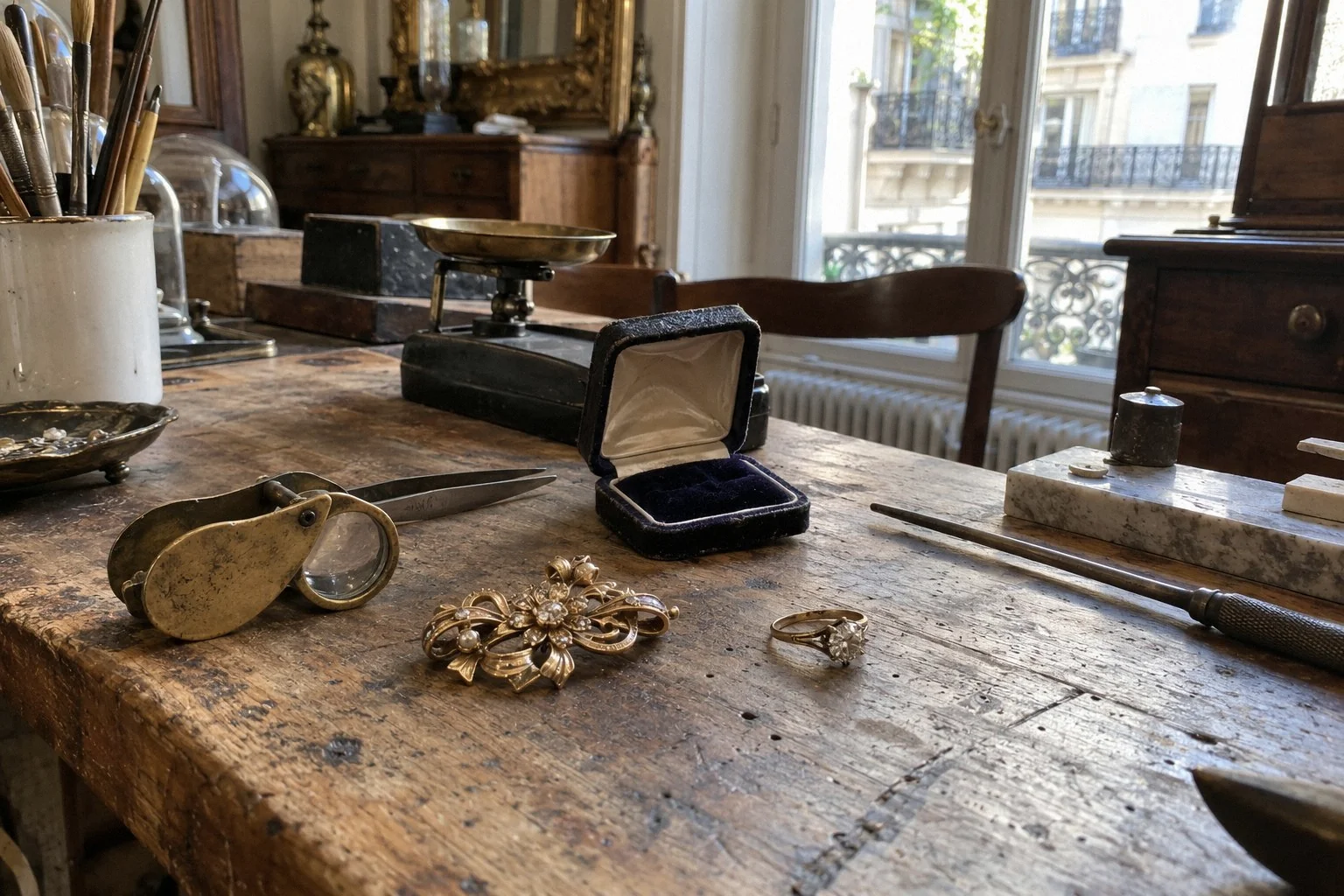
By Baptiste Murier, antique and second-hand dealer in Île-de-France.
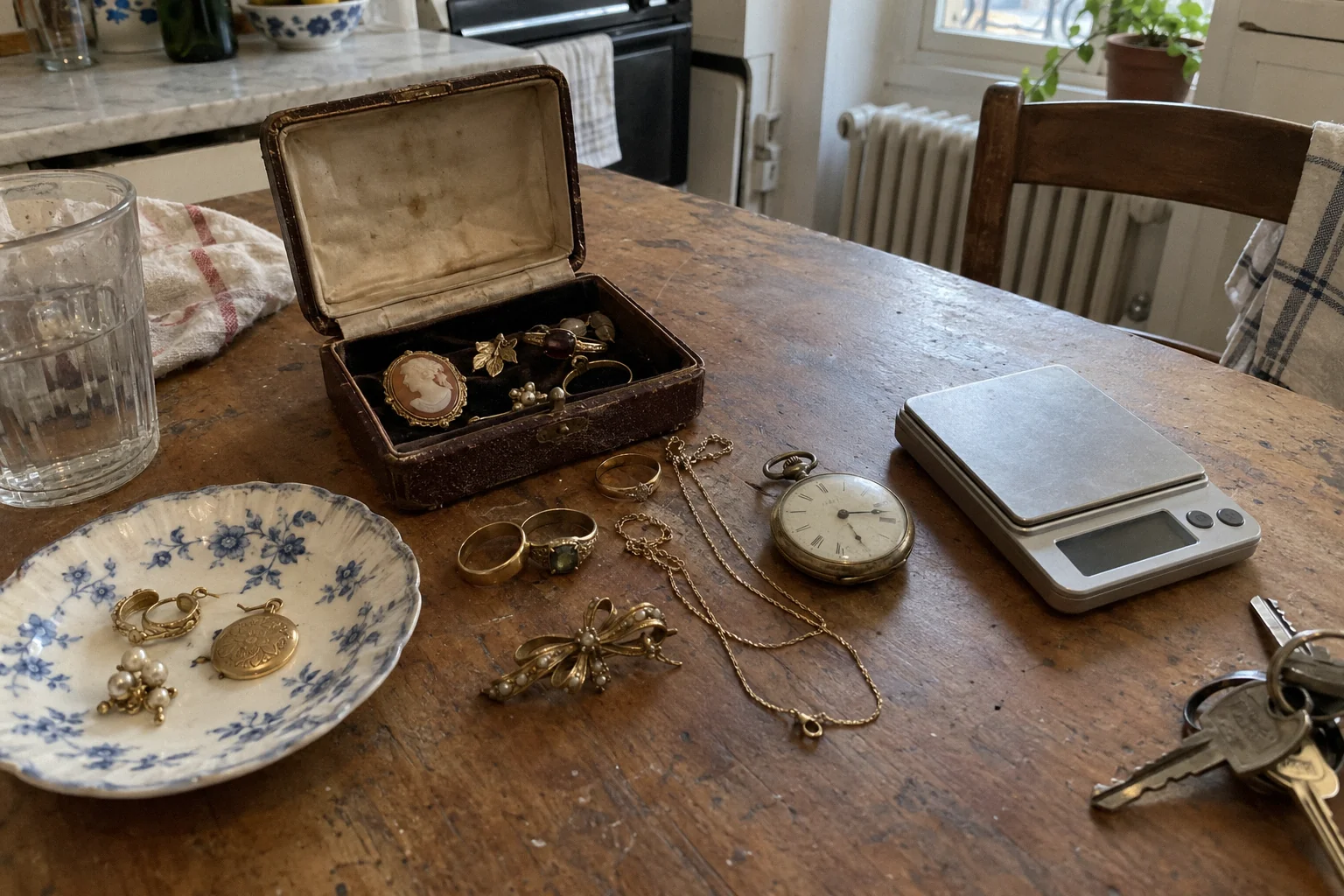
The short answer: the price of an antique jewel is set in two stages. First the value of the gold: the jewel is weighed, its standard is checked (in France, 18 carat gold is 750 thousandths and carries an eagle head) and the gold price is applied. Then the value of the jewel itself: its period, its signature, its stones, its condition. For many pieces, the first value is the right one. For others, the second is much higher. The whole point, before you sell, is to know which case you are in.
Two values: the metal and the jewel
The value of the metal is the base. It is what the gold is worth if it is melted down. It depends on three things: the weight, the standard and the gold price on the day of the sale.
The value of the jewel may come on top, or not. A well designed Art Deco ring, a signed brooch, a necklace with natural pearls: these pieces have a collectors' market. A buyer who only looks at the weight misses this value.
So the real question is: should this jewel be melted down, or sold on as a jewel? A good valuation answers that question before talking about price.
18 carat gold, 750 thousandths: reading the eagle head hallmark
The gold in jewellery is never pure: it is mixed with other metals, often silver and copper, to make it stronger. The standard tells you the share of pure gold. 18 carat gold contains 750 thousandths of gold, or 750 grams of pure gold per kilo of metal.
In France, gold at 750 thousandths carries a hallmark shaped like an eagle's head. It is tiny: look for it with a magnifier on the band of a ring, the clasp of a necklace or the pin of a brooch. Next to it, you will often find the maker's mark, shaped like a lozenge (a diamond shape).
French law also recognises other standards: 375 thousandths (9 carat), 585 thousandths (14 carat), 916 thousandths (22 carat) and 999 thousandths. On foreign jewellery, the number is often stamped directly, such as 750 or 585.
A few cases worth knowing:
- Small recent pieces: since 2001, gold objects under 3 grams are exempt from the French guarantee hallmark. So no eagle head does not always mean "no gold".
- 19th century jewellery: it may carry other, older hallmarks. Reading them takes practice.
- Gold plate and rolled gold: a thin layer of gold on another metal. They are not sold by the weight of gold.
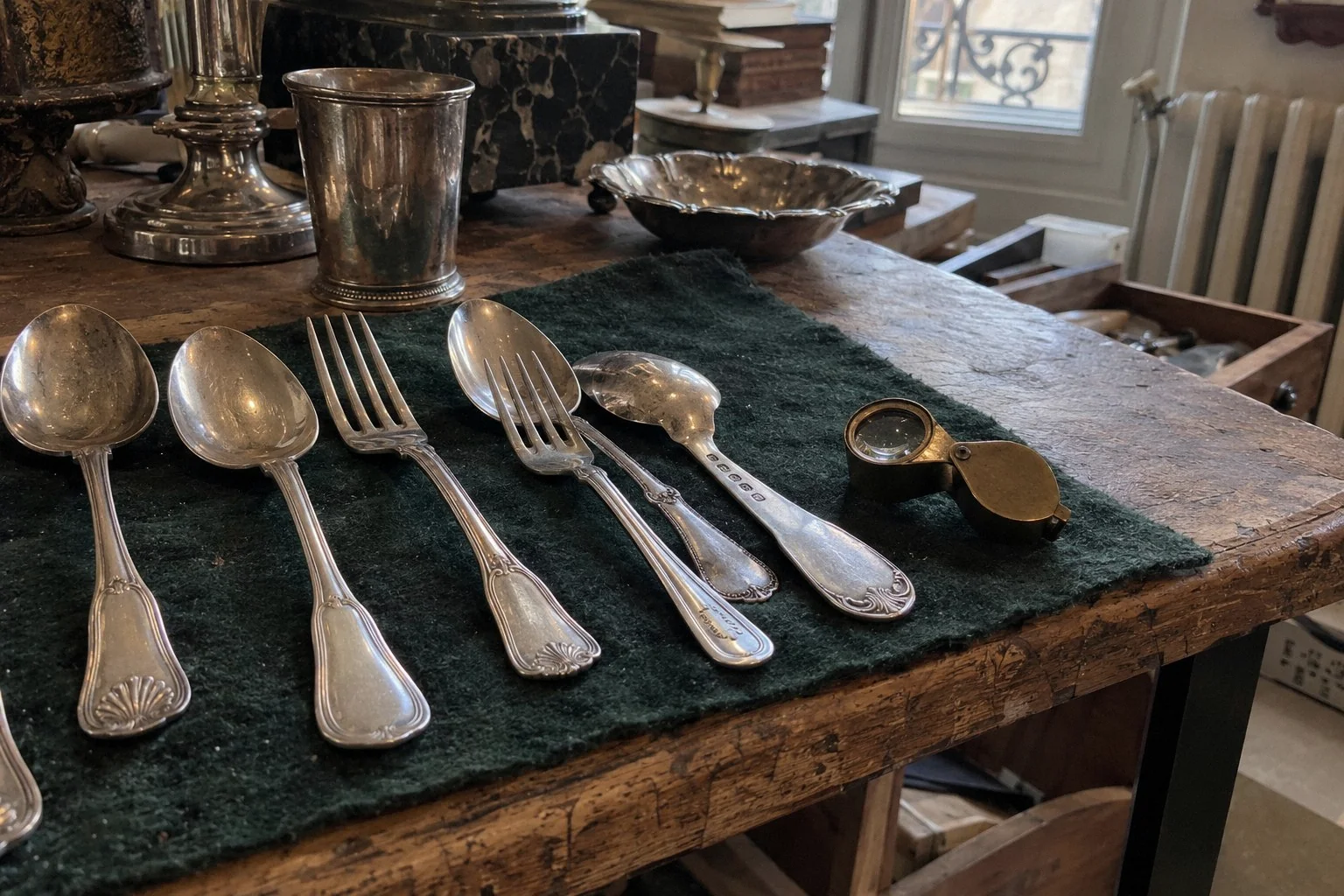
For silver, the rules are different. We explain them in our guide to recognising solid silver from its hallmarks.
How is the gold value of a jewel worked out?
The calculation takes three steps.
- Weighing. The jewel is weighed on accurate scales. Anything that is not gold does not count: stones, pearls, springs or steel parts.
- The standard. The weight is converted into pure gold. For 18 carat gold, you keep three quarters of the weight.
- The gold price. It changes every day. Each buyer then sets their buying price from this rate, with their own margin.
Our practical advice:
- ask for the weighing to be done in front of you;
- ask for the details in writing: weight, standard, price per gram;
- compare at least two offers on that same basis.
What raises the value of antique jewellery
Period and style
Some periods are much sought after: Napoleon III, Belle Époque, Art Nouveau, Art Deco jewellery, or pieces from the 1940s and 1950s. A jewel typical of its period, well made and in good condition, is often worth more than its gold.
Signature
A signature from a great jewellery house, engraved with a number, changes the value a lot. But a signature must be checked: copies exist. The original box and the invoice help a lot.
Stones and pearls
An old-cut diamond, a ruby, a sapphire or an emerald add value, depending on their quality. A natural pearl is worth much more than a cultured pearl. For some stones and for pearls, only a laboratory can decide. We tell you so frankly when that is the case.
Condition
A complete jewel, with its original clasp and no visible repair, sells better. A missing stone, damaged enamel or a cut ring band lower the value. A broken jewel is usually sold at the weight of its gold.
How does payment work in France?
The rule is clear. When a professional buys metals from a private person, they must pay by crossed cheque or by bank transfer to an account in the seller's name. This is article L112-6 of the French Monetary and Financial Code. Cash payment is forbidden, whatever the amount.
The professional also records your identity: bring an ID document. They enter the purchase in a register, the "livre de police" (police register).
With us, the purchase of antique jewellery and gold is paid straight away, by bank transfer.
A tax point worth knowing, under French law: for a piece sold for more than EUR 5,000, a flat-rate tax may be due, unless you choose the capital gains regime (articles 150 VI and following of the French tax code). Below that amount, jewellery is exempt. Gold bars and gold coins follow other rules: see our page on valuing old coins. If in doubt, ask the French tax office.
Boxes, invoices, certificates: keep everything
Before you sell, gather what you have:
- the original box, even if damaged;
- invoices, even old ones;
- certificates for stones or pearls;
- insurance contracts that mention the jewel.
These papers help to date the jewel and check a signature. They can also serve as proof of the purchase price. If the jewellery comes from an estate, talk to the notaire (the French notary handling it) before selling, and read our guide on what to do with furniture and belongings in an estate.
Why not sell to the first "we buy gold" shop
A gold buying counter often does a single calculation: the weight. For a broken or very common jewel, that makes sense. For an antique jewel, signed or set with fine stones, you risk selling at the price of the metal an object worth more.
- Take your time: do not sell under pressure.
- Ask for a written offer, with the details.
- Compare at least two opinions, including one from someone who knows antique jewellery.
- Do not let a buyer take the jewel away to "examine it elsewhere".
A first idea from photos
Send us on WhatsApp, at 06 24 56 38 58 (+33 6 24 56 38 58 from abroad), a photo of the whole jewel, a close-up of the hallmark and, if you have it, the weight. We will give you a first idea. The valuation is free and with no obligation, from photos, at your home in Paris and the Île-de-France, or at weekends at our stand at the Puces de la porte de Vanves flea market.