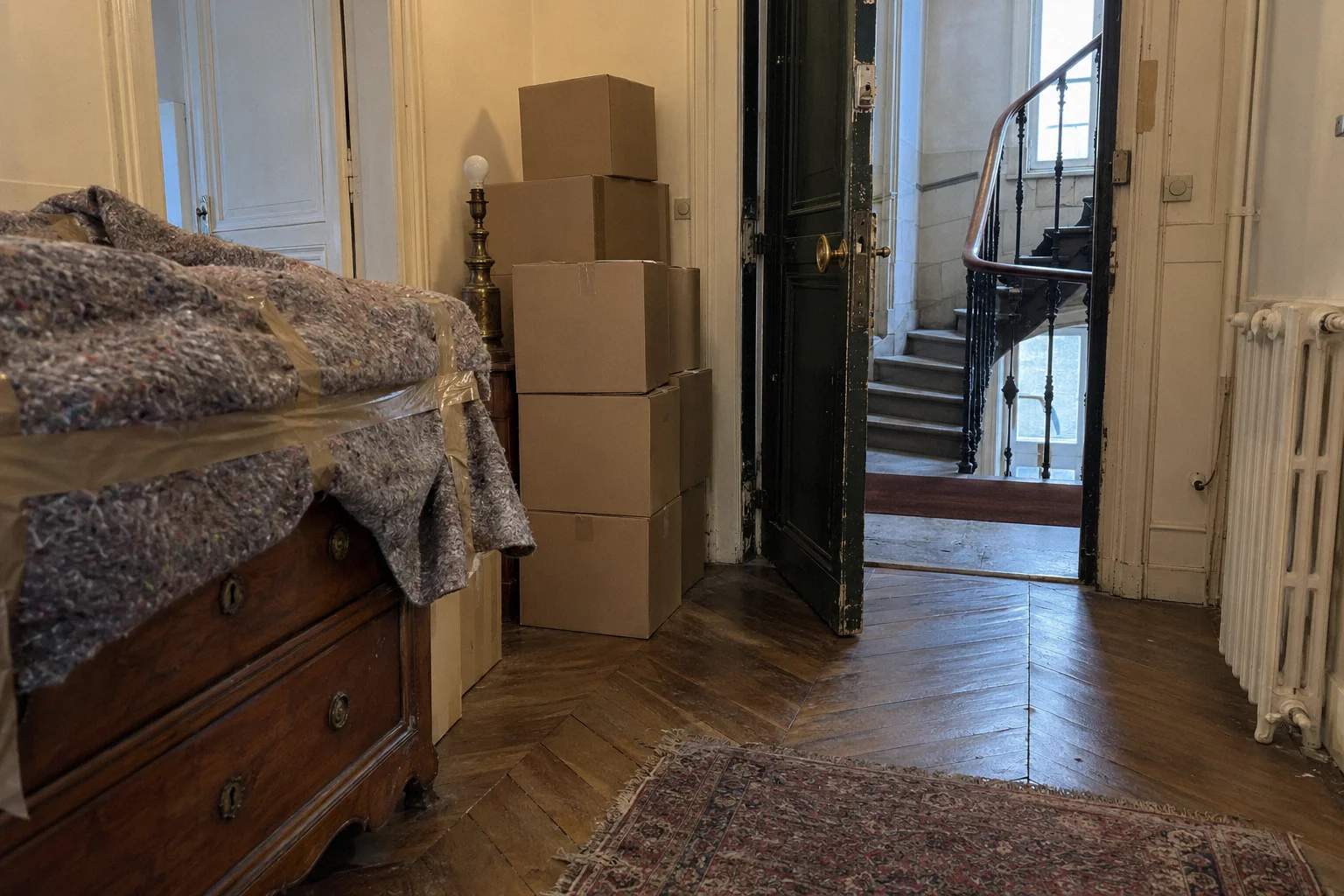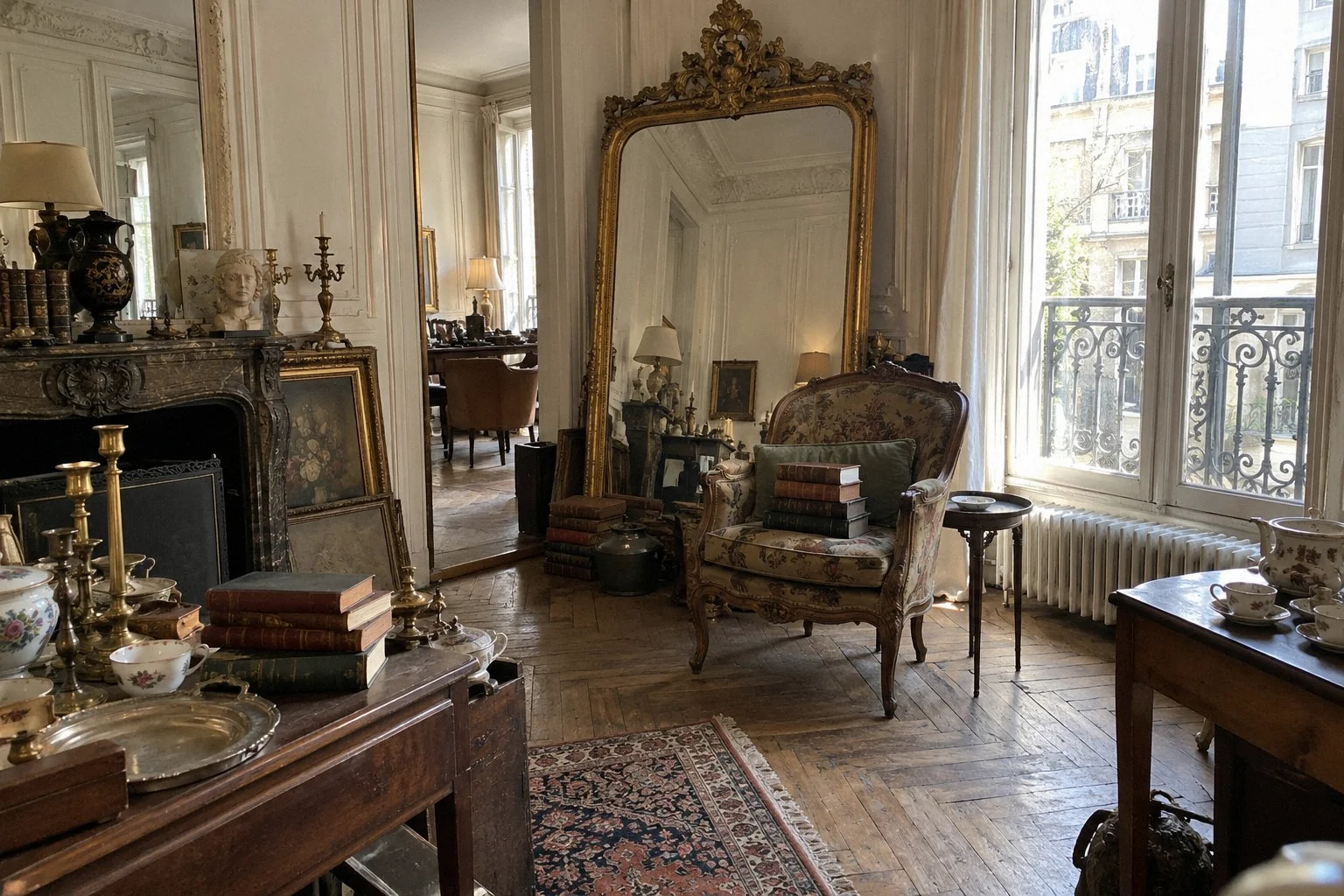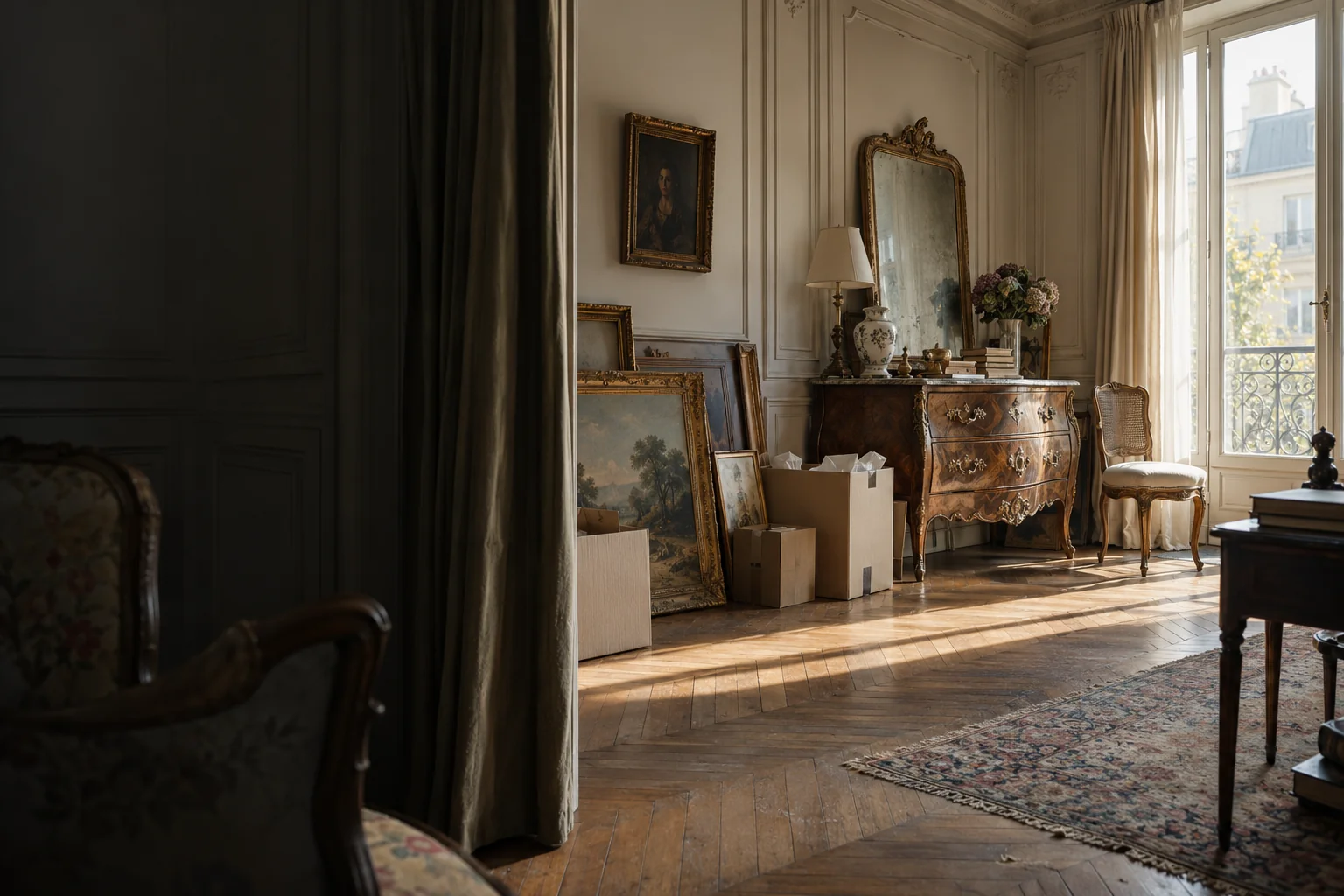
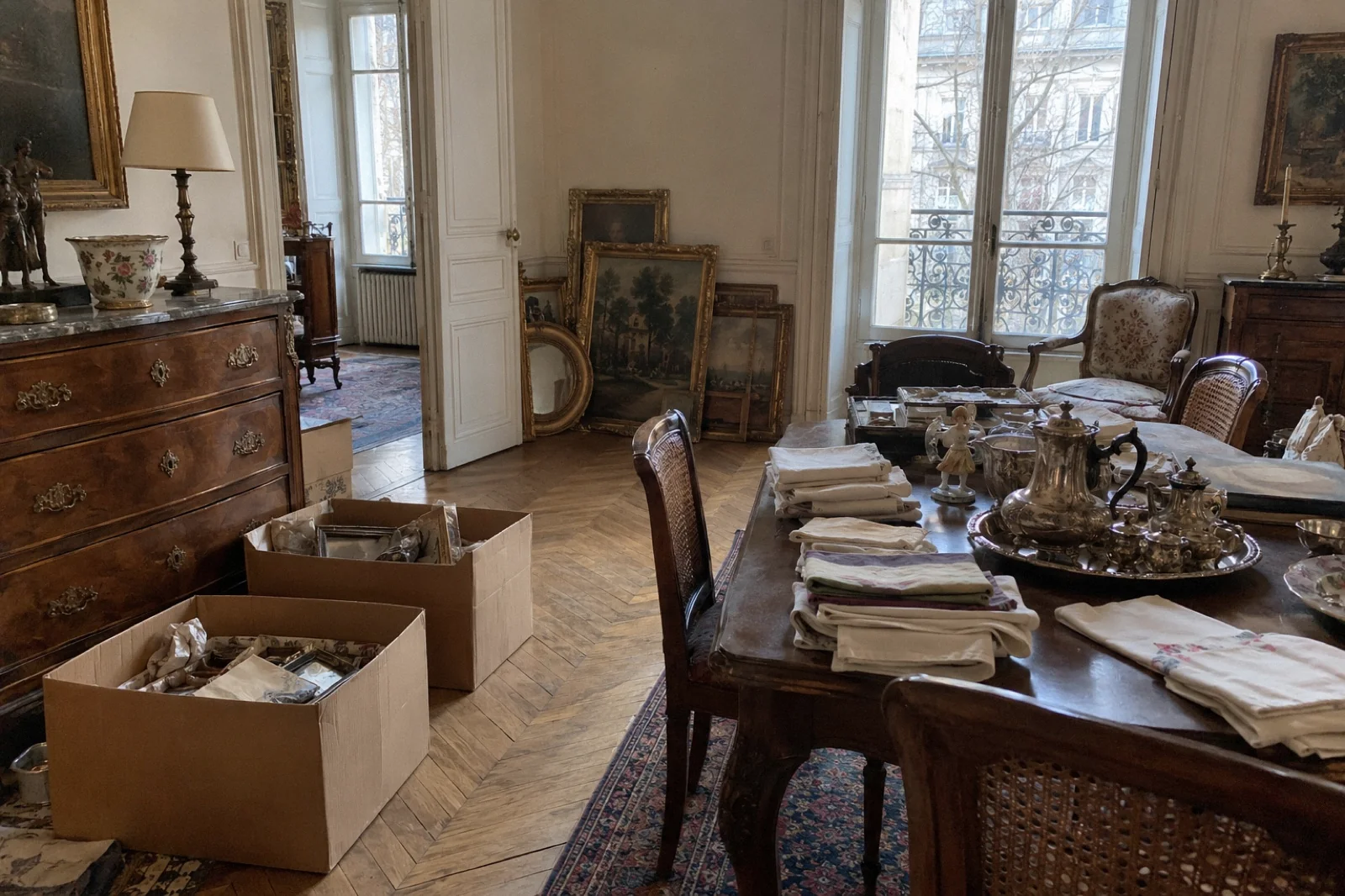
By Baptiste Murier, antique and second-hand dealer in Île-de-France.
After a death, the house of the person who has died often stays full for weeks, sometimes months. Then comes the time to empty it. To prepare this clearance well, five steps are enough: agree between heirs, put papers and keepsakes somewhere safe, throw nothing away too quickly, have anything of value appraised, then organise the clearance itself. Here is how to go about it, without rushing and without regrets.
Where do you start when you have to clear a loved one's house?
With nothing practical, in fact. In the first days there are other priorities: the funeral, telling family and friends, the urgent formalities. The house can wait.
The right first move is to lock up the house, check that it is insured and keep a spare set of keys for each heir who needs one. Only then can you talk about the clearance.
If the house is rented, the timing depends on the lease and the landlord. If it is to be sold, the notaire (notary) or the estate agent will tell you when it needs to be empty. In both cases, ask for the deadline early: it sets everything else.
Step 1: do all the heirs need to agree before the house is emptied?
Yes, this is the most important point. In France, until the estate is settled, the furniture and belongings generally belong to all the heirs together. No one should empty the house, sell or give anything away on their own.
A few tips so that everything goes smoothly:
- Bring the heirs together, even remotely, before setting a date.
- Note what each person wants to keep, room by room, and keep a written record of the agreement.
- Ask the notaire for advice if they are handling the estate. They will tell you whether an inventory is useful before clearing, and what precautions to take.
- Choose one person to oversee the clearance. This avoids conflicting instructions on the day.
Questions of dividing the estate and of tax are specific to each family. Our article on the 5 per cent furniture allowance in a French estate explains how furniture is taken into account in the inheritance tax return.
Step 2: which papers and keepsakes should you set aside?
Before any visit, walk round the house with one or two boxes. The aim is not to sort the whole house, only to save what must not leave.
Official papers
These are the ones most often missing afterwards. Look for:
- notarial deeds, the livret de famille (French family record book), property title deeds;
- bank statements, insurance and life insurance (assurance vie) contracts;
- tax notices, recent bills, letters from pension funds;
- purchase invoices for furniture, jewellery or paintings, which can help with the valuation.
Look everywhere: desks, secretaires, shoe boxes, under mattresses, in coat pockets. Older people sometimes keep their papers in unexpected places.
Photos and keepsakes
Albums, letters, notebooks, gifts, children's drawings: what matters to the family often has no market value, but cannot be replaced. Keep them apart in a locked room or in boxes marked "to keep".
Step 3: why throw nothing away before the visit?
Because a family house often hides valuable items where you least expect them. What seems of no interest to the family may interest a collector or an antique dealer.
Here is what gets thrown away too quickly:
- old papers: posters, menus, postcards, engravings, old books, military documents;
- bottles: old perfume bottles, crystal flasks, small metal boxes;
- old toys: trains, dolls, toy cars, wooden or tin games;
- small items: stopped watches, medals, buttons, broken jewellery, coins at the back of a drawer;
- tableware: silver plated or solid silver cutlery, porcelain, objects from Asia.
Think too of the attic, the cellar, the garage and the garden shed. In a house lived in for a long time, these are often the richest places. If you find cutlery, our guide on recognising solid silver from its hallmarks gives some first pointers.
In short: keep things, set them aside, but do not throw them away. The final sorting happens after the visit.
Step 4: how do you get the valuable items appraised?
Once the papers and keepsakes are safe, ask an antique and second-hand dealer to come. We travel free of charge in Paris and across the Île-de-France, for a visit and a valuation with no obligation.
During the visit, we go through every room, including the cellar and the attic. We pick out what can be bought: period furniture, clocks and watches, antique jewellery and gold, silverware, paintings, porcelain, coins and medals, postcards, curiosities. We also look at access to the house and the volume to remove.
This visit does two things. It lets the family know what the items are worth before deciding. And it prepares the quote for the clearance.
If the heirs live far away, a first valuation can be done from photos sent by WhatsApp. Our page on our antiques service for estates explains how we work with several heirs.
Step 5: how does the house clearance itself work?
When everyone agrees, we set a date. On the day of the clearance, we put the items we are buying to one side, then empty the house room by room. If you wish, cleaning can follow.
Is the buy-back deducted from the cost of the clearance?
Yes. The amount for what we buy comes off the cost of the clearance. When it covers it, the clearance can be free. The items we buy are paid for immediately, by bank transfer.
What happens to the items that are not bought?
We do not put everything in a skip. Whatever can still be used, such as furniture in good condition, tableware or linen, is given to Emmaüs, the Secours catholique, the Armée du Salut (Salvation Army) or nearby ressourceries (reuse centres). What can no longer be used goes to the tip or to recycling channels.
For many families, knowing that a parent's belongings will help other people makes this step gentler.
House or apartment: what are the differences?
A house often needs more preparation than an apartment. There are more storage spaces: attic, cellar, garage, lean-to. You also find things you do not see in town: tools, garden equipment, firewood.
On the other hand, access is often easier, because the van can park right outside. If you need to clear an apartment, our guide to clearing an apartment in Paris covers the lift, parking and the rules of the copropriété (the building's co-ownership).
What if the family is not ready?
Nothing forces you to do everything at once. Some families prefer to come back over several weekends to sort the keepsakes, before calling someone in for the rest. That is a good way to do it, as long as no one throws away anything important between visits.
If a deadline is approaching, talk to us about it during the visit. We will work out with you a timetable that gives everyone the time they need.
Do you need to prepare the clearance of a loved one's house? Call us on 06 24 56 38 58 (+33 6 24 56 38 58 from abroad), or send a few photos of the rooms and items on WhatsApp to the same number. The valuation is free and with no obligation, anywhere in the Île-de-France.