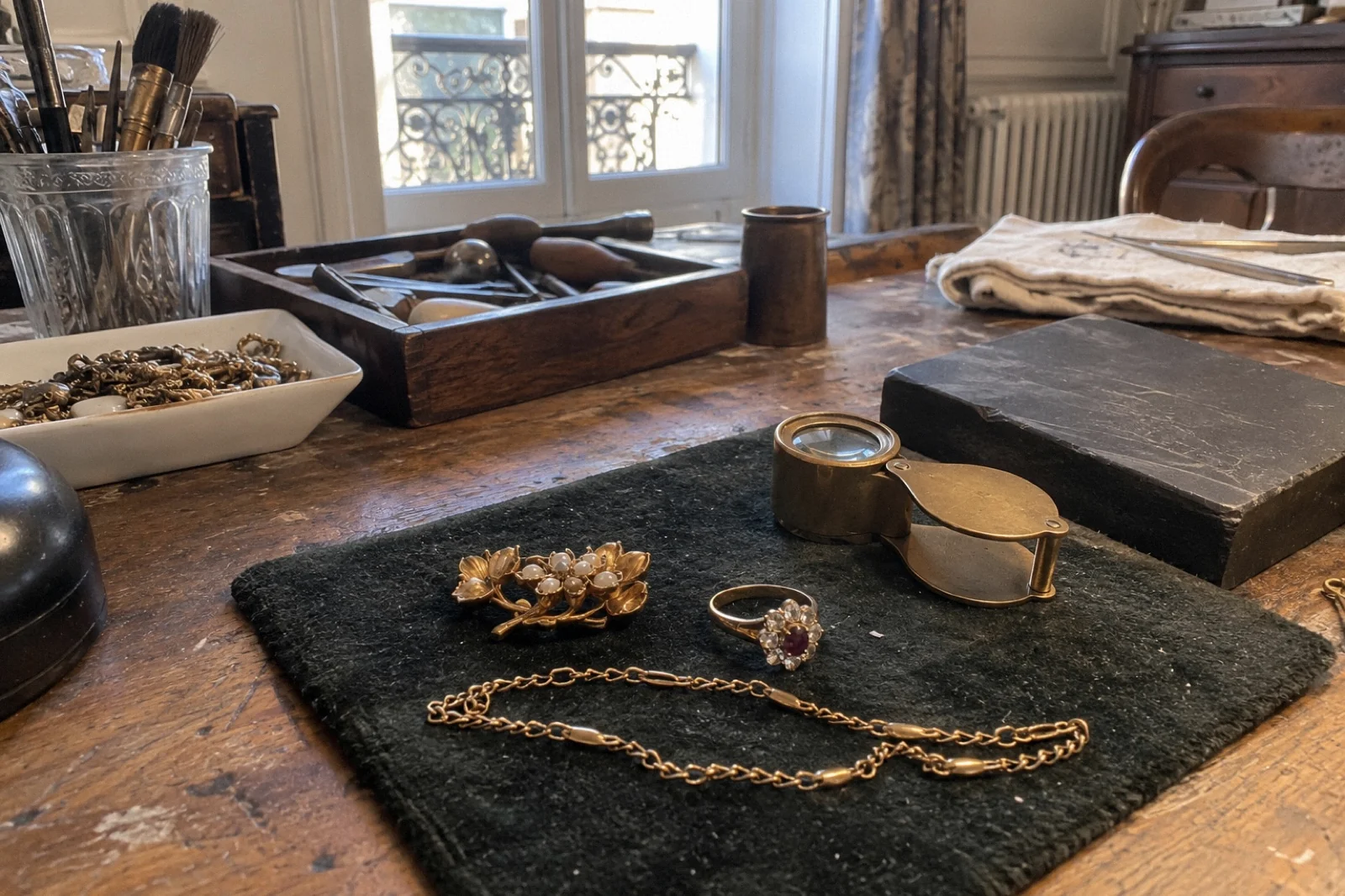
By Baptiste Murier, antique and second-hand dealer in Île-de-France.
You have inherited a ring, a chain or a brooch, and you want to know if it is 18 carat gold. In France, the answer often hides in a tiny detail: an eagle's head, struck into the metal. Here is how to find it, how to read it and what to do when it is not there.
What does the eagle head hallmark mean?
The eagle head is a guarantee mark. It is an official mark, applied by a French assay office, which confirms the standard of the metal. The standard is the share of pure gold in the alloy.
For the eagle head, that standard is 750 thousandths. Out of 1000 grams of metal, 750 grams are pure gold. The rest is a mix of other metals, such as copper or silver, which make the gold stronger and give it its colour. This is what is commonly called 18 carat gold.
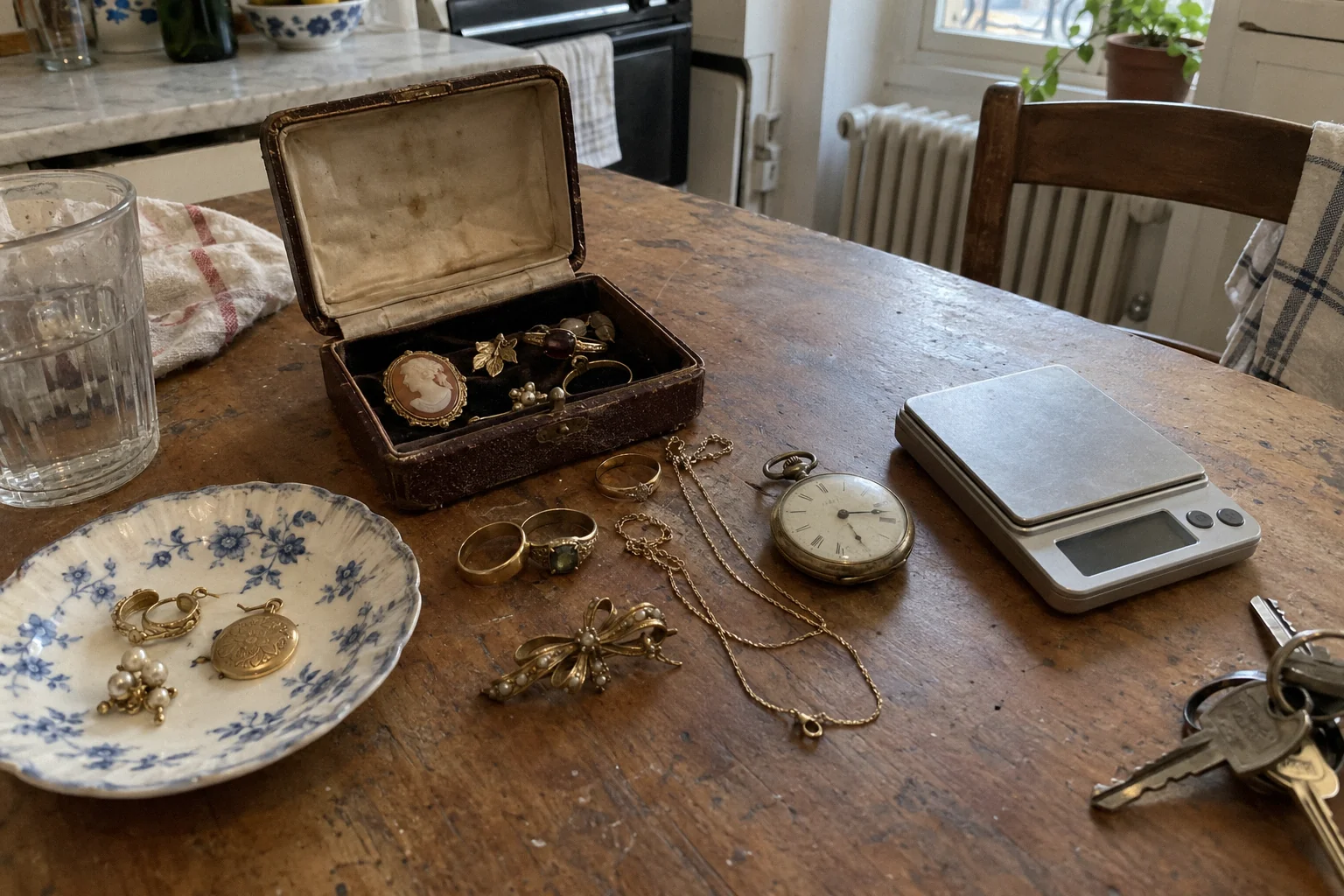
This hallmark has been in use in France since 1838. So you find it on a large share of the gold jewellery sold in France since the mid 19th century: family rings, wedding bands, chains, identity bracelets, christening medals, watch cases.
Why "18 carat"?
Here the carat measures the purity of gold, on a scale of 24. Pure gold is 24 carat. So 18 carat gold contains 18 parts of gold out of 24, or three quarters, which is 750 thousandths. Do not confuse it with the carat used for precious stones, which is a unit of weight.
Where should you look for the eagle head on jewellery?
The hallmark is struck in a discreet place, where it does not catch the eye. These are the most common spots:
- on a ring: inside the band, often under the setting or near it;
- on a chain or bracelet: on the clasp, on the closing ring or on a small tag near the clasp;
- on a brooch: on the back, near the pin or its hinge;
- on earrings: on the post or on the fastening;
- on a watch: inside the lid or the case back.
On a set made of several parts, each main part may carry its own mark. Look everywhere before you decide there is none.
How do you recognise the eagle head with a loupe?
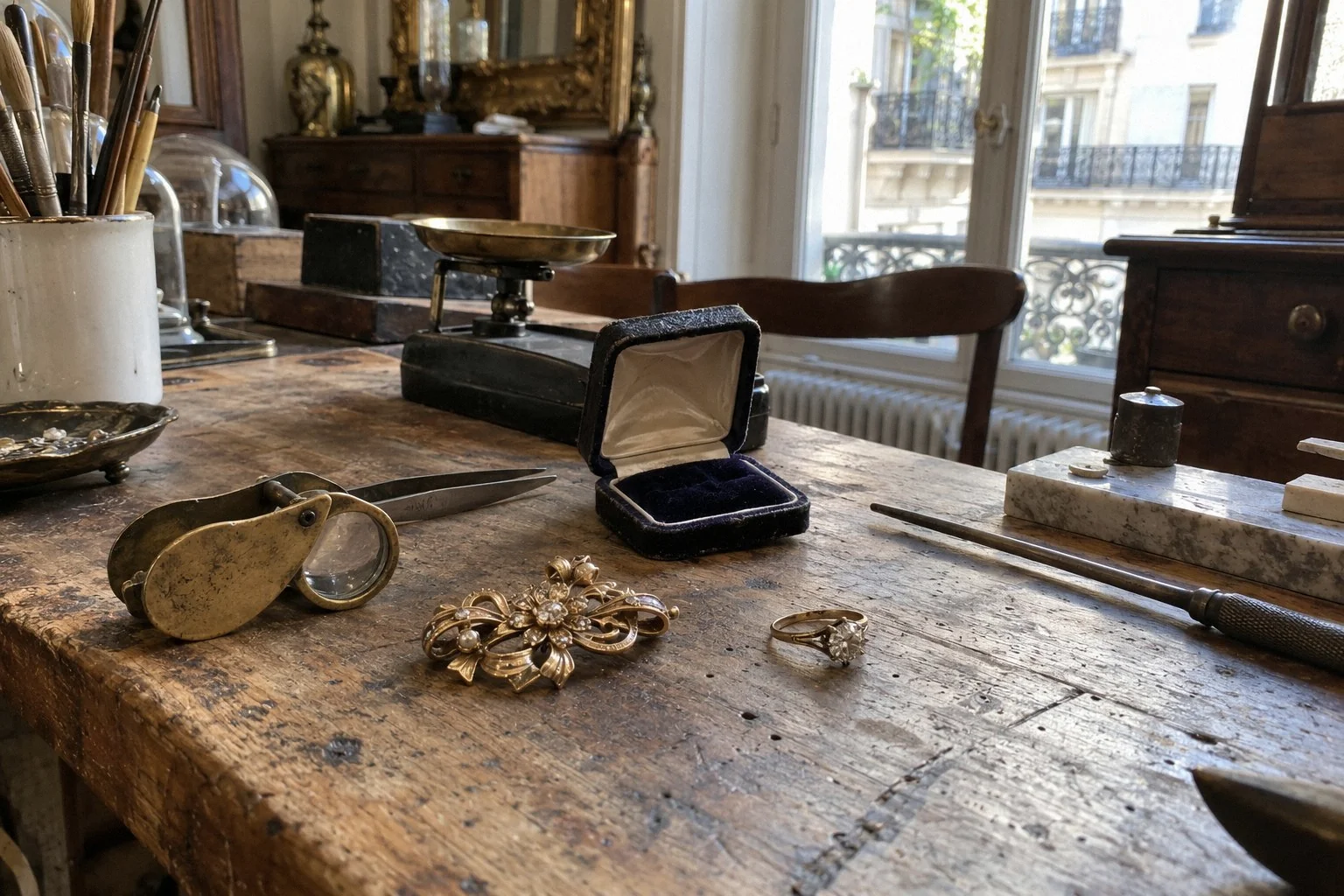
Use a magnifier of at least ten times. Stand near a window or under a lamp, and turn the jewel slowly. The mark often appears when the light hits it from the side.
You are looking for a bird's head seen in profile, with a clearly hooked beak, inside a small outline. On a new piece, the design is sharp. On a piece worn for decades, only a vague shape may be left, where you can just make out the beak.
The other marks next to the eagle
The eagle head often comes with a second mark, shaped like a lozenge (a diamond shape). This is the maker's mark: it identifies the maker or the workshop, with initials and a small symbol. It says nothing about the standard, but it sometimes helps to date or attribute a piece.
A piece made outside France and imported may carry other French marks, such as the owl. The other gold standards also have their own marks. If you see a sign you do not recognise, note it or take a photo: it is easy to check.
Is a piece marked "750" or "18K" as good as an eagle head?
Not quite. The number "750" or the letters "18K" are usually struck by the maker.
These marks are a good lead. But on their own, they are not a State guarantee. A costume jewel can also carry a fake "18K". And some words mean something else entirely: "plaqué or" (gold plated) or "doublé" (rolled gold) mean a thin layer of gold on an ordinary metal.
If you find both an eagle head and a "750", that is consistent. If you only find an "18K" with no other mark, a check is still useful.
What if your jewellery has no hallmark?
This is more common than people think. A piece with no visible mark is not necessarily fake. Several things explain a missing hallmark:
- wear: a ring worn every day for years ends up erasing the mark, especially inside the band;
- resizing: when a jeweller makes a ring bigger or smaller, the band is cut, and the hallmark can disappear in the process;
- a repair: a solder, a new clasp or polishing can remove the mark;
- old or handmade work: some very old pieces, or pieces made outside the usual trade, were never hallmarked.
In these cases, you can no longer read the standard: you measure it.
The touchstone test
This is an old method, still widely used. The jewel is rubbed on a hard black stone, in a discreet spot, to leave a thin trace of metal. Acids of different strengths are then placed on the trace. Depending on how the trace reacts or disappears, the standard of the gold can be placed.
The gesture is light and leaves no visible mark on the jewel when it is done well. It takes practice and the right products: it is not a test to do alone at home.
Measuring density
Gold is a very dense metal. A density meter compares the weight of the jewel in air and in water, which gives its density. A density that is too low points to a metal with less gold, or to a hollow object. This method does not touch the jewel, but it gets harder when the piece has stones, which distort the result.
Is the hallmark enough to know what a jewel is worth?
No. The eagle head tells you the metal is gold at 750 thousandths. It says nothing about the interest of the jewel itself.
For antique jewellery, several things count on top of the metal: the period, the style, the goldsmith's work, a possible signature, the stones and the general condition. A fine, well kept brooch can be worth more than its weight in gold. We explain these points in our guide on what antique jewellery is worth.
That is why we always examine the whole piece, and not only its mark.
What should you do before selling gold jewellery?
A few simple habits will help you see clearly:
- do not clean the jewel: a household product or a brush can damage a pearl, enamel or a fragile stone;
- keep boxes, receipts and papers: they help to date and identify the piece;
- note the marks you see and photograph them close up, with a magnifier in front of your phone's lens;
- do not split up a matching set: a complete set often keeps more interest.
On payment, the rule in France is clear. A professional who buys gold from a private person cannot pay in cash: payment must be by bank transfer or cheque, under article L112-6 of the French Monetary and Financial Code. At Murier Antiquités, we pay by bank transfer, straight away. To learn more about how we work, see our page on buying antique jewellery.
If you have other objects to look at, such as silverware, coins or watches, we can examine them during the same home valuation. For silver, the logic of hallmarks is similar: our guide on solid silver and its hallmarks will help you.
Have your gold jewellery examined
Not sure about a mark, or have a piece with no hallmark? Call us on 06 24 56 38 58 (+33 6 24 56 38 58 from abroad), or send photos of your jewellery and its marks on WhatsApp to the same number. The valuation is free and with no obligation, from photos or at your home, in Paris and the Île-de-France.