By Baptiste Murier, antique and second-hand dealer in Île-de-France.
When you sell a piece of gold jewelry, a gold coin or a gold bar in France, the sale falls under the French tax regime for precious metals. By default, a flat tax applies, calculated on the sale price, with no proof of purchase required. You can also choose to be taxed on the actual capital gain, provided you can prove the date and price of acquisition. Below a certain sale price, the flat tax does not apply.
We are antique dealers, not tax advisers. This guide explains the principle as we understand it, with caution. For your own situation, the tax office (centre des finances publiques) or your notary remain the reference contacts, and the figures are published on impots.gouv.fr.
Is selling gold taxed in France?
It depends on what you sell, to whom, and at what price. The French Code général des impôts provides a specific regime for precious metals: gold, silver and platinum. It covers bars, coins and jewelry.
Two things to remember:
- the sale of gold is not treated like the sale of a piece of furniture or a painting;
- an exemption threshold exists for small sales, but you should check the current figure before selling, because the rules can change.
What is the difference between the flat tax and the actual capital gain?
These are the two ways of being taxed on a sale of gold. You do not combine them.
The flat tax
This is the default regime. It is calculated on the sale price, not on the profit you made. You therefore do not need to find the original purchase receipt, which matters for a piece of jewelry received as a gift or an inheritance.
Its advantage is simplicity. Its drawback: if you sold at a loss, or nearly, it still applies to the sale price.
The actual capital gain
You can choose to be taxed on the capital gain, meaning the difference between the sale price and the purchase price. To do so, you must prove the date and price of acquisition, for example with a receipt.
According to the rules as we know them, this regime includes a reduction that grows with the length of time you have owned the item, up to full exemption for something held for a very long time. The exact periods and rates should be checked with the tax authorities before you choose.
When the item is old, the actual capital gain regime can be worthwhile. When you have no papers at all, the flat tax is in practice the only route.
Who declares the sale and who pays the tax?
If you sell to a professional, it is often the professional who declares the sale and pays the tax on your behalf, after deducting it from the price. If you sell to another private individual, the declaration is up to you.
Ask the question before agreeing to anything. The professional should be able to explain what they deduct, what they declare and what record of the sale they give you. A vague answer is a bad sign.
Which items are covered?
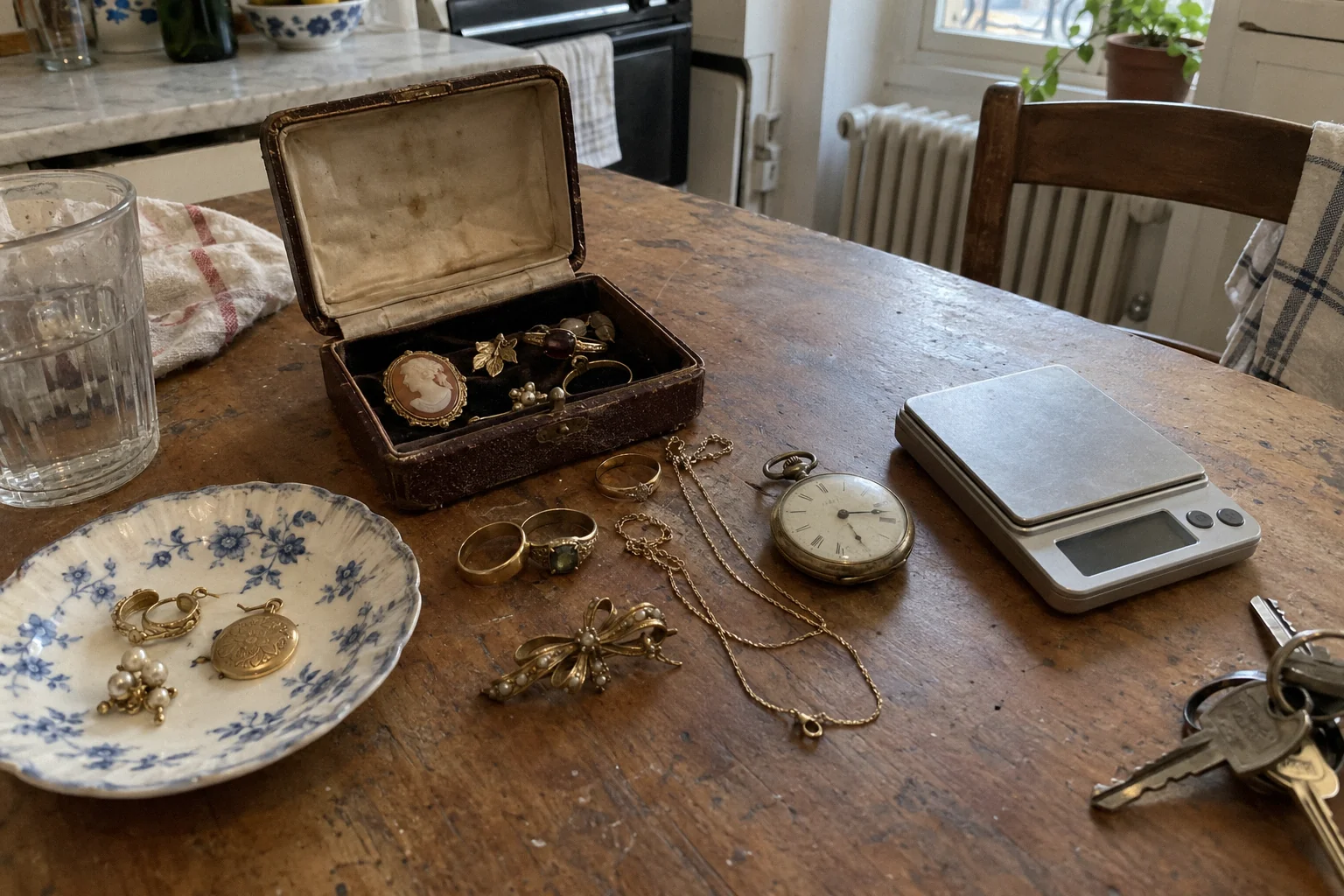
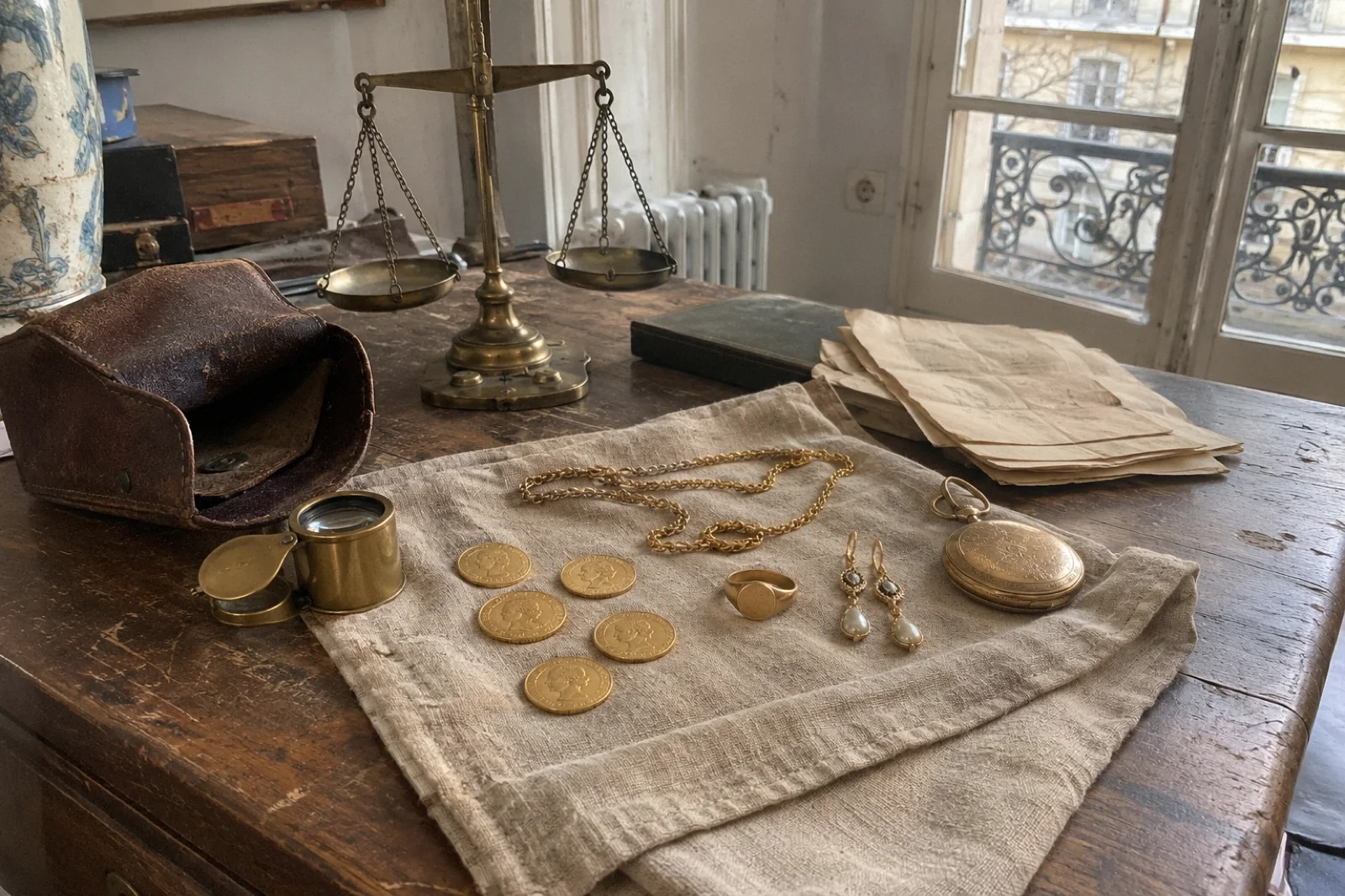
- gold jewelry, even broken, odd or damaged;
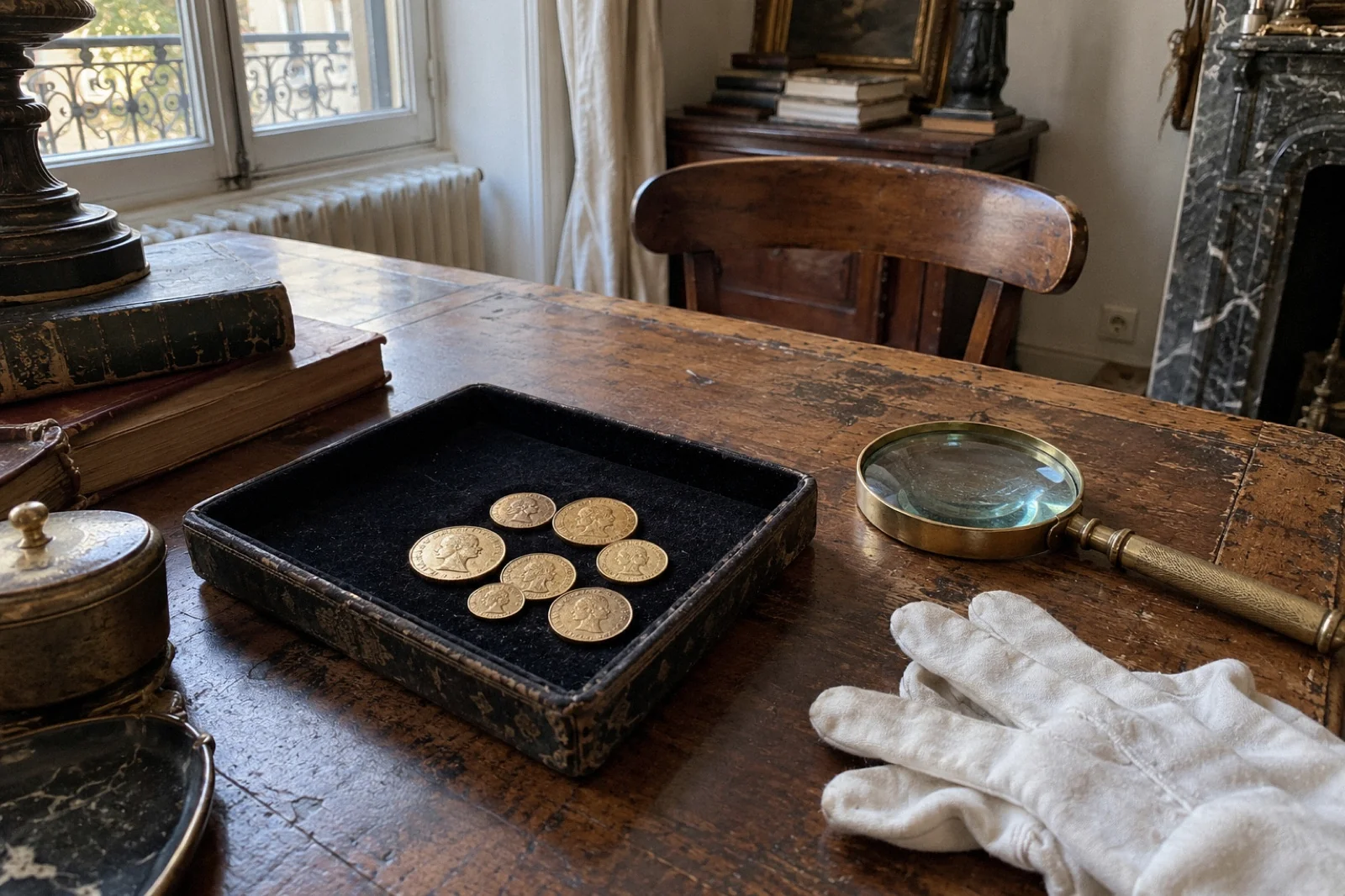
- gold coins, such as the 20-franc Napoleon or the Sovereign;
- bars and small ingots;
- scrap gold: cut chains, odd earrings, empty settings.
For coins, our article on the 20-franc Napoleon gold coin goes into the gold price and the condition.
What about antique jewelry and collectibles?
Antique jewelry is not always sold for its gold alone. A signed piece, a rare coin or a work of art can have collector value, and its tax treatment may differ from that of scrap gold. We do not decide this question for you: ask the tax authorities how your item is classified.
What we can do is tell you whether your jewelry is worth mostly for its metal, or also for its age, its craftsmanship or its stones. Our guide on how the price of antique jewelry is set explains the difference.
Should I keep the purchase receipts?
Yes, when you have them. A receipt, a jeweler's warranty certificate or a deed of gift can help prove the date and price of acquisition. They matter most if you choose the actual capital gain regime.
Also keep:
- the original cases and boxes, which sometimes carry the jeweler's name;
- insurance papers that list the piece;
- the estate deed or inventory, if the jewelry comes from an inheritance.
With no papers at all, you can still sell. The flat tax was designed for exactly these cases.
What happens with jewelry received as an inheritance?
This is a very common case. A family piece rarely comes with its receipt, and the date of acquisition is not easy to establish.
A few cautious pointers:
- jewelry in an estate may appear in the estate declaration or in the inventory; the notary knows how it is treated;
- furniture and personal belongings can be valued on a flat-rate basis in an estate under article 764 of the French CGI (Code général des impôts), but this flat rate does not by itself settle the question of a later sale;
- if several heirs are involved, it is better to decide on the sale together before selling.
For the general context, read what to do with furniture and objects from an estate. And always ask your notary about the tax treatment of the sale before you sell.
What papers do I need to sell gold to a professional?
A professional who buys gold has obligations in France: they must identify the seller and keep a register. So plan to bring:
- valid proof of identity;
- proof of address, sometimes requested;
- any papers that come with the jewelry.
With us, payment is made by bank transfer, which is mandatory for gold and precious metals. It is immediate once we have agreed. You do not have to worry about a cash payment, and the sale stays traceable.
How do I avoid bad surprises?
Before selling, a few habits help:
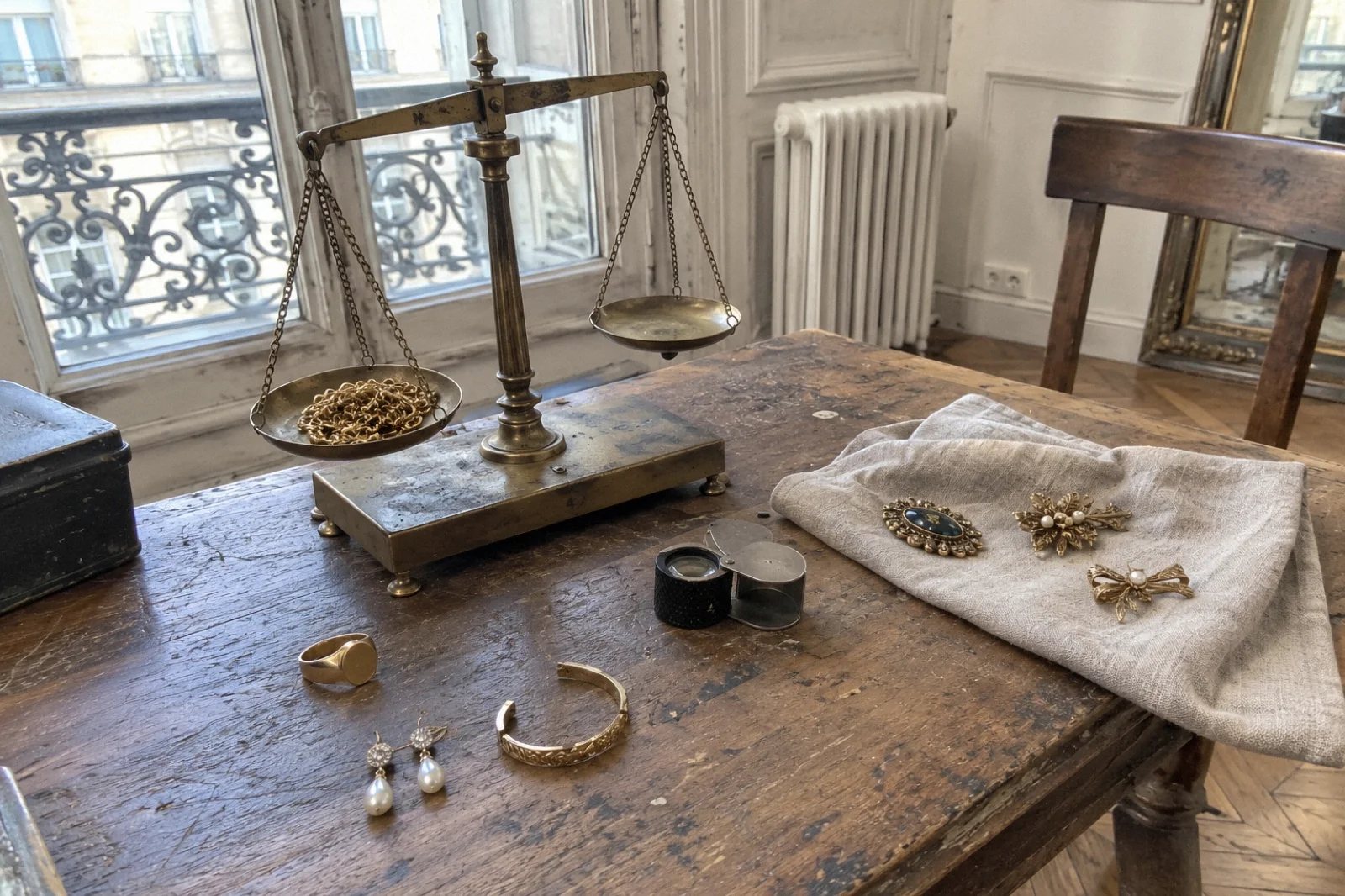
- Have the gold weighed and examined in front of you. The weight, the purity and the hallmark should be explained. Our article on the eagle's head hallmark helps you read a purity mark.
- Ask for a written breakdown: weight, purity used, price offered, any deductions.
- Compare several opinions, without rushing.
- Do not sell under pressure, or after an unsolicited phone call.
- Ask the tax question to the professional and to the tax authorities.
Our guide on having your gold valued covers these points in detail, with the traps to know about.
Who should I ask about tax questions?
- The tax office (centre des finances publiques) for your home address, which can advise on your case.
- The impots.gouv.fr website, where the current rules and thresholds are published.
- Your notary, if the jewelry comes from an estate.
- A tax adviser or a tax lawyer, for a large or complex sale.
On our side, we value your jewelry, we tell you what is worth something as gold and what is worth something as an object, and we offer to buy antique jewelry with payment by bank transfer. What we cannot do is guarantee a tax treatment: it depends on your situation.
Why get a valuation before deciding?
A valuation gives you what you need to decide: the weight of gold, the purity, the condition, and any added value from age. With these details, you can ask the tax authorities or your notary a precise question instead of starting from zero.
Our valuation is free and without obligation. It can be done from photos, at our stand at the weekend, or at your home in Paris and Île-de-France, with no travel charge.
For a first valuation, call us on 06 24 56 38 58 (+33 6 24 56 38 58 from abroad), or send a few photos of your jewelry and its hallmarks on WhatsApp to the same number. We will reply with a free opinion and no obligation.