By Baptiste Murier, antique and second-hand dealer in Île-de-France.
To get your gold valued, you need to know three things: the weight of each piece, its purity (the share of gold in the alloy) and the day's gold price. A good buyer weighs the pieces in front of you, reads the hallmarks, explains the calculation and leaves you free to say no. Here is how it works, step by step.
How does a gold valuation work?
A serious valuation always follows the same path:
- The buyer examines each piece and looks for hallmarks.
- They determine the purity, that is, the proportion of gold in the piece.
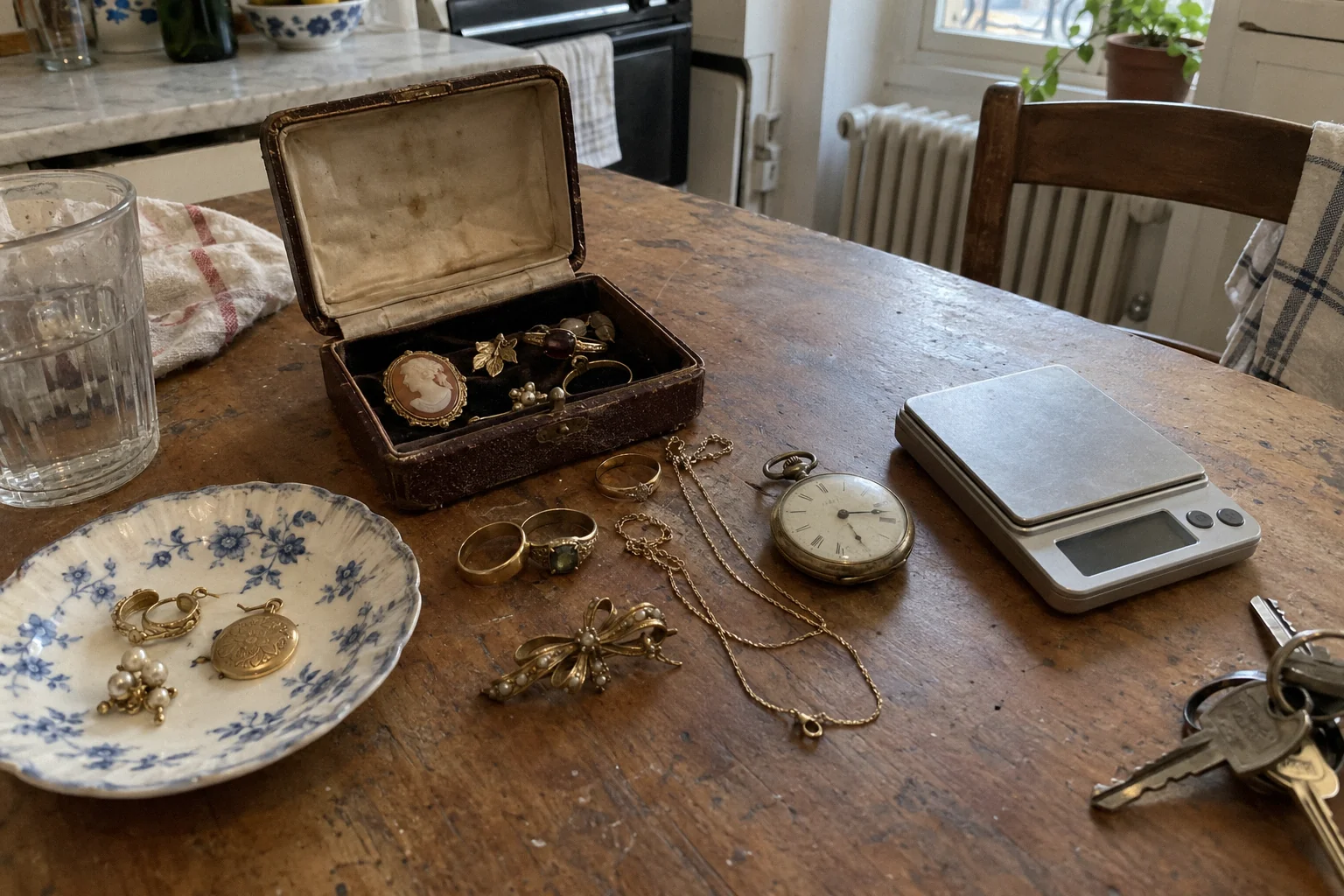
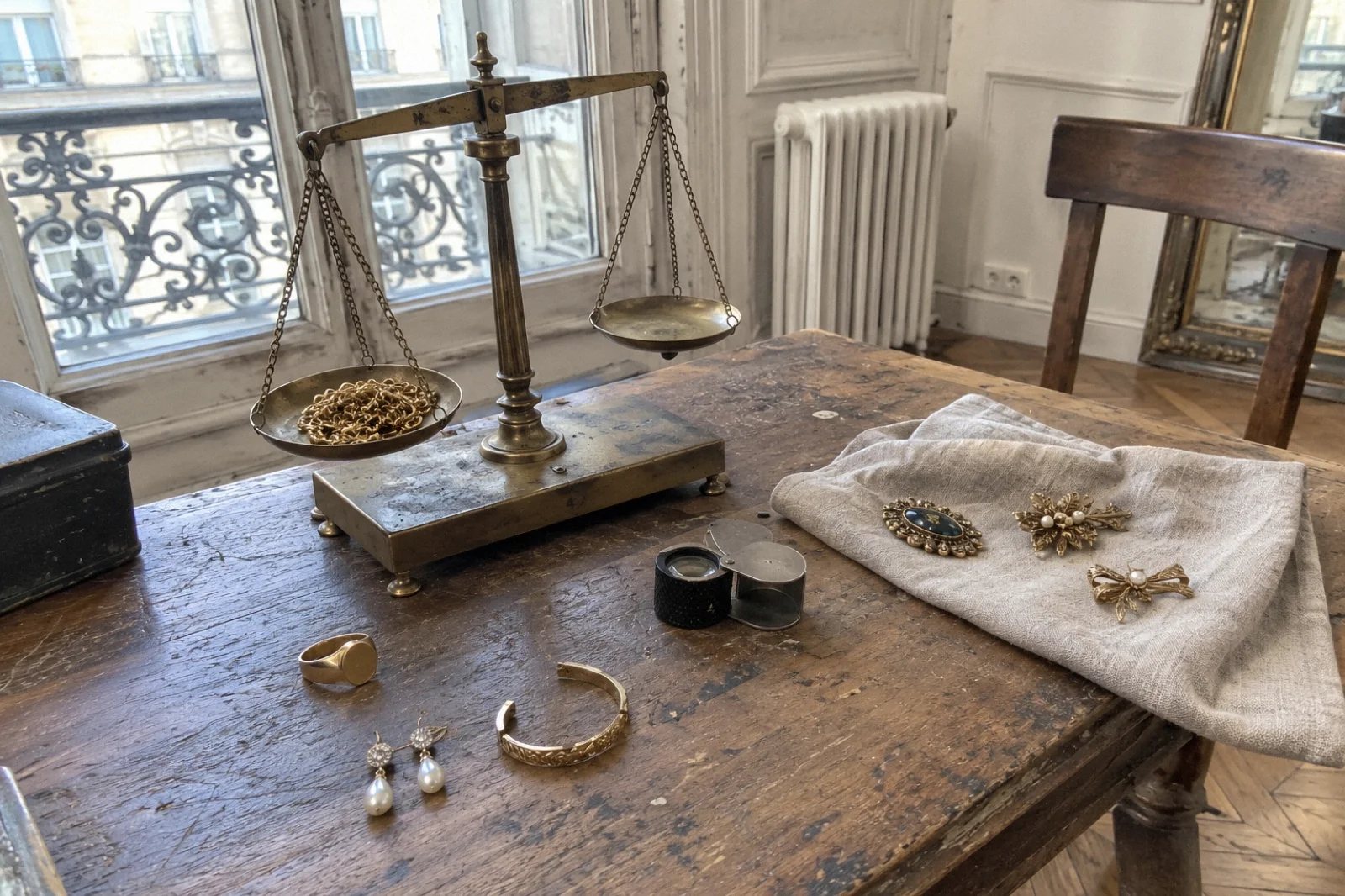
- They weigh the pieces on a precision scale, in front of you.
- They work out the amount of pure gold and compare it with the day's gold price.
- They explain the result, and you decide.
With us, the valuation is free and without obligation. It can be done at your home or from photos, and we travel free of charge in Paris and Île-de-France.
What is gold purity and how do you read it?
Pure gold is too soft to make a solid piece of jewellery, so it is mixed with other metals. The purity shows the share of gold, in parts per thousand or in carats:
- 24 carats: almost pure gold, 999 parts per thousand;
- 18 carats: 750 parts per thousand, or three quarters gold;
- 14 carats: 585 parts per thousand;
- 9 carats: 375 parts per thousand.
A simple example: a ten gram piece in 18 carat gold contains seven and a half grams of pure gold. The rest is alloy.
In France, 18 carat gold normally carries an eagle's head hallmark. We explain how to spot it in our article on the eagle's head hallmark and 18 carat 750 gold. Jewellery from abroad follows other customs, and some very old pieces no longer have a legible hallmark. In that case, a professional checks the purity another way.
How can you tell if it is really gold?
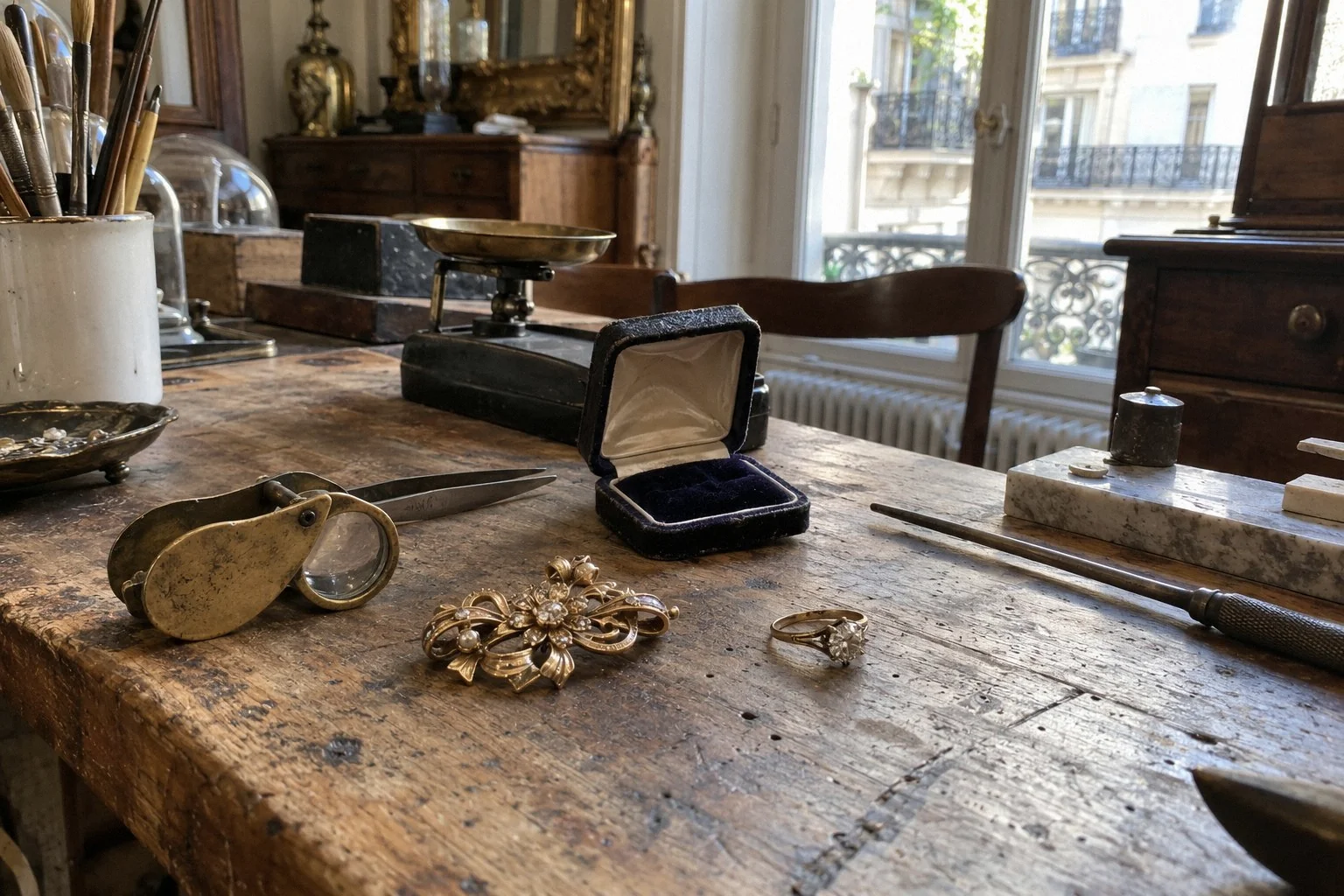
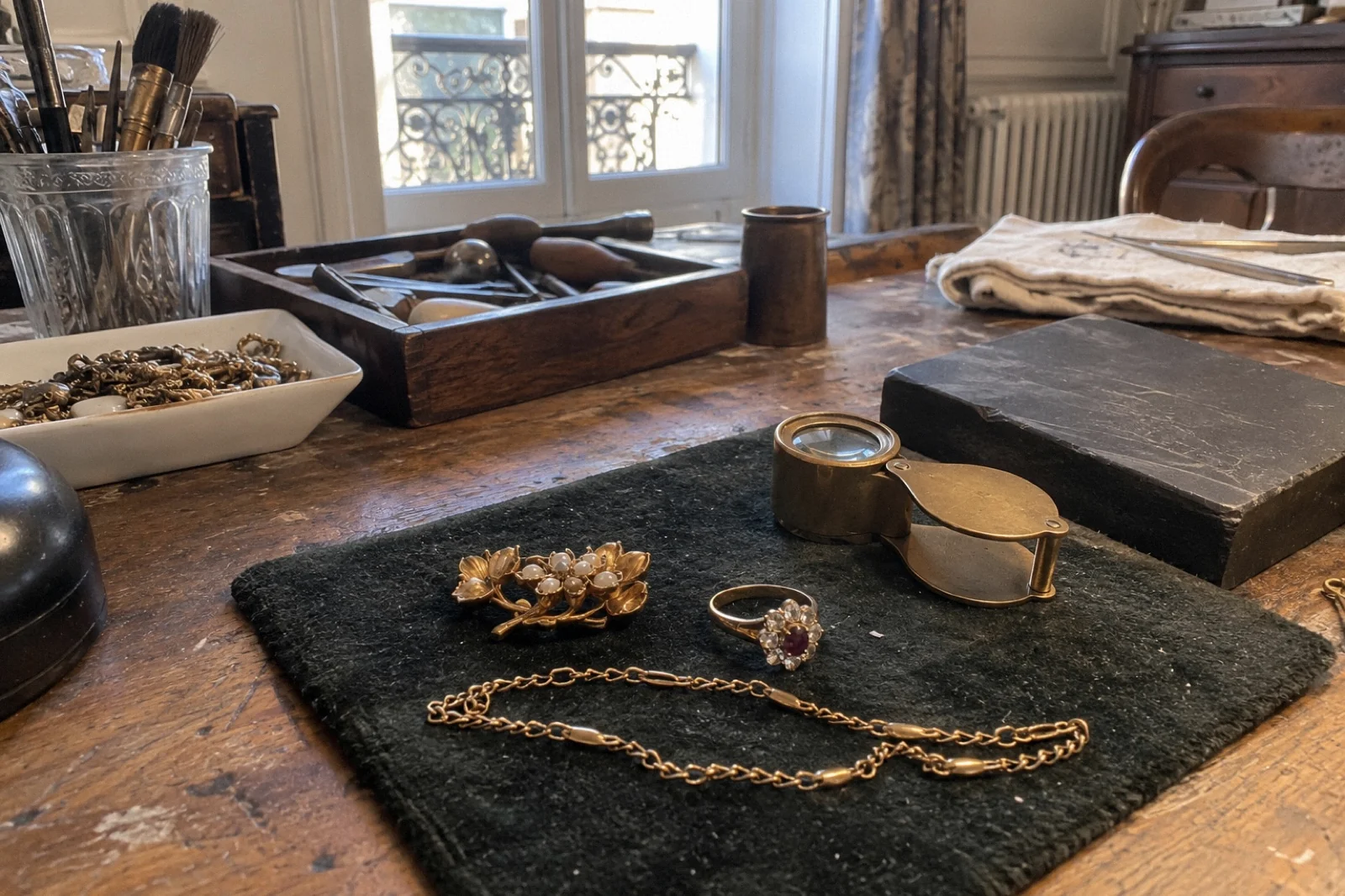
Start with a magnifying glass and good light. Look for tiny hallmarks near the clasp, on the inside of a ring band or on the edge of a brooch.
A few useful pointers:
- words such as plated or gilded mean a thin layer of gold over another metal, which changes the value completely;
- gilded silver (vermeil) can look like gold;
- gold is not magnetic: if a piece sticks to a magnet, it is not solid gold, or only part of it is;
- the reverse is not true: a piece that does not react to a magnet is not necessarily gold.
Avoid acid tests at home: they can damage the piece, and reading them takes practice. Leave that to a professional.
Should you sort your jewellery before having it valued?
No, bring everything. A broken chain, a ring with no stone, an odd earring or an old brooch each has its own interest.
Some pieces are worth more for their workmanship than for their weight: a jeweller's signature, fine stones, a sought-after period. If you sort them yourself, you may set aside the very piece that is most interesting.
Two tips before you come:
- do not clean your jewellery with an abrasive product;
- do not have it repaired: a recent solder joint can get in the way of the valuation.
Getting gold valued: by weight or as an antique piece?
This is the question that spares you the most nasty surprises. A piece of jewellery can be looked at in two ways.
By weight: only the material counts. The piece is judged on its weight in pure gold and on the day's gold price. This is the case for an ordinary chain or a damaged piece with nothing special about it.
As an object: the design, the signature, the period and the stones are part of the valuation. The value can then go beyond that of the metal.
A buyer who melts everything down without looking is not doing you a favour. A good antique dealer examines the piece first and tells you honestly which category it belongs to. Our page on buying old jewellery describes this approach in detail.
Gold coins have their own logic, where the price and the condition both matter. We cover them in the article on the Napoleon 20 franc coin.
How is the offer you receive set?
The gold price changes every day. The amount offered therefore depends on several things:
- the actual weight of the piece;
- its purity;
- the day's gold price;
- for an old or signed piece, its interest as an object.
Be careful with a figure given over the phone without anyone having seen the pieces. It is only an indication, never a valuation. To understand better what counts, read our article on how the price of old jewellery is set.
What pitfalls should you avoid?
These are the situations that most often cause problems:
- accepting an offer without the calculation being explained to you;
- leaving your jewellery in another room during the weighing;
- not noting down the weight and purity announced;
- being rushed by an offer that is "valid today only";
- selling a signed or antique piece by weight;
- asking for only one opinion.
A second opinion costs nothing and is quick. Since the gold price is public, the difference between two buyers comes mainly from how they look at the piece and the care they take to explain things to you.
Can you be paid in cash for gold?
No. In France, cash payment is not allowed when a professional buys gold and precious metals from a private individual. Payment is made by bank transfer. With us, payment is immediate, by bank transfer.
A professional buyer will also ask you for proof of identity. That is normal: they have to record their purchases. Be wary instead of anyone who offers to pay in cash with no paperwork.
What should you do with gold from an estate?
After a death, a parent's jewellery often raises questions. Take your time. Before selling, agree among the heirs and ask the notary (in France, the notary handles the estate). A piece that looks ordinary sometimes has a family history, and a sale cannot be undone.
Once things are settled, a valuation tells you what each piece is worth, with no obligation to sell. We can come to your home, or look at photos for a first opinion.
Where can you get your gold valued around Paris?
We are based in Issy-les-Moulineaux, and we have a stand at the Puces de Vanves flea market at weekends. Baptiste Murier, antique dealer and flea market trader, looks at each piece in hand: hallmarks, weight, condition, workmanship. You can come to the stand with your pieces, or ask us to visit you at home. To understand how we work, see our page on valuation at your home.
To get your gold valued free of charge and without obligation, call us on 06 24 56 38 58 (+33 6 24 56 38 58 from abroad), or send a few photos of your jewellery on WhatsApp to the same number. We will reply with a clear first opinion, and we will explain each step.