By Baptiste Murier, antique and second-hand dealer in Île-de-France.
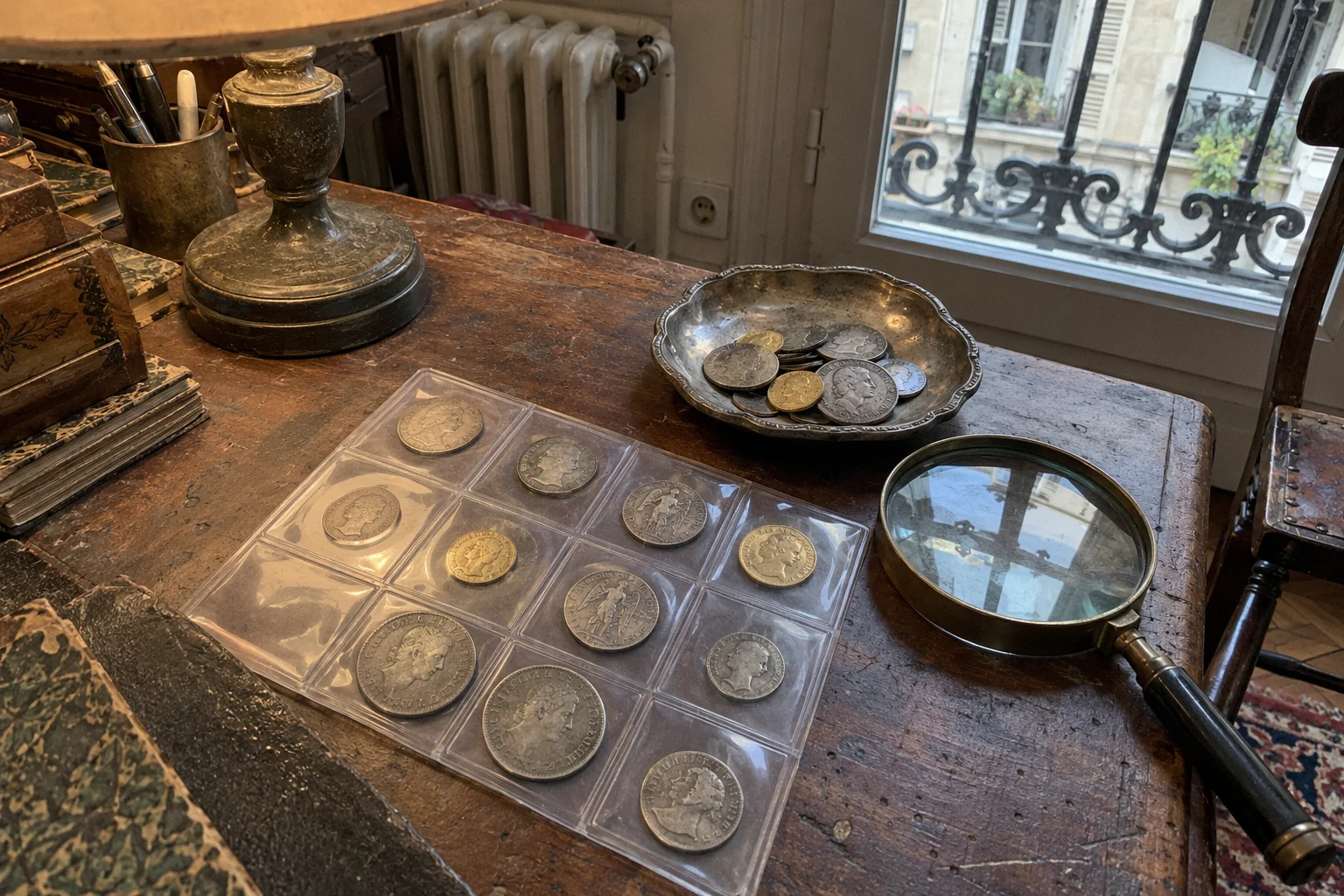
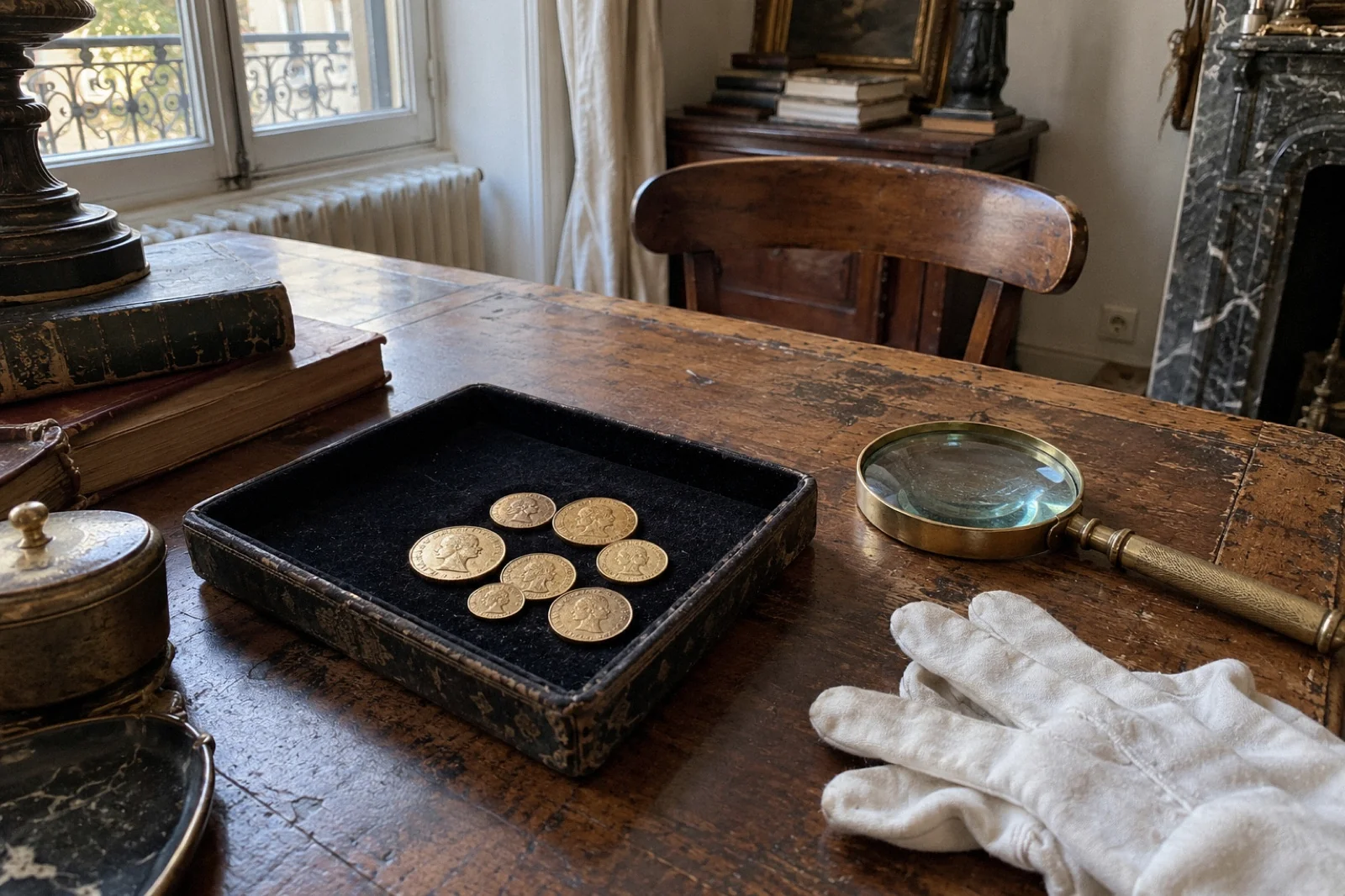
In France, people often call any gold 20 francs coin a "Napoleon", even when it shows Marianne or a winged genius. These coins were struck for more than a century, under several regimes. Their value rests first on the gold they contain. But the date, the mint, the portrait and above all the condition can make a real difference. Here is what we look at when someone brings us a coin of this kind.
What is a 20 francs Napoleon coin?
It is a small gold coin, about 21 millimetres across. It was created at the start of the 19th century and struck until just before the First World War. The name comes from Napoleon Bonaparte, whose portrait appeared on the first strikes. Common use kept the name for the whole series.
They are often found in a box at the back of a drawer, in a bank safe or in an inheritance. Many French families kept a few as savings for a rainy day. That is why they turn up so often when an estate is settled.
How much gold is in a 20 francs Napoleon?
The weight and fineness are the same for the whole series:
- total weight: about 6.45 grams;
- fineness: 900 thousandths, so 90 % gold;
- fine gold: about 5.81 grams per coin.
The rest of the alloy is copper. It makes the coin harder and protects it from wear. A very worn coin may have lost a little metal, but the difference stays small for a coin that was simply carried in a pocket.
These figures allow a first check. A coin that weighs clearly less, that sounds wrong or whose colour looks strange deserves a careful look. Imitations exist, and precise scales are not always enough to spot them.
How does the price of gold set its value?
For a common coin, the value closely follows the price of gold. This price changes every day, sometimes sharply over a few weeks. So we never give a fixed figure in advance: a valuation only makes sense on a given date.
The Napoleon also has its own price, quoted on the investment gold market. It can be a little above or below the value of its fine gold alone, depending on supply and demand. When the coin sells for more than its metal, this is called a premium.
Keep one simple idea in mind: for the great majority of coins, the gold makes up most of the price. For a few coins, collector interest adds value that can exceed that of the metal.
Which portraits appear on gold 20 francs coins?
The design changes with the period. Here are the types we see most often:
- Napoleon III bare head: the emperor's profile without a wreath, on Second Empire strikes before about 1860.
- Napoleon III laureate head: the same profile with a laurel wreath, on strikes from the 1860s.
- The Genius (Génie): a winged angel engraving a tablet, struck under the Second Republic and then mainly under the Third Republic.
- Ceres (Cérès): a woman's head crowned with ears of wheat, struck under the Second Republic, in smaller numbers.
- Marianne and rooster (Marianne au coq): Marianne in profile on one side, a rooster on the other, at the start of the 20th century.
You also come across coins of Napoleon I, Louis XVIII, Charles X or Louis-Philippe. They are less common in family collections. Their interest depends a lot on the date and the condition.
For the Marianne and rooster, one useful detail: some of these coins were restruck in the middle of the 20th century with old dates. These restrikes are gold, of the same weight, but collectors do not value them in the same way as the original strikes.
Which dates and mints are worth more than the gold?
Each coin carries a date and a mint letter, which shows the city where it was struck. A stands for Paris, BB for Strasbourg, and other letters exist depending on the period. It is usually under the portrait or on the reverse, near the date.
Some years were struck in small numbers. Some mints produced very few coins for a given date. In these cases, the coin can be worth clearly more than its gold, especially if it is in fine condition.
It is impossible to give a reliable list here of all the sought after dates. The differences are fine and also depend on varieties. This is exactly the work of an old coin valuation: reading the date, the letter and the condition, then comparing with market references.
How does condition change the price of a Napoleon?
For a common coin, condition matters little: you are mainly paid for the gold. For a collector's coin, condition matters enormously. Two coins of the same date can have very different values.
Here is what we examine:
- wear on the raised parts, especially the hair, the laurel or the rooster's feathers;
- knocks on the edge and dents on the faces;
- scratches, even fine ones, visible when you turn the coin under the light;
- the original shine, known as mint lustre;
- traces of a mount, solder or a hole, when the coin was worn as jewellery.
A coin mounted as a pendant or soldered onto a ring almost always loses its collector interest. It is still gold, and we then buy it by weight. If you have jewellery like this, our page on buying antique jewellery explains how we look at it.
Why should you never clean a gold coin?
This is the most common mistake, and it comes from a good intention. You want to show the coin at its best, so you rub it with a cloth, a brush or a metal polish.
The result is almost always negative. Rubbing leaves micro scratches and removes the mint lustre. A trained eye sees it at once. A cleaned coin loses its collector premium and is then worth only its weight in gold.
The right habits are simple:
- hold the coin by its edge, between two fingers;
- store each coin separately, in a pouch or a holder;
- do not mix coins loose in a bag or a box;
- do not rub it, even if it looks dull to you.
How does selling a gold coin work?
We start with a free valuation without obligation. It can be done from photos, at our stand at the Puces de Vanves at the weekend, or at your home in Paris and the Ile-de-France. For a few coins, good photos of both sides are often enough for a first opinion.
If you decide to sell, payment is made by bank transfer. In France this is a legal requirement for buying gold and precious metals. For a larger sale, with other things from the house, see also our page on buying antiques.
As for tax, selling investment gold in France follows special rules. Two regimes can apply, depending on your situation and the papers you keep, such as a purchase invoice or a succession deed. We are not tax advisers: ask your notaire (notary) or an adviser before selling.
How do you take good photos of your coins?
A few rules make a remote valuation more reliable:
- photograph each side, lying flat, in daylight;
- avoid the flash, which creates glare on gold;
- take a close photo where the date and the mint letter can be read;
- if you have several coins, place them side by side for an overall view.
Also tell us how many coins there are and where they come from if you know, for example an inheritance. This helps us prepare the visit or the conversation.
Have your gold Napoleons valued
You have one or more gold 20 francs coins? Call us on 06 24 56 38 58 (from abroad: +33 6 24 56 38 58), or send photos of both sides on WhatsApp to the same number. The valuation is free and without obligation.