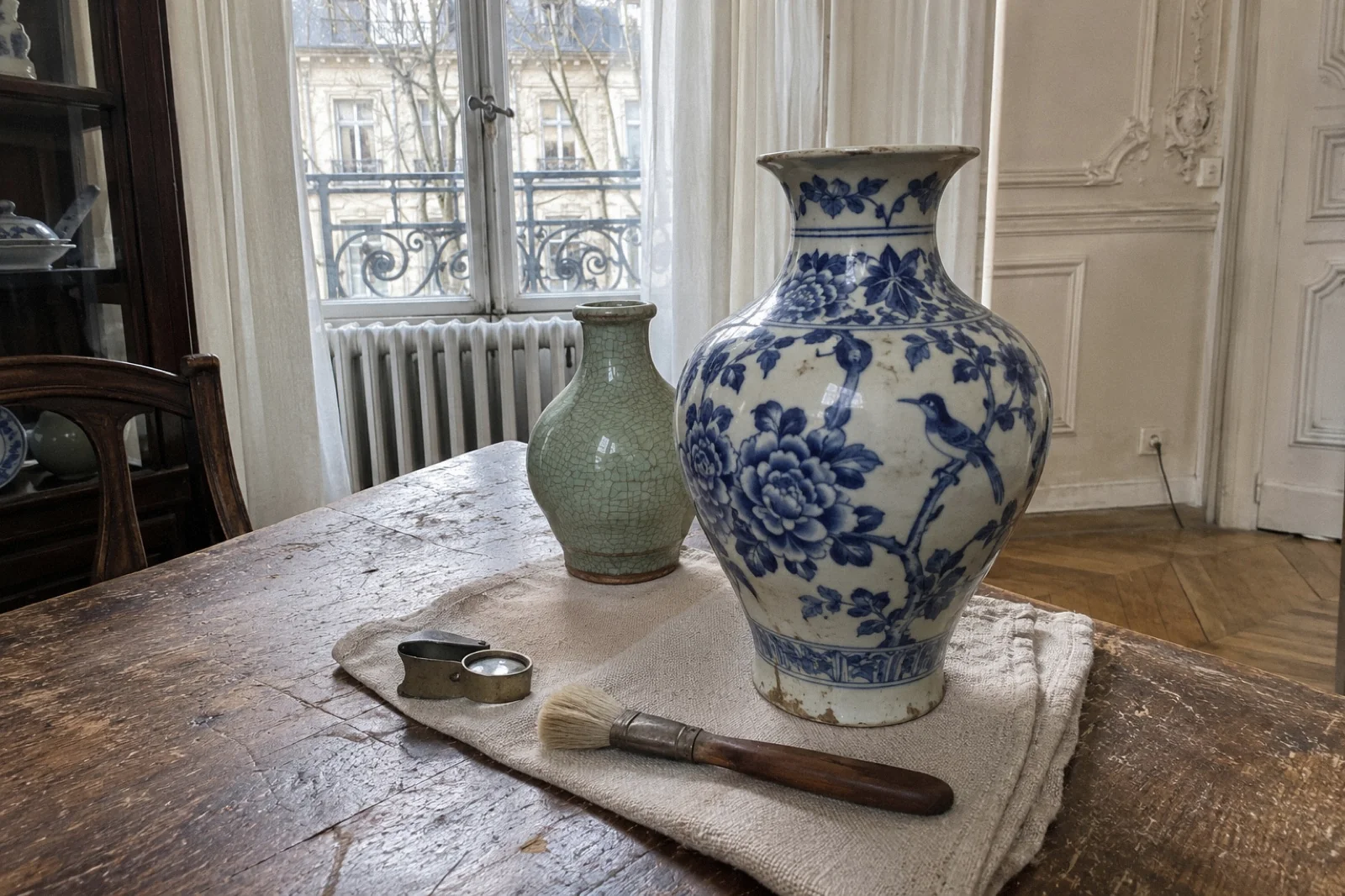
By Baptiste Murier, antique and second-hand dealer in Île-de-France.
To tell if a Chinese vase is valuable, you need to weigh several clues together: the shape, the body and glaze, the decoration, the base, the mark and the condition. None of them is enough on its own. A vase can carry an old mark and be recent, or look modest and be highly sought after. Here is what we look at, what you can safely observe at home, and when to show the piece to a specialist.
What gives a Chinese vase its value?
Value depends on several criteria working together:
- period: a vase from the Ming or Qing dynasties cannot be compared with a 20th century piece;
- quality: fineness of the porcelain, evenness of the glaze, precision of the decoration;
- rarity: some shapes and some decorations are seen less often than others;
- condition: cracks, chips and restorations weigh on the value;
- history: a known provenance or an old label can help.
A large vase is not necessarily a valuable one. Many big decorative pieces were made in quantity in the 20th century. Conversely, a small vase with a simple shape can interest collectors.
How can you tell if a Chinese vase is old?
There is no single test. We observe several elements and compare them with each other.
Shape and proportions
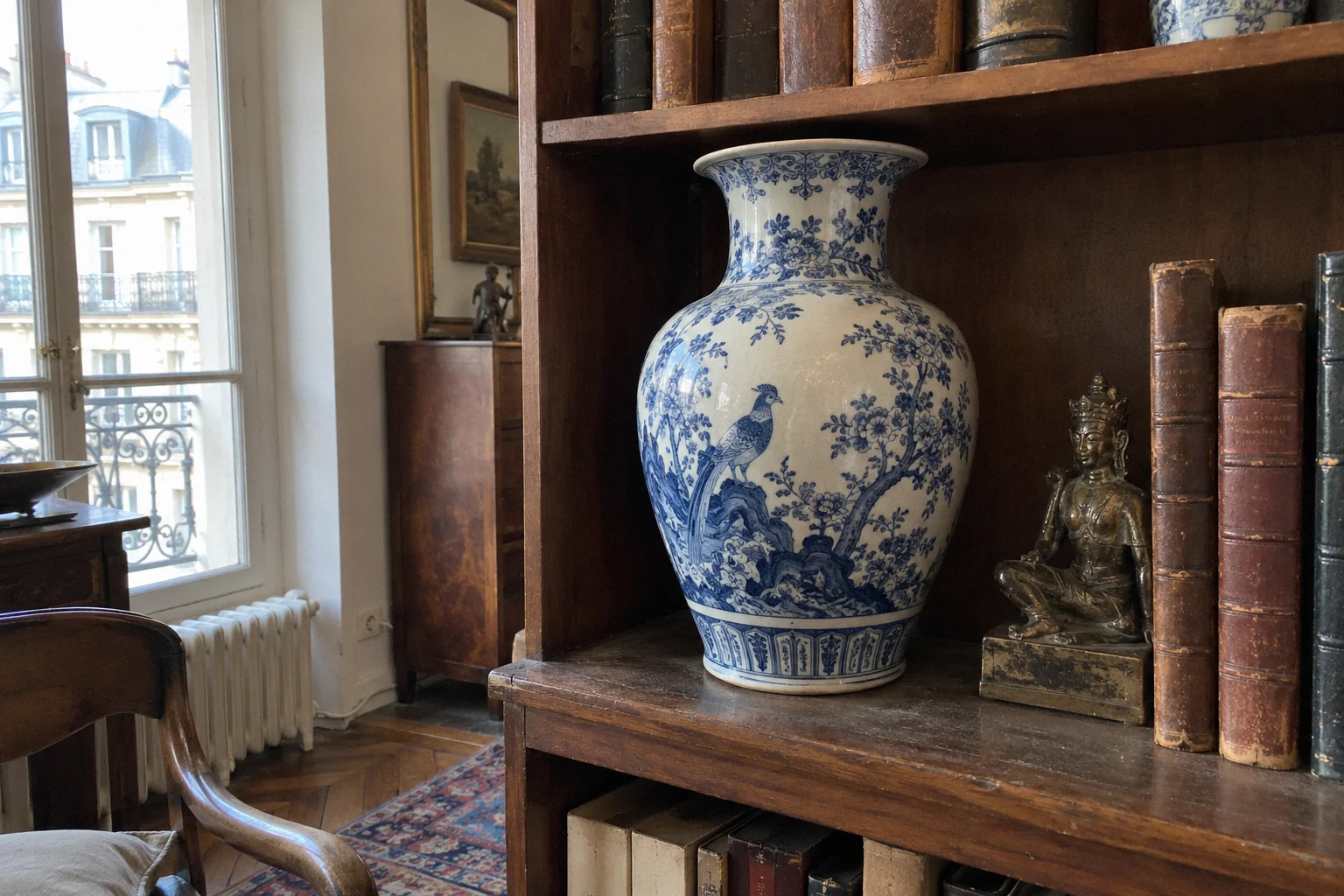
Chinese potters reused classic shapes for centuries. A classic shape therefore does not prove age. What matters is balance: a harmonious neck, shoulder and foot, and sound proportions. A piece that looks heavy, squat or badly proportioned deserves a second look.
Body and glaze
Turn the vase over carefully and look at the unglazed area on the foot, which shows the body of the piece. On porcelain it is white and dense; stoneware tends to have a grey or brown body. A glaze may show tiny bubbles or slight runs, signs of handmade production.
Do not tap the vase to listen to the sound: you could make an invisible crack worse.
The decoration
The decoration is often the best clue. A hand painted decoration varies slightly from one motif to the next, with thick and thin strokes. A decoration that is too regular, with identical motifs, may come from a transfer. Under a magnifying glass, a transfer sometimes shows a fine pattern of dots.
The underside of the vase
The foot tells a lot. An old vase often shows wear on the foot ring, where it has been set down and moved. The wear should look natural and uneven. A uniform brown dirt, as if applied with a brush, should on the contrary raise doubts.
Does the mark under the vase prove its period?
No, and this is the most common mistake. Many Chinese porcelains carry a reign mark under the base, written in Chinese characters. It names an emperor and seems to give a date.
Yet these marks have been copied. Later pieces reuse the marks of earlier reigns, sometimes as a tribute, sometimes to imitate. Conversely, many old pieces have no mark at all.
A mark is therefore one clue among others. It must stay consistent with the shape, the body, the decoration and the way it is drawn. To photograph it, light the underside well, without cleaning it.
Which types of Chinese vase do you come across most often?
A few families come up often:
- blue and white: cobalt blue decoration under a transparent glaze;
- famille verte and famille rose: decorations painted in coloured enamels;
- celadon: pale green glaze, sometimes crackled;
- monochromes: a single glaze colour, where the quality of the glaze matters a great deal;
- export porcelain: made for Europe, with decorations adapted to Western taste.
Many vases in these families were reproduced in the 19th and 20th centuries. The name of the style therefore does not tell you the period. Some pieces sold as Chinese are also Japanese, with different techniques and different decorations.
How can you spot a reproduction?
Certain signs come up often:
- a very bright white, a glaze that is too uniform, a shine that looks like plastic;
- a decoration identical from one vase to another, or a pattern of dots under a magnifying glass;
- a very sharp mark on a foot with no wear at all;
- artificial ageing: uniform stains, fake crackle;
- a modern mention of origin, printed or stuck under the base.
A reproduction can have decorative interest. But it is not sold as an old piece.
Which flaws lower the value of a Chinese vase?
Condition matters a lot. Look for:
- cracks, sometimes fine and hard to see;
- chips, especially on the neck and the foot;
- restorations: glue, filling, paint retouching;
- a drilled base, when the vase has been turned into a lamp.
A torch held at a low angle helps you see differences in the surface. A restored vase, or one turned into a lamp, can keep real interest, depending on the piece. What matters is to know this before selling.
What should you do before having a Chinese vase valued?
A few simple steps avoid mistakes:
- do not clean it: no product, no brush. Old dirt can be informative;
- do not lift it by the neck or the handles, which may be fragile: support the underside with both hands;
- photograph it: the whole piece, the underside, the mark, the decoration up close, the flaws;
- note its height and, if you know it, where it comes from;
- store it wrapped in a cloth, away from busy passages.
Should you have a Chinese vase valued before selling it?
Yes. A vase that looks modest can be highly sought after, and a large spectacular vase can be a reproduction. Without an opinion, you risk being wrong in both directions.
At Murier Antiquités, Baptiste Murier, antiques dealer and flea market trader, looks at the piece as a whole. Our valuation of Chinese objects and Asian art is free and without obligation, from photos or at your home. For your other objects, the home valuation works in the same way.
If a piece needs the opinion of a specialist in a particular period, we tell you so. And if you decide to sell, we can buy your objects with immediate payment.
Inherited a vase, or found one in a house being cleared: what to do?
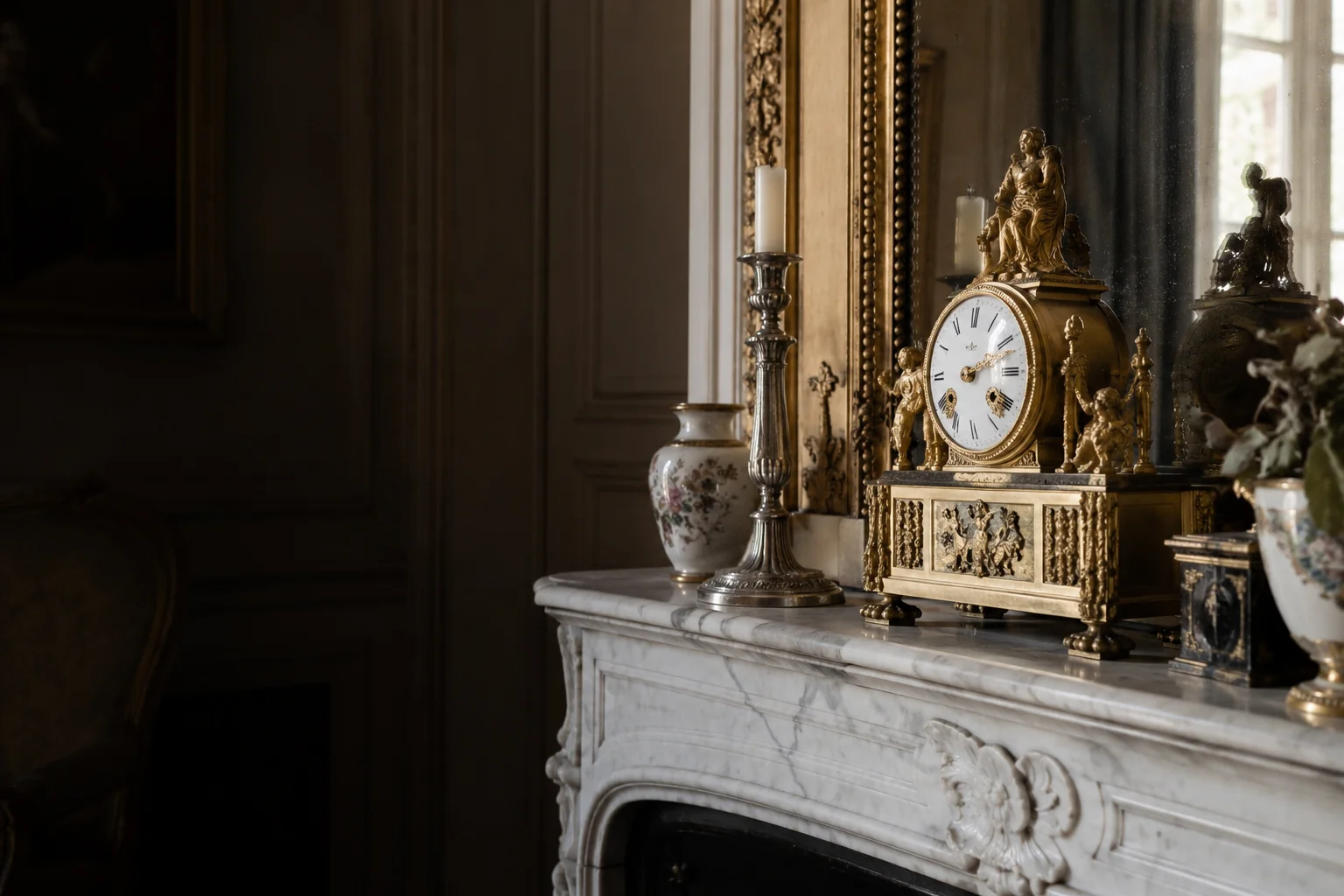
A Chinese vase often turns up during an estate clearance: on a mantelpiece, in a display cabinet, at the back of a cupboard. Before clearing, set aside the vases, the porcelain and the objects from Asia, without moving them needlessly or cleaning them.
Our article on what to do with the furniture and objects of a home explains the steps. This applies to estates in France, where the rules of French law apply. For more everyday tableware, see the pieces of old tableware that have value.
Do you have a Chinese vase and want to know what it is worth? Call us on 06 24 56 38 58 (+33 6 24 56 38 58 from abroad), or send a few photos on WhatsApp to the same number, for a free valuation without obligation.