By Baptiste Murier, antique and second-hand dealer in Île-de-France.
Antique dishes are worth money when several things come together: a recognised maker, a hand-painted or rare pattern, very good condition and, often, a complete set. Old does not mean precious. Most family sets made in large series are common and sell for little. But a few pieces deserve a real opinion, and they are easy to spot if you know where to look.
Are all antique dishes valuable?
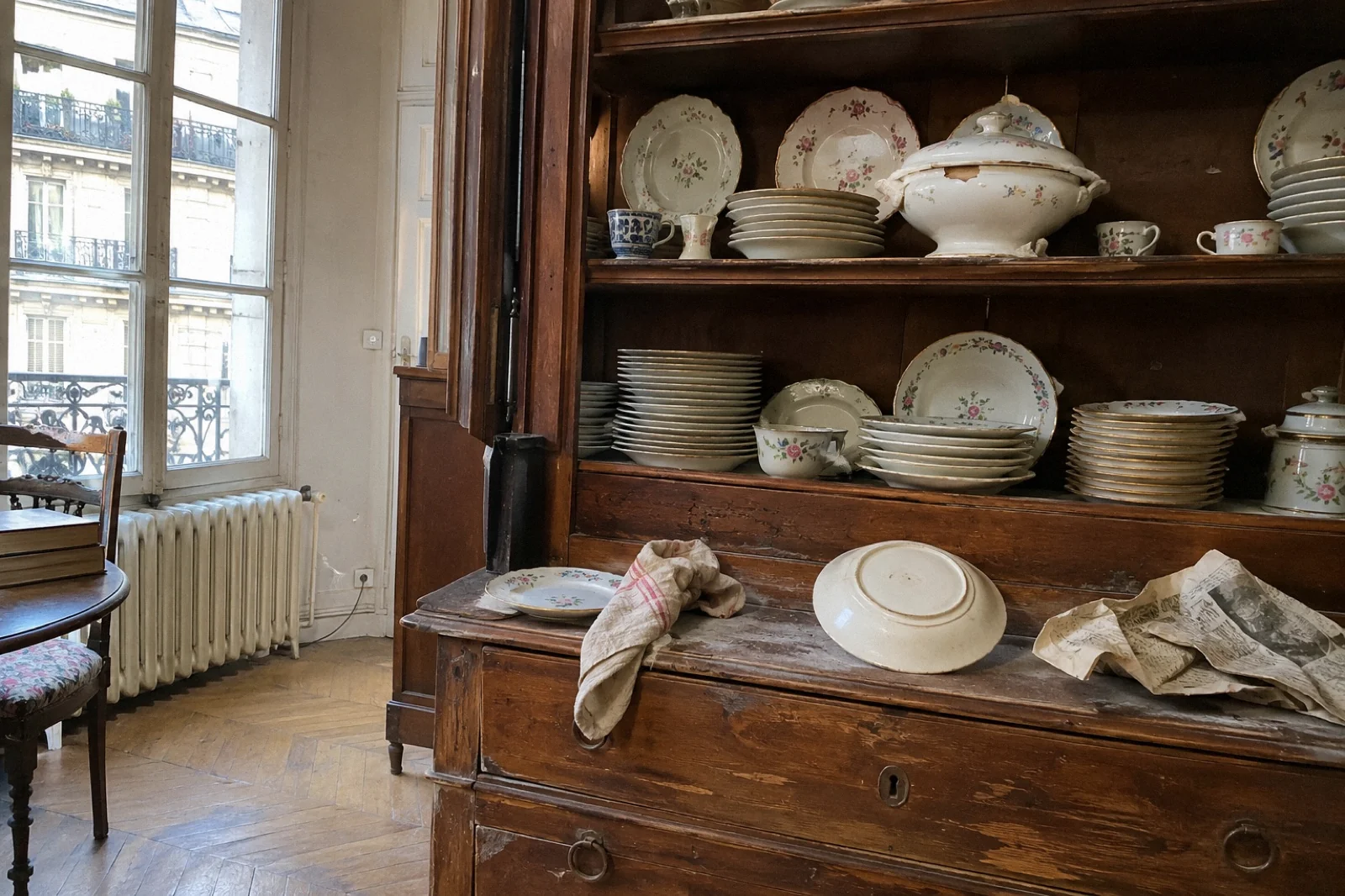
No, and that is the first thing to know. A grandmother's sideboard often holds a lot of dishes, but few sought-after pieces.
Why? Because since the 19th century, faience and porcelain factories have produced in series for ordinary households. These plates were sold by the thousands. They have sentimental value, sometimes a practical use, but rarely any interest for collectors.
On the other hand, a single piece can be a surprise: a tureen from a good maker, a hand-painted plate, a pair of vases. That is why it is better to look before throwing away or giving away.
Which antique dishes are in demand?
These are the families that enthusiasts and dealers look at first:
- Porcelain from major manufactories, such as Sèvres or Meissen. These names are also widely copied: a mark proves nothing on its own.
- Fine antique faience, in particular 18th-century pieces made in Moustiers, Rouen, Strasbourg or Nevers, when they are authentic and well preserved.
- 19th-century Paris porcelain, especially with hand-painted decoration and fine gilding.
- Shaped pieces: tureens, terrines, sauce boats, deep serving dishes, jardinières, milk jugs. They are rarer than plates, because they were broken or lost more often.
- Signed or highly worked decoration, painted by an identified artist, or typical of Art Nouveau and Art Deco.
- Asian porcelain, when it is old. Here too, reproductions are common. We talk about it on our page about valuing Asian art.
A piece that meets several of these criteria is more likely to interest a buyer.
How can you tell porcelain, faience and stoneware apart?
This helps you describe your piece, and it already guides the valuation.
- Porcelain is white, hard and thin. Held against the light, the thin parts let light through. Tapped gently, it gives a clear ring.
- Faience is thicker and heavier. It stays opaque. Where the glaze has chipped on an edge, you see a duller body, often beige or pinkish.
- Stoneware is dense and rings dully, and is often used for pitchers, pots and tankards.
If you are unsure, do not push the test. A sharp photo is enough for a professional to decide.
What should you look for under a plate?
Turn the piece over. The underside tells you a lot:
- a printed or painted mark: the name of the maker, the town, sometimes a date;
- an impressed stamp in the body of the piece;
- a painter's signature or initials, written by hand;
- a model number, useful for tracing a series;
- no mark at all, which often happens on old pieces and does not rule them out.
Photograph these details up close, in good light. Be wary of quick conclusions: a famous mark can be imitated, and a modest mark can appear on a fine piece.
Which flaws lower the value?
Condition matters a lot, sometimes more than age. Look for:
- hairline cracks, sometimes invisible from the front. A dull, muffled sound when you tap gently can reveal one;
- chips on rims, handles, spouts and lids;
- restorations: glue, repainting, remade parts. Some show up better under ultraviolet light, but a trained eye often spots them by touch alone;
- worn gilding, especially on rims and handles;
- knife scratches and ingrained stains in the centre of plates;
- missing pieces: tureen lid, stand, saucer.
A flaw does not remove all value, especially on a rare piece. But it changes the way the piece is valued. It is better to point it out honestly than to hide it.
Is a complete set worth more than single pieces?
Often yes, because a coherent set is more pleasant to use or display. But the reality is more nuanced.
Many large dinner services, for twelve place settings or more, are hard to sell today: people entertain differently, store fewer dishes, and look for smaller pieces. The set alone does not create the value. What counts is the maker, the pattern, the condition and how few pieces are missing.
Conversely, a single rare piece, such as a fine tureen or a shaped dish, can interest buyers more than a stack of plates. For the specific case of Limoges porcelain, read our article on the Limoges porcelain dinner service.
Are Sarreguemines, Gien or Longwy plates worth anything?
These are well-known names that inspire confidence, but they are not enough.
These manufactories produced very varied models. Some series and patterns are sought after by collectors: rare patterns, historical series, shaped pieces, signed models. Others were made in very large numbers, and are easy to find.
To know where your dishes stand, you therefore need to look at the name of the pattern, the model number, the shape of the piece and its condition. Send us photos of the whole set and of the underside: we will tell you whether it deserves a closer look.
Should you clean antique dishes before showing them?
The best approach is to do as little as possible.
- Wipe the dust with a soft cloth, dry or slightly damp.
- Avoid the dishwasher: heat and detergents damage gilding and can make a crack worse.
- Do not use abrasive sponges or stripping products.
- Do not glue anything back yourself: the wrong glue complicates any later restoration.
If a piece is broken, keep all the fragments. Simply tell the appraiser what has been repaired.
How do you get your antique dishes valued?
There is no need to unpack everything. A few good photos are enough for a first opinion:
- an overall view of the piece or the set;
- the underside, with the mark clearly legible;
- a close-up of the decoration;
- the flaws: cracks, chips, worn gilding;
- a list of what makes up the set.
With that, we can tell you whether the piece is common or interesting. A valuation of antiques is free and without obligation, from photos or at your home. If you wish to sell, we can also buy your items with immediate payment.
For a whole house to clear, our house clearance service lets us sort the valuable items before anything is removed, including dishes stored at the back of a sideboard or in an attic.
What should you do with dishes that have no value?
They can still be useful. Items that we do not buy but that are in good condition can be given to Emmaüs, the Secours catholique, the Salvation Army or nearby ressourceries (charity reuse centres). Broken or unusable pieces go to the recycling centre or an appropriate recycling channel.
In any case, do not throw anything away before showing a photo. An ordinary pile can hide one plate that is not.
To find out what your dishes are worth, call us on 06 24 56 38 58 (+33 6 24 56 38 58 from abroad) or send a few photos on WhatsApp to the same number: the valuation is free and without obligation.