By Baptiste Murier, antique and second-hand dealer in Île-de-France.
The value of a Limoges porcelain dinner service varies a great deal. It depends on the maker, the decoration, the condition of the pieces and how many there are. A complete, chip-free service from a good house can interest a buyer. A common, incomplete or damaged service is harder to sell. The word "Limoges" first tells you where something was made, not that it is rare. Here is what to look at, and how to have it valued.
Is Limoges a guarantee of value?
Not in itself. Limoges is a city where porcelain has been made since the late 18th century, after kaolin deposits were discovered near Saint-Yrieix, in Haute-Vienne. Many makers, small and large, worked in the region. Some produced refined services, others made everyday tableware in large quantities.
So the word Limoges tells you where the porcelain comes from. Its value depends on what you actually have in your hands.
How can you recognise Limoges porcelain?
Turn a plate over. Under the foot, you will usually find a mark, called a backstamp or maker's mark. It often includes:
- the name or initials of the manufacturer;
- the word Limoges, sometimes with France;
- sometimes the name of the decorator or of the firm that sold the service;
- a pattern or decoration number.
The mark may be printed, painted or stamped into the porcelain. It helps identify the maker and place the date, but only roughly: firms changed their marks over time, and you need to compare against directories of marks.
Look at the material too. Porcelain is white, hard and fine, and it lets light through thin edges. A faience plate is thicker and opaque.
Which makers are most sought after?
Some names come up often among collectors: Haviland, Bernardaud, Raynaud, Pouyat. Their quality services are easier to place than those of unknown makers. But a big name is not enough: a famous house also made plain, very common patterns.
Conversely, a little-known maker may have produced a carefully done decoration that appeals to buyers. That is why we look at the whole service, not only the mark.
What gives a dinner service its value?
Four criteria matter most.
The decoration
Decoration weighs heavily. A hand-painted design, a neatly applied gilt edge, fine floral motifs or a well-executed Art Deco pattern are more sought after than a simple line.
Many services have printed decorations or ones applied as transfers. They are not without interest, but they differ from a design painted with a brush. Look at the pattern through a magnifying glass: a painted decoration shows small irregularities in the line.
The condition
This is the first thing buyers examine. Look for:
- chips on the edges and under the feet;
- hairline cracks, fine lines sometimes visible against the light;
- crazing of the glaze, a network of fine lines;
- worn gilding, especially on edges and handles;
- knife scratches in the centre of plates and brown stains;
- repairs and paint retouching.
Gently tap the rim with a fingernail: a sound piece rings clearly, a cracked piece often gives a dull sound. A cracked or glued piece usually loses much of its interest. On the other hand, a service kept in a cupboard and rarely used is often in better condition than you would think.
The number of pieces
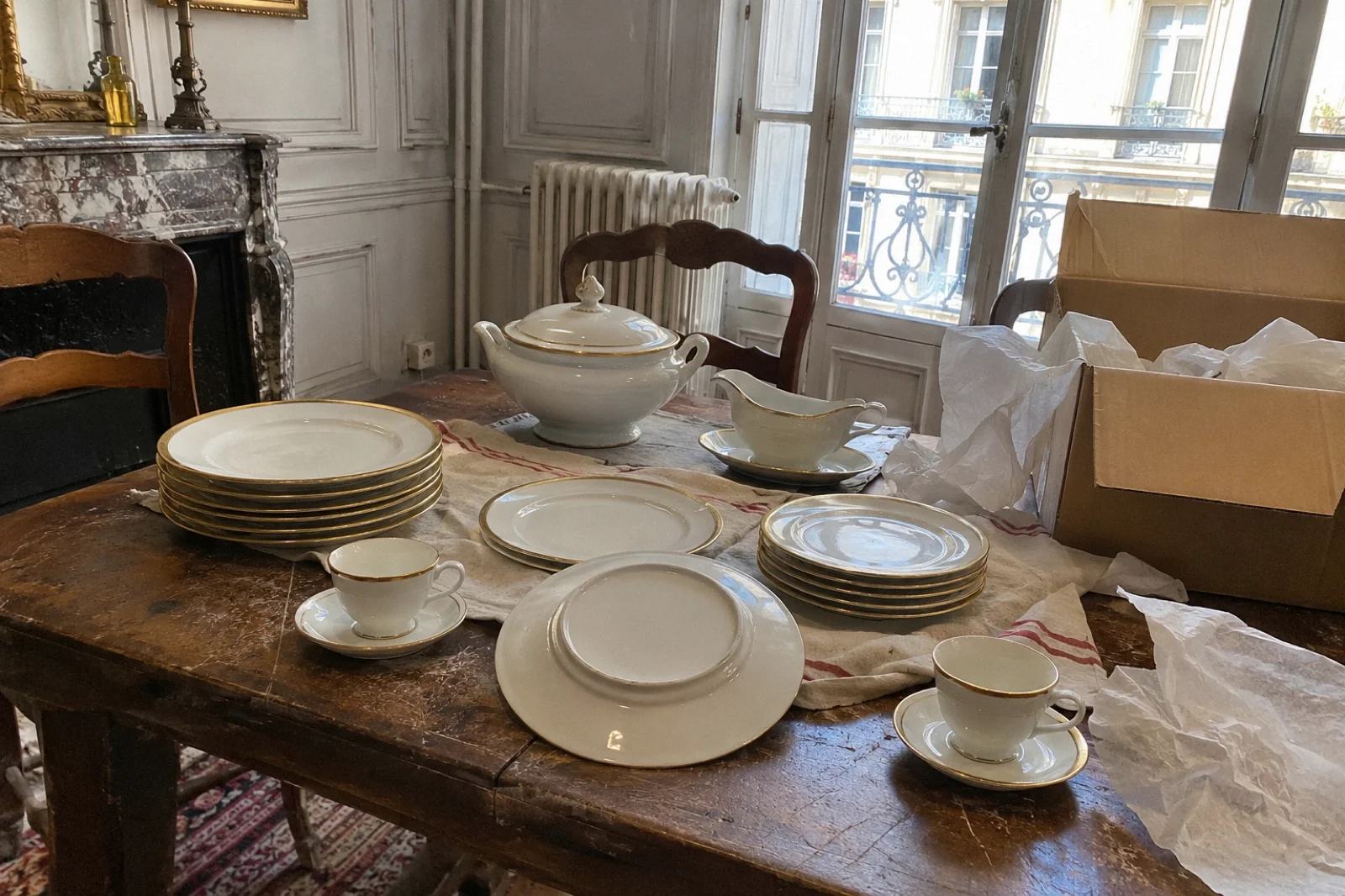
A complete service sells better. A service for twelve often includes dinner plates, soup plates and dessert plates, along with serving pieces: a soup tureen, round and oval dishes, a sauce boat, a vegetable dish, a salad bowl.
These serving pieces are the most fragile and the hardest to find again. Check that they are all there, with their lids.
The period and the style
A service from the 19th century or the early 20th century can attract more interest than a recent one. But age is not everything: a modern service from a good house can sell better than an ordinary old one. Tastes matter too, as many families today use formal tableware less than they once did.
Does an incomplete service still have value?
Yes, but it is harder to sell. A service missing a few plates remains interesting if it is beautiful and from a good maker. Some buyers complete a service piece by piece. Others look for single plates to decorate with or to set a mismatched table.
If it is the serving pieces that are missing, the loss is more marked. In any case, do not buy pieces elsewhere to complete the service before selling: show us what you have first.
How should you prepare a service before having it valued?
A few simple steps are enough.
- Take out all the pieces and count them by type: dinner plates, soup plates, dessert plates, cups, dishes, tureen.
- Photograph the mark under several pieces.
- Photograph each different shape and the decoration up close.
- Note the flaws: chips, cracks, worn gilding.
- Keep the original boxes, invoices or papers if there are any.
Do not clean excessively and do not attempt any restoration. A dusty service shows up very well in a photo, whereas a clumsy repair complicates the valuation.
How do you care for gilded porcelain?
Wash by hand, in lukewarm water, with a mild detergent. The dishwasher, heat and harsh products dull gilding and can wear it away. Once the gilding is gone, it does not come back.
To store it, slip a piece of felt or a sheet of paper between the plates. This prevents scratches and chips. Do not scrape a stain with a hard object.
Where can you sell a Limoges porcelain dinner service?
Several routes exist:
- an antiques dealer or a brocante dealer, who may buy the service if it suits their customers;
- an auction, useful for a quality service, with fees to expect;
- a consignment shop or private classified ads, which take time;
- flea markets and brocantes, for common pieces.
A common service will not always find a buyer in the same place as a service from a good house. We prefer to tell you this frankly rather than let you hope for more.
If the service interests us, we can buy it, with immediate payment. You will find the details on our page on buying antiques.
Often, the service is stored with cutlery. If it is silver, our page on valuing antique silverware explains how to tell solid silver from silver plate.
What should you do with a dinner service in an estate?
In an estate, tableware counts as furniture and household contents. It often has sentimental value, sometimes real value as an antique. Before sharing it out, giving it away or throwing it out, have it looked at. We cover the main steps in our article estate clearance: what to do with furniture and objects.
If the whole house needs to be emptied, our house clearance service includes a visit, a valuation and sorting. The amount of the buyback is deducted from the price of the clearance. Items we do not buy but that are still usable go to charities such as Emmaüs, the Secours catholique, the Armée du Salut or local ressourceries. A service with no market value can still be of use to others.
How can you have your dinner service valued?
A photo is enough for a first opinion. Send us the mark, an overall view, a close-up of the decoration and any flaws. We tell you what we see: the maker, the condition, how interesting the service is, and whether we can buy it or point you elsewhere.
Our valuation costs nothing and commits you to nothing. It can be done at your home or from photos, and travel is free in Paris and Île-de-France. For a complete service, with its serving pieces, a visit lets us examine everything up close.
Do you have a Limoges porcelain dinner service and want to know its value? Call us on 06 24 56 38 58 (+33 6 24 56 38 58 from abroad), or send a few photos on WhatsApp to the same number. The valuation is free and without obligation.