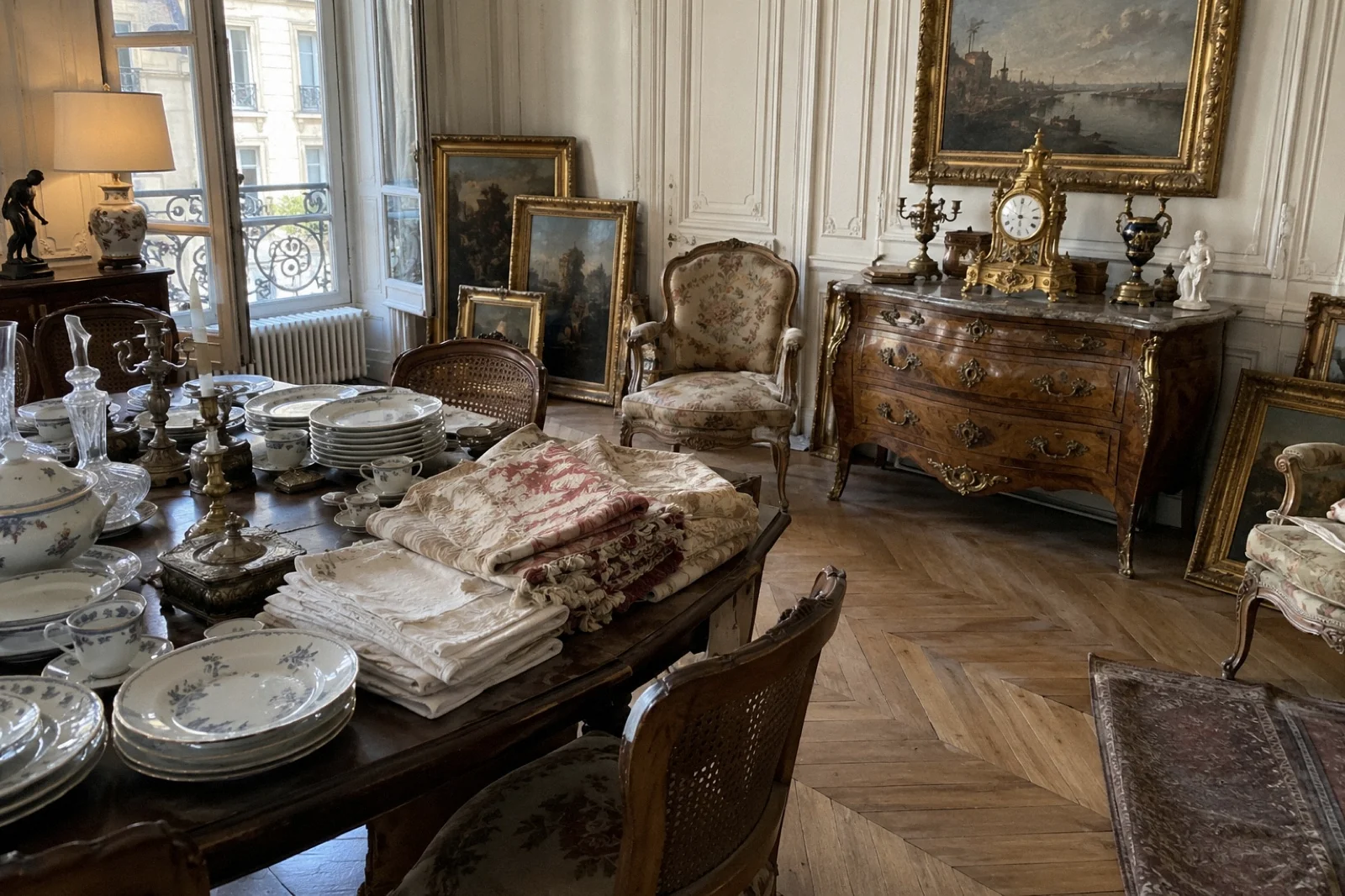
By Baptiste Murier, antique and second-hand dealer in Île-de-France.
Sharing out the furniture of a parent who has died is rarely about money. It is about memories, about space in each person's home, and sometimes about old family stories. The good news: most deadlocks come from three simple things. Nobody knows what the items are worth. No rule was agreed before starting. And nothing is written down. Here is a method that deals with all three.
If you are at the very beginning, first read our guide what to do with the furniture in an estate. It explains the first steps (photos, papers, notaire). Here, we start from the moment the family is ready to divide the items.
Who has the right to decide how the furniture is shared out?
Until the sharing out is done, the furniture belongs to all the heirs together. This is what French law calls indivision (joint ownership). In practical terms, no heir should take away or sell a piece of furniture on their own without the agreement of the others.
Article 815-3 of the French Civil Code sets the rules for decisions. Some management decisions can be made by a two thirds majority. But to sell property held in indivision, in principle everyone must agree, with a few exceptions. Nobody has to stay in indivision forever: article 815 of the same code allows each heir to ask for the property to be shared out.
In practice, within the same family, the furniture is often shared out by mutual agreement. The notaire (notary) handling the estate remains the right person to tell you whether an official deed is needed, and how the furniture fits into the overall sharing out. We are not lawyers: our advice is about the items, not the law.
Why start with a neutral valuation?
Because without a value, everyone forms their own idea. One heir thinks grandmother's chest of drawers is worth a fortune. Another believes everything is fit for the flea market. And both are suspicious.
A valuation by someone outside the family changes the discussion. It does not settle matters of feeling, but it lays a basis everyone can accept. Surprises are common:
- a large solid wood wardrobe may have a modest resale value today;
- a mantel clock, a set of silver cutlery or a box of jewellery can count for much more than expected;
- a painting with no visible signature sometimes deserves a second look;
- Asian objects, watches and coins are often underestimated by families.
We give a valuation of your antiques free of charge and without obligation, at home or from photos. When several heirs are involved, the simplest is for everyone to be present, or to receive the same list in writing. That way, nobody feels that something is being hidden from them.
A useful point: our valuation is for deciding among yourselves. It does not replace the official inventory made by a notaire or a commissaire de justice (court officer). For the French inheritance tax return, furniture follows separate tax rules, which we explain in our article on the 5 % furniture allowance.
How do you make balanced lots between heirs?
The French Civil Code sets a clear principle in article 826: equality in the sharing out is equality in value. So each heir does not need to receive the same number of items, but shares that are worth the same.
Here is an approach that works in many families:
- Start from the valued list, item by item, with the photos.
- Split the items into two groups: those with a real resale value, and those that matter mainly as keepsakes.
- For the first group, put together lots of similar value. Mix the categories: a piece of furniture, some silver, a painting.
- If an heir is set on an item that weighs more than their share, they can make up the difference. Either by giving up other items, or by paying a sum to the others. This is called a soulte (balancing payment).
- When the lots are ready, assign them. If nobody has a strong preference, drawing lots avoids any suspicion.
Keep in mind that a lot should be acceptable to whoever receives it last. If you would not want the weakest lot yourself, the lots are badly made.
What do you do when two heirs want the same piece?
This is the most common deadlock. A few options, from the simplest to the most formal:
- Talk about the reasons. Often, one wants the item to use, the other for a particular memory. A photo, another item from the same room or a promise to pass it on later can be enough.
- Compensate. Whoever takes the piece gives up something else of similar value, or pays a soulte.
- Draw lots. It is imperfect, but nobody can say the method was unfair to them.
- Sell and share the proceeds. When nobody gives way, a sale puts everyone on an equal footing. In principle it requires everyone's agreement.
If nothing works and the whole sharing out is blocked, the notaire can help bring the positions closer. As a last resort, a sharing out can be requested from a judge, but it takes a long time, and for a few pieces of furniture it is rarely worth it.
And keepsakes with no market value?
Photos, letters, an old coffee grinder, the breakfast cup: these are often the items that matter most, and are worth least on resale. Do not mix them with the lots of value.
For these items, choosing in turns works well. Draw lots for an order. Each heir picks one item, then it is the next person's turn, and you go round again until everyone has what they want. To keep it fair, reverse the order each round: whoever chose last chooses first in the next round.
A few practical tips:
- do this sorting with everyone present, or by video call for those who live far away;
- for photo albums, think about digitising them: everyone keeps a copy;
- family papers, decorations and very personal items can stay together with one heir who agrees to look after them.
What do you do with the furniture nobody wants?
Once everyone has taken what they want, there is almost always a lot left. Several options:
- Buying as a lot. A professional buys whatever has resale value. With us, payment is immediate, by bank transfer. The sum can then be shared between the heirs.
- Giving away. Whatever can still be used finds a second life with a charity or a ressourcerie (community reuse centre).
- A full clearance. To hand back or sell the home, it often has to be emptied completely.
Our house clearance service brings these steps together. The amount we pay for what we buy is deducted from the cost of the clearance, and the clearance can even be free when what we buy covers it. Useful items with no resale value go to Emmaüs, the Secours catholique, the Armée du Salut (Salvation Army) or a ressourcerie. The rest goes to the proper waste and recycling channels.
Remember to have things bought or sold before giving them away, and to give them away before throwing them out. Otherwise, valuable items may leave too quickly.
Why put the sharing out in writing, even within the family?
Because memory changes over time. A simple sheet is enough: the list of items, the name of who receives them, any compensation, the date and the signature of each heir. Attach the photos. Send a copy to the notaire, who will tell you whether this document is enough or whether it needs to be included in a deed.
This short document saves a lot of questions, years later.
To learn more about how we work with families, see the page on our support for estates in the Ile-de-France.
A free valuation for the whole family
Call us on 06 24 56 38 58 (from abroad: +33 6 24 56 38 58), or send photos of the furniture and items on WhatsApp to the same number. We will give you a first idea, then we can come to the property for a free valuation without obligation, in Paris and the Ile-de-France, with all the heirs present if you wish.