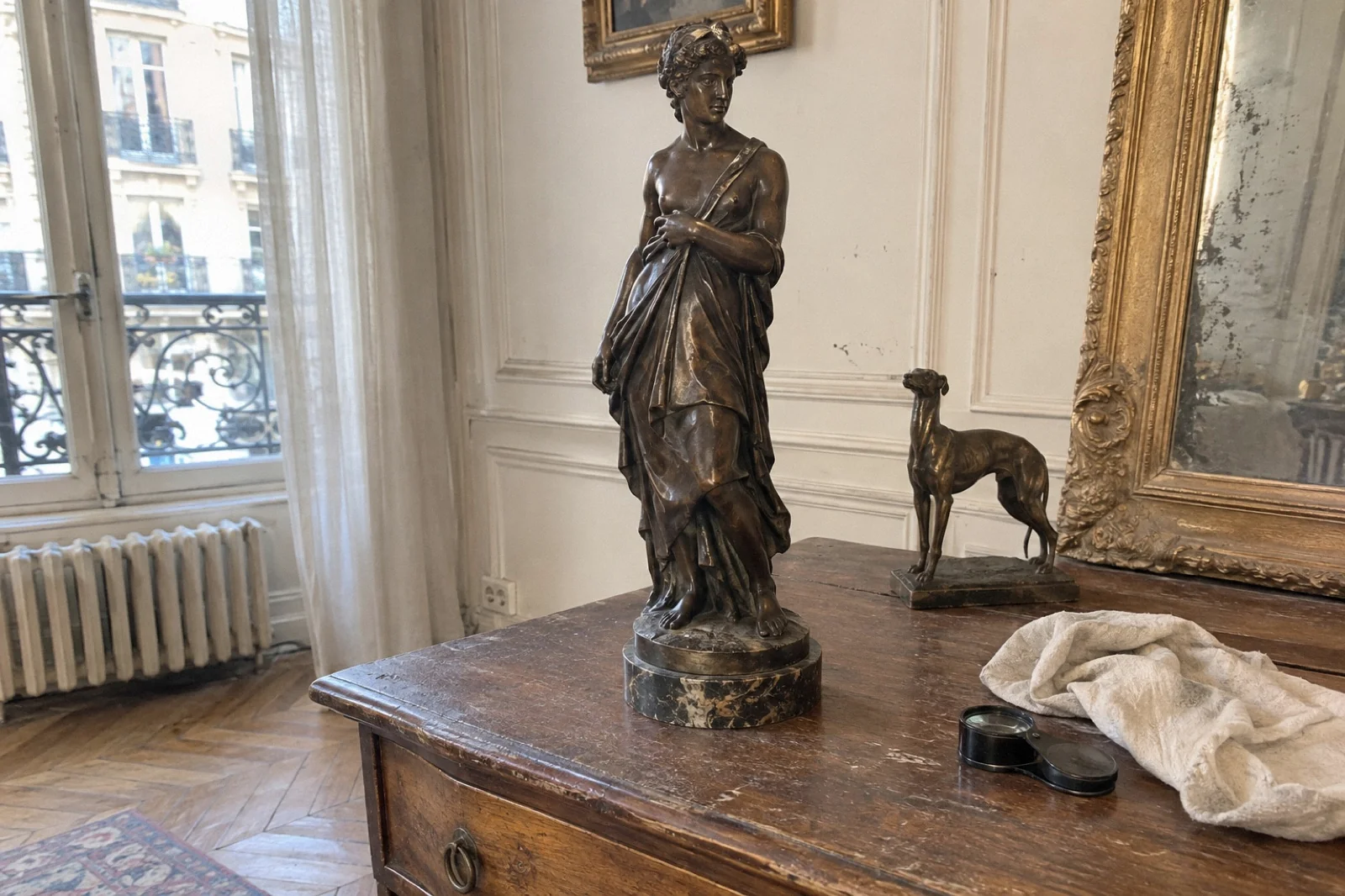
By Baptiste Murier, antique and second-hand dealer in Île-de-France.
The value of a bronze statue has nothing to do with its weight or its size. It depends mainly on four things: the name of the artist, the foundry that cast it, whether the casting is old or recent, and the condition of the surface. A legible signature and a known foundry mark are good signs, but neither is enough on its own. For a serious opinion, we need to see the piece, or at least good photos. Here is how to read your bronze before having it valued.
What gives a bronze statue its value?
Several elements work together. None of them decides alone:
- the artist: the sculptor who created the model, often identified by a signature;
- the foundry: the workshop that cast the bronze, sometimes recognizable by a mark;
- the date of the casting: a casting made during the artist's lifetime does not hold the same place as a much later edition;
- the quality: fineness of detail, chasing, evenness of the patina;
- the condition: knocks, repairs, missing parts, damaged patina;
- the subject and the demand: some themes and some artists are more sought after than others.
You also need to check that the statue really is bronze. A lighter object, painted to imitate bronze, is judged in a completely different way. We cover this point in our article bronze or spelter: how to tell the difference.
Where do you find the signature on a bronze statue?
Look first at the terrace, the small bronze plate the statue stands on. This is the most common place. The sculptor's name is often inscribed there, in recess or in relief, sometimes followed by a date or a number.
If you find nothing, try these places:
- the side or the back of the terrace;
- the underside of the object, if the base can be removed;
- the foot, the thigh or the lower back, for full-length figures;
- the marble or wooden plinth, which may carry a plaque or a label.
Take a flashlight and a magnifying glass. A signature can be worn, or hidden by patina or dust. Light it from the side: the relief shows up better.
Cast signature or engraved signature?
On many bronzes, the signature is cast: it is part of the model and appears in the casting. It has the same softened edges as the rest of the relief.
A signature engraved afterwards has sharper lines, sometimes bright, that stand out against the patina. This does not prove by itself that the signature is false, but it calls for caution. An opinion in person helps here, because the difference is easier to see by hand than in a photo.
What does the foundry mark mean?
An art bronze is rarely cast by the sculptor in person. It goes through a foundry, which works from a model and produces the copies. Many workshops mark their work with a stamp: a name, a monogram or a mention in relief in the casting.
You often find it:
- at the back of the terrace;
- on the side of the base;
- under the statue, in a spot that is hard to see.
The foundry matters because the quality of the casting and the chasing varies from one workshop to another. Some French houses are well known to collectors, such as Barbedienne, Susse or Valsuani, among others. A known mark is therefore a point in favor, but not a guarantee: late reproductions exist, and marks can be copied. Here again, the object has to be examined.
What if I don't recognize the mark?
Photograph it up close, with raking light, and note where it is. Do not rub it. A half-faded mark can remain legible to a professional who has already seen comparable castings.
What is an edition, a proof, a number?
A single model can be cast several times. Each copy is an edition piece or a proof. Depending on the case, you may find:
- a number, such as 3/8, which shows the rank of the copy in a limited series;
- a mention such as "artist's proof";
- a simple signature with no number at all, common on older edition bronzes.
The shorter a series is, and the more closely the artist or their heirs follow it, the more likely the copy is to interest collectors. In France, the term "original proof" is governed by regulations that limit the number of copies. If you want to know whether your piece qualifies, you need to look at the markings on the object and, if you have them, the papers that came with it.
The oldest edition bronzes do not always carry a number. A missing number is therefore not a flaw in itself.
How can you tell an old bronze from a recent one?
No single clue is enough, but several can point the way:
- the patina: on an old bronze it is generally deeper and more even, with lighter areas where the surface has been rubbed;
- the underside: the hollow interior, the way the piece was fixed, signs of repair;
- the chasing: on a fine piece the details are reworked by hand after casting, and the lines are sharper;
- the plinth: marble, wood or stone, with its own signs of wear;
- the screws and fixings: very regular, modern-made screws may point to a more recent mounting or a reassembly.
Be wary of patinas that are too uniform, which look as if they were applied with a brush, and of surfaces that are too smooth, which may have been polished. These are clues, not proof.
Does a modern bronze have any value?
It depends. A 20th-century bronze, signed by a recognized sculptor and cast in a good foundry, can sell very well. On the other hand, many statues "after" a famous model are decorative reproductions, made in quantity and sold as decorative objects.
A few questions to ask yourself:
- is the signature that of an artist whose work is known?
- is there a foundry mark and a number that are consistent?
- does the object look finished by hand, or repeated identically?
- do you have an invoice, a paper, any trace of provenance?
If you answer yes to several of these questions, a professional opinion is worth having. If not, the statue often keeps its value as a decorative object, which is already something.
Should you clean your statue before having it valued?
No. This is the most common mistake. The patina is part of the object and shows at first glance. Here is what to avoid:
- do not polish the bronze with a metal polish;
- do not use stripper, solvent or a hard brush;
- do not apply varnish or wax without advice;
- do not force a plinth that does not come off easily.
A soft, dry cloth and a soft brush for the dust: that is enough. Photograph the statue just as it is.
How do you get a bronze statue valued?
Take clear photos in daylight:
- the statue from the front, the back and the side;
- the terrace and the underside, in close-up;
- the signature and the foundry mark, up close;
- the flaws: knocks, missing parts, repairs;
- the plinth, if there is one, with its dimensions.
Also note the height and what you know of the origin: inheritance, purchase, gift. These details help place the object.
With these elements, we can give a first opinion. For a more important piece or a group of objects, we come to you: a valuation at your home is free and without obligation. If your statue goes with a clock, for example as part of a mantelpiece set, see also our page on antique clock and watch valuation. And if you wish to sell, we can buy your bronze with immediate payment.
What about an inheritance?
A bronze found in a family home is not always easy to place. Before deciding what to do with it, it is better to have it valued. Our article on what to do with the furniture and objects of an estate explains how to go about it without rushing. The rules it describes are French rules.
For a free valuation without obligation, call us on 06 24 56 38 58 (+33 6 24 56 38 58 from abroad) or send a few photos of your statue on WhatsApp, to the same number. Baptiste Murier, antique dealer and flea market trader, will answer you.