By Baptiste Murier, antique and second-hand dealer in Île-de-France.
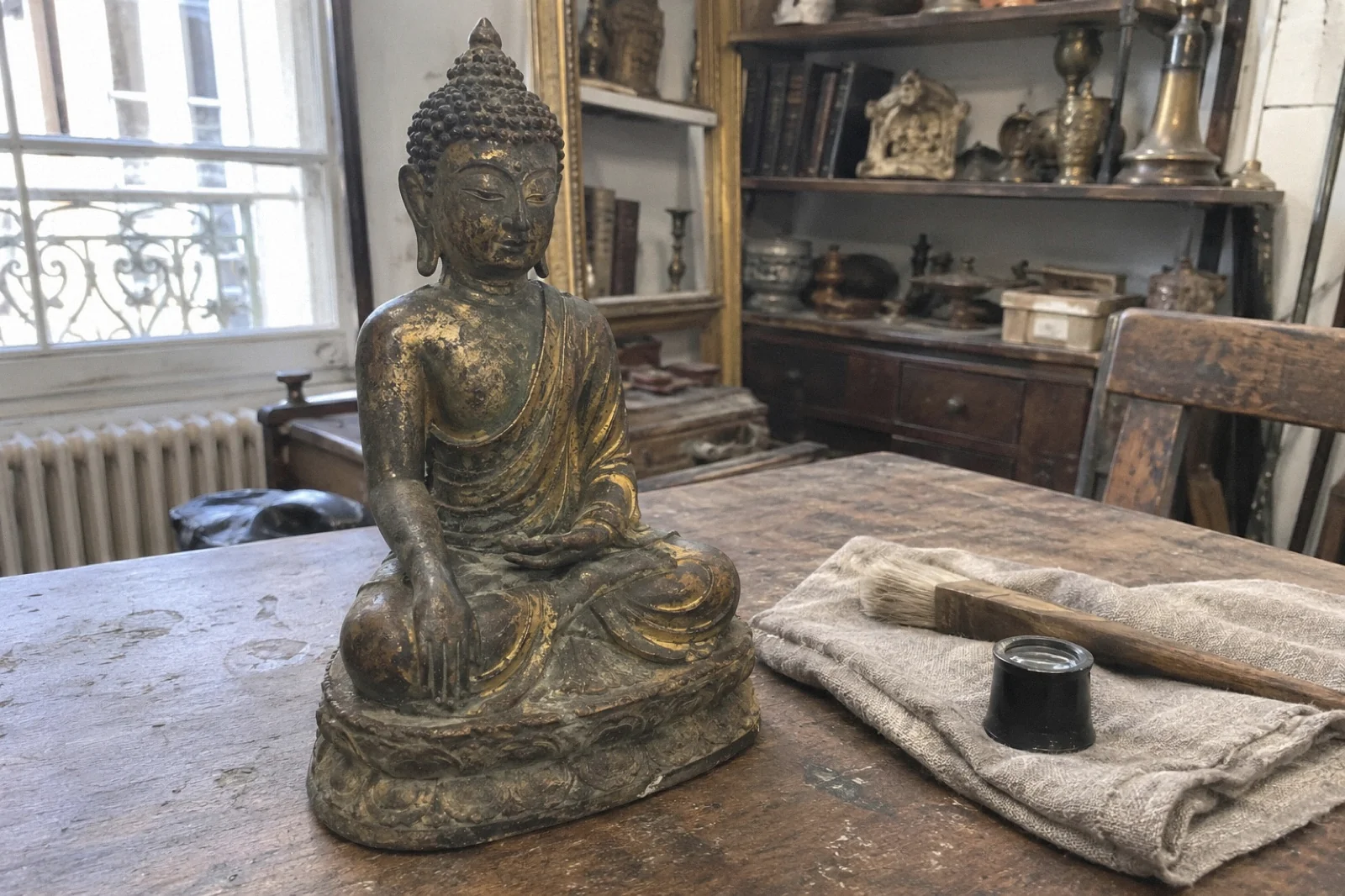
A bronze Buddha statue is antique if it was cast long ago and shows the marks of long use. Yet most of the ones found at flea markets or in family homes are recent decorative objects, made in series. To tell them apart, we look at the wear, the weight, the quality of the casting, the patina and above all the underside of the base. No single clue is enough on its own. A sharp photo often allows a first opinion.
Is a bronze Buddha statue always old?
No. Bronze is a copper alloy, used in Asia for religious images for a very long time. It is still cast today, in large numbers, both for worship and for decoration. A heavy, dark statue is therefore not necessarily old.
In practice, there are three cases:
- the antique piece, cast long ago, with signs of age and of devotional use;
- the good recent piece, well cast and well finished, but made today;
- the mass-produced decorative piece, often lighter, with soft details, sometimes artificially aged.
The last two are by far the most common. They can look very good in a home, but they do not hold the same place on the antiques market.
Where does your Buddha come from?
Images of the Buddha took different forms depending on the region. Recognizing the style helps place the statue.
- Southeast Asia (Thailand, Burma, Cambodia, Laos): often slender figures, a point or flame at the top of the head, sometimes gilding.
- Himalayas (Tibet, Nepal): a lotus-shaped base, pleated monastic robes, and often a sealed underside.
- China: loose drapery and rounded forms. The "laughing Buddha" usually represents Budai, a popular figure, and not the historical Buddha.
- Japan: varied styles, often more restrained.
These are general guidelines. Styles have been copied a lot, including recently, so style alone does not date a piece.
How can I tell if a bronze Buddha is old?
Pick the statue up and go through a few small checks.
Wear in the right places
A statue that was touched and censed for a long time wears where hands pass: the raised parts of the face, the hands, the knees, the edge of the base. The relief is softened, the patina smoother on contact points and darker in the recesses. Perfectly even wear, or sharp, fresh scratches, should raise doubts.
The weight
An old piece is often cast with a thick wall, so it feels heavy for its size. A statue that is surprisingly light is suspect (thin metal, or another material). But weight alone proves nothing, since recent copies can be heavy too. A magnet that sticks indicates iron, not bronze.
The casting and the details
Look at the face, the hands, the folds of the robe. Good casting leaves crisp features and a serene expression. Beware of soft details, crude welds, or parts hastily assembled at the neck or the base. Small irregularities of hand finishing are not a flaw.
The patina
An old patina forms slowly. It is uneven, mixed with dust and wax in the recesses. An artificial patina is often too uniform, may flake like paint or come off on your fingers. Do not rub it to check.
The underside of the base
This is often the best clue. On many Himalayan statues, the base is closed by a metal plate, fitted at the time of consecration. Check whether the plate is firmly in place, whether its patina matches the rest, and whether it shows recent tool marks. A plate that looks too new or fits badly, or a hollow base with no plate, should be noted. Never force it open.
What does a "consecrated" statue mean?
In some traditions, especially Himalayan ones, contents are placed inside the statue before the base is sealed. For a believer, it is then a religious image, not a simple decorative object.
If you inherit such a piece, do not open it, and tell us about it during the appraisal. Some families prefer to entrust it to a place of worship rather than sell it. That choice is yours.
Are recent Buddha statues worth anything?
Most are decorative: pleasant to look at, but made in series. Their resale value is usually modest. A few recent pieces are nevertheless well made, signed by a workshop or an artist, and may interest collectors. These are exceptions, and only an examination can settle it. We prefer to tell you this plainly rather than promise more.
What gives an antique statue its value?
Several factors come into play:
- origin and period, when they can be established;
- the quality of the casting and the finish;
- the type of figure and the gesture of the hands;
- condition: losses, breaks, restorations;
- original gilding and patina, preserved;
- the size of the statue;
- provenance: an old collection, a family, documents.
Brass, an alloy of copper and zinc, is often mistaken for bronze. Our guide to bronze and spelter gives pointers to avoid confusing them. A statue signed by a founder is covered better in our article on bronze statues.
Some countries regulate the export of their old cultural property. If you know where your statue comes from, keep any documents that came with it.
Should I clean my statue before having it appraised?
No. Avoid polishes, wire brushes and acids. They remove the patina and the gilding, which are both clues and part of the value. A gentle dusting with a soft brush is enough. Do not add wax or varnish.
Which photos should I send for a first opinion?
A few sharp photos in daylight are enough to start:
- the statue from the front, the side and the back;
- close-ups of the face and the hands;
- the underside of the base, with the plate if there is one;
- any inscription, mark or number;
- the flaws: knocks, losses, repairs;
- the height, measured with a tape measure, and the weight if you know it.
We explain the principle in free appraisal of antiques from photos. A photo does not always replace examining the object: if a doubt remains, we tell you.
How can I have a Buddha statue appraised or sell it?
We can come to your home: the home appraisal is free and without obligation, and so is the travel, in Paris and across Île-de-France. You can also send us photos. Our page on Asian art appraisal details what we look at.
If you wish to sell, we can buy the statue with immediate payment once we agree on a price. If it is decorative, we simply tell you so, and you remain free to keep it, give it away or entrust it to a place of worship.
Unsure about your bronze Buddha statue? Call us on 06 24 56 38 58 (+33 6 24 56 38 58 from abroad), or send us a few pictures on WhatsApp at the same number. The appraisal is free and without obligation.