By Baptiste Murier, antique and second-hand dealer in Île-de-France.
Yes, a free appraisal of antiques from simple photos is possible. You send a few pictures of the object by WhatsApp or email, we look at them and give you a first opinion, with no obligation and no charge. For that opinion to be useful, you need good photos: the whole object, the underside, the marks and the flaws. This page explains which photos to send, what they allow us to say, their limits, and what happens next if you want to sell.
How does a free appraisal from photos work?
The principle is simple, and you do not have to travel anywhere.
- You photograph the object with your phone.
- You send the photos on WhatsApp to +33 6 24 56 38 58 (06 24 56 38 58 from within France), or by email to murierantiquites@gmail.com.
- We look at the images and ask you questions if a detail is missing.
- We give you a first opinion: what kind of object it is, what matters for its value, and what we would do with it.
- You decide what happens next. Nothing obliges you to sell.
All of this is free and without obligation. If the object deserves an examination in the hand, we can also arrange a home appraisal.
Which photos should you send to appraise an antique?
The more complete the photos, the more precise the opinion. Here is what to prepare for each object:
- The whole object, from the front, on a plain background and well lit.
- The other sides: sides, back, top.
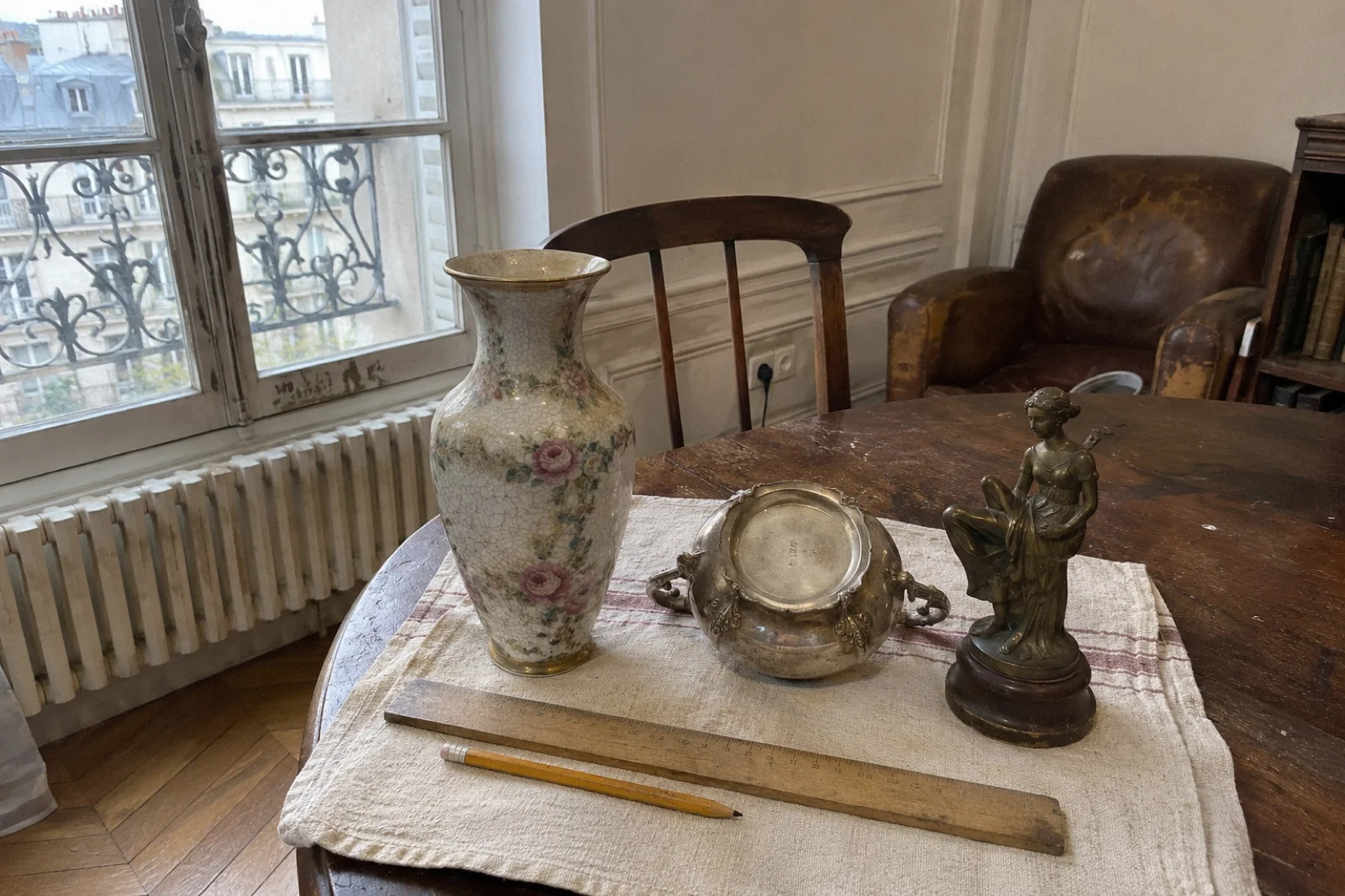
- The underside, often very telling: labels, maker's marks, numbers, hallmarks.
- Marks and signatures, in close-up and sharp.
- Flaws: chips, hairline cracks, scratches, repairs, missing parts, stains. It is better to show them than to hide them.
- A sense of size, by placing a ruler, a pen or a hand beside it.
- The inside, for a box, a drawer, a case or a watch case.
How do you photograph an antique well with a phone?
You do not need any equipment. A few simple habits are enough.
Light
Prefer daylight, near a window. Avoid the flash, which creates reflections on metal, glass and porcelain.
Background and framing
Place the object on a plain surface, a light-coloured sheet or a clear table. Frame the shot so that the object fills most of the image.
Sharpness
For a signature or a hallmark, move closer, wait until the image is sharp, then take the photo. A blurry photo tells us nothing. If your phone has a macro mode, use it.
Sets
For a dinner service, a set of cutlery or a collection, one overall photo is not enough. Add photos of the oldest or most marked pieces.
What information should you give with the photos?
A few lines of explanation help a great deal. If you know them, tell us:
- the approximate dimensions;
- where the object comes from: inheritance, purchase, gift, found in a cellar or an attic;
- what you know of its history;
- whether the object has been repaired, cleaned or restored;
- your town, so that we know whether a visit is possible.
If you know nothing, that is fine. Just say so: many objects come from families who no longer know their history.
What can be learned about an object from photos?
Sharp photos often make it possible to answer several questions:
- what the object is, and which family it belongs to (clocks and watches, silver, porcelain, painting, jewellery);
- whether it looks old or rather recent;
- whether the condition is good or whether flaws weigh on its value;
- whether it is of interest for a sale, or whether it is a common object, more decorative than sought after;
- what further details would be needed to go any further.
We also tell you frankly when an object has little market value. This happens often, and it is better to know before travelling.
Is an appraisal from photos reliable?
It gives a first, honest opinion, but not a certainty. A photo shows neither the weight, nor the exact material, nor the sound of a clock movement. It does not always show a discreet restoration.
For a common object or one of little value, this first opinion is often enough. For an important piece, we offer to come and see it, or to examine it at our stand. Examining it in the hand lets us confirm what the photos suggested.
An appraisal is not a guarantee of sale either: the value of an object depends on its condition, on current demand and on what the buyer will be able to do with it.
For which objects is a photo not enough?
Some objects need to be examined in the hand before any serious opinion.
- Gold and precious metals: weight and hallmarks are checked in the hand. For jewellery, see our page on buying antique jewellery.
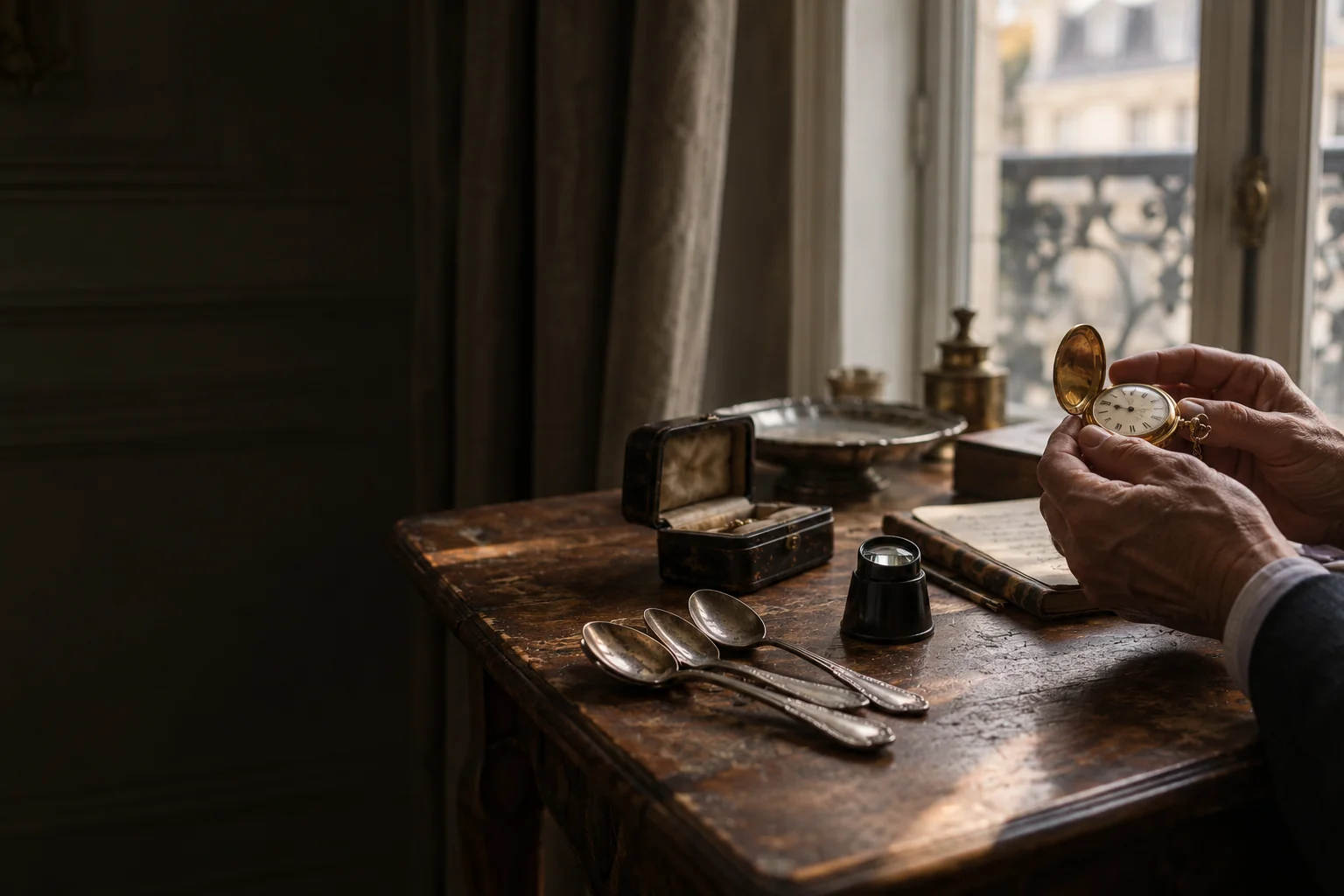
- Silver: a photo rarely shows whether cutlery is solid silver or silver plate. Hallmarks and weight help to decide.
- Coins and medals: condition and the details of the strike are judged up close.
- Paintings: the signature, the support and the condition of the canvas or paper are easier to see in person.
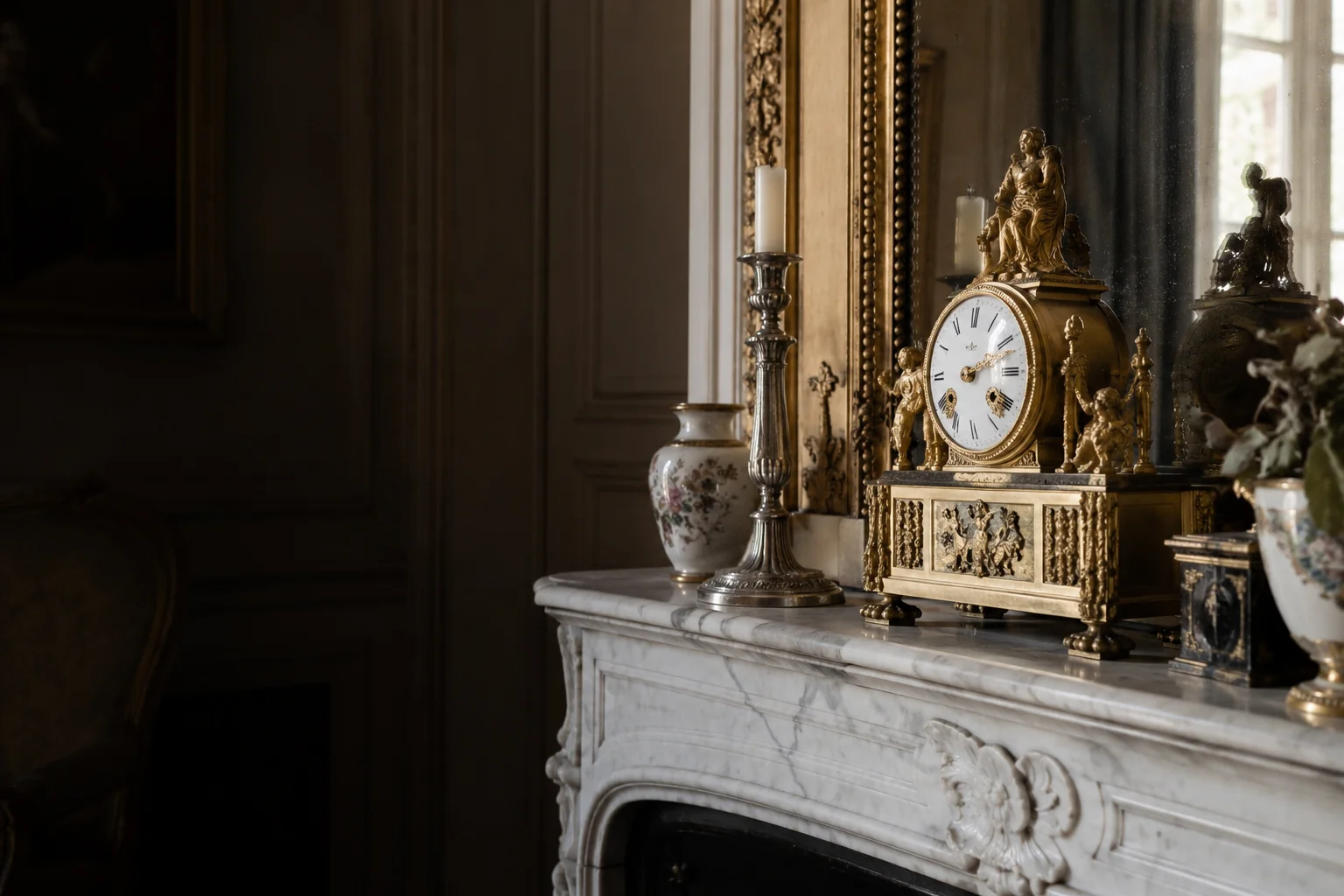
- Watches and clocks: knowing whether the movement works and whether it is original requires examining it. We detail the points to look at in how to appraise an antique clock.
- Furniture: the joinery, the inside of the drawers and the underside tell the age of a piece.
In all these cases, photos serve as a first sort. They tell us whether it is worth going further.
Is the appraisal from photos really free?
Yes. We ask nothing to look at your photos and give you an opinion, and you have no obligation afterwards. Our travel is also free in Paris and Île-de-France when we come to see an object or a group of items at your home.
What we ask in return is simple: honest photos, and the chance to ask you a few questions.
What happens if you want to sell?
If the object interests us, we can buy it. After examination, we offer you an amount, and payment is immediate. It is made by bank transfer, which is mandatory for gold and precious metals. The terms are detailed on the page buying antiques and old objects.
If you prefer to sell elsewhere, that is your right: the appraisal remains useful for knowing what you have.
Can you also show us the object in person?
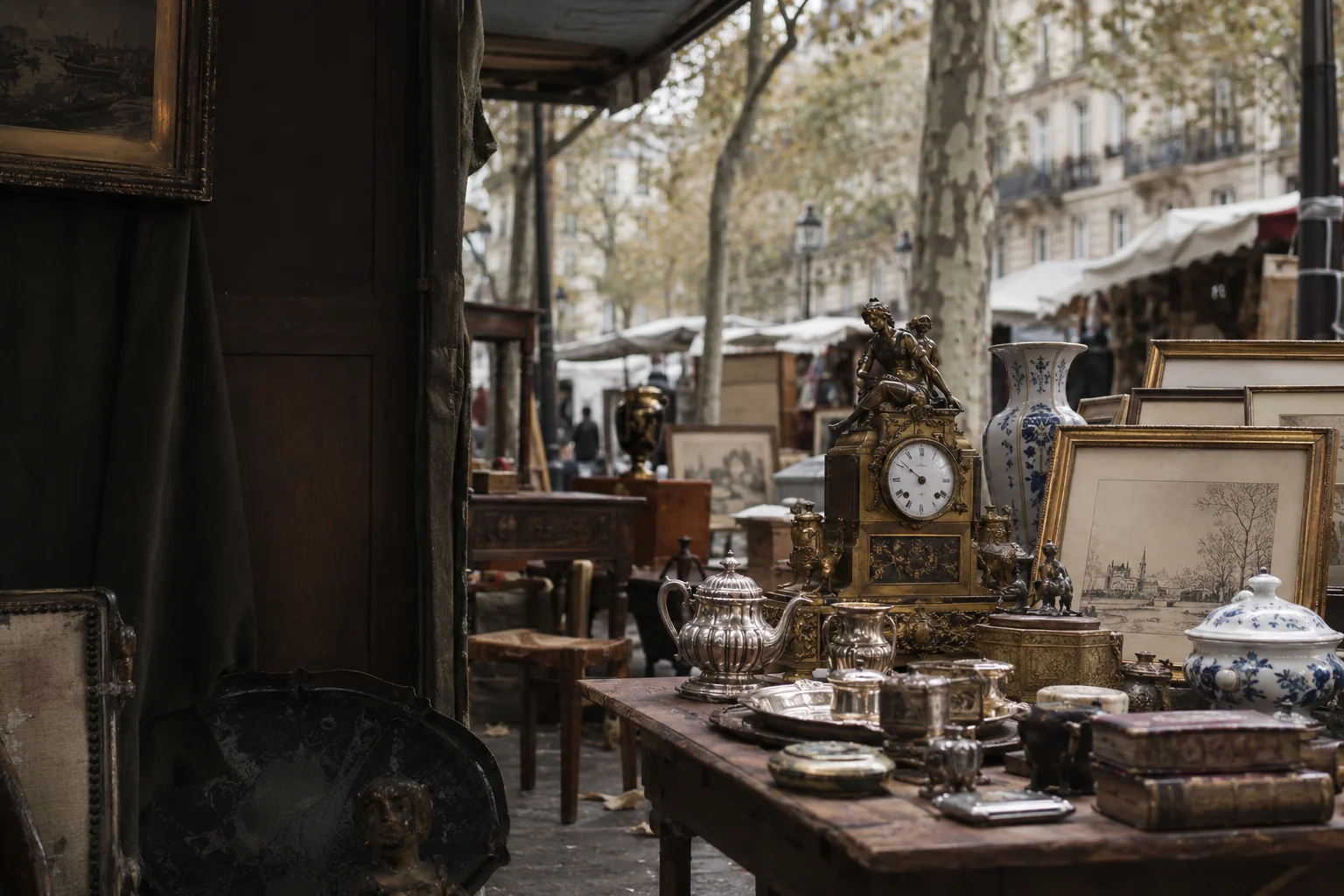
Yes. At weekends, we run a stand at the Puces de la porte de Vanves flea market, in Paris 14th arrondissement, on avenue Marc Sangnier and avenue Georges Lafenestre. You can come with the object, or with a photo on your phone. We are also present at brocantes (flea markets) in Île-de-France.
For a piece of furniture, a collection or a whole estate, the simplest is for us to visit you at home. You can write to us first: the contact page gives all the ways to reach us.
Which mistakes should you avoid before sending photos?
- Cleaning the object. Polishing can wipe away the patina, and fragile gilding can disappear. Do not rub it and do not wash it.
- Repairing or gluing. Show the object as it is.
- Hiding a flaw. It will show up at examination, so you might as well mention it from the start.
- Sending a single photo. It almost never suffices.
- Throwing away the papers. An invoice, a label, a letter: an old document sometimes goes with the object and helps trace its history.
Have an object waiting to be appraised? The simplest is to write to us on WhatsApp at 06 24 56 38 58 with your photos, or to call us on that same number. The opinion is free and commits you to nothing.