By Baptiste Murier, antique and second-hand dealer in Île-de-France.
To value an antique French clock, we look at these points in order: its period (not just its style), the material and quality of the bronze, the movement, the signature, the state of the dial, the original parts and any restoration. Two clocks that look alike from a distance can have very different values. Here is how we examine them, and what you can check yourself before asking for an opinion.
Period or style: what difference does it make to value?
This is the first point, and the most misunderstood. A clock "of the Louis XVI period" was made during the reign of Louis XVI. A clock "in the Louis XVI style" uses that decoration, but was made later, very often in the 19th century.
Both can be of fine quality. But a period piece in good condition is generally more sought after than a later version of the same model.
The main periods to recognise
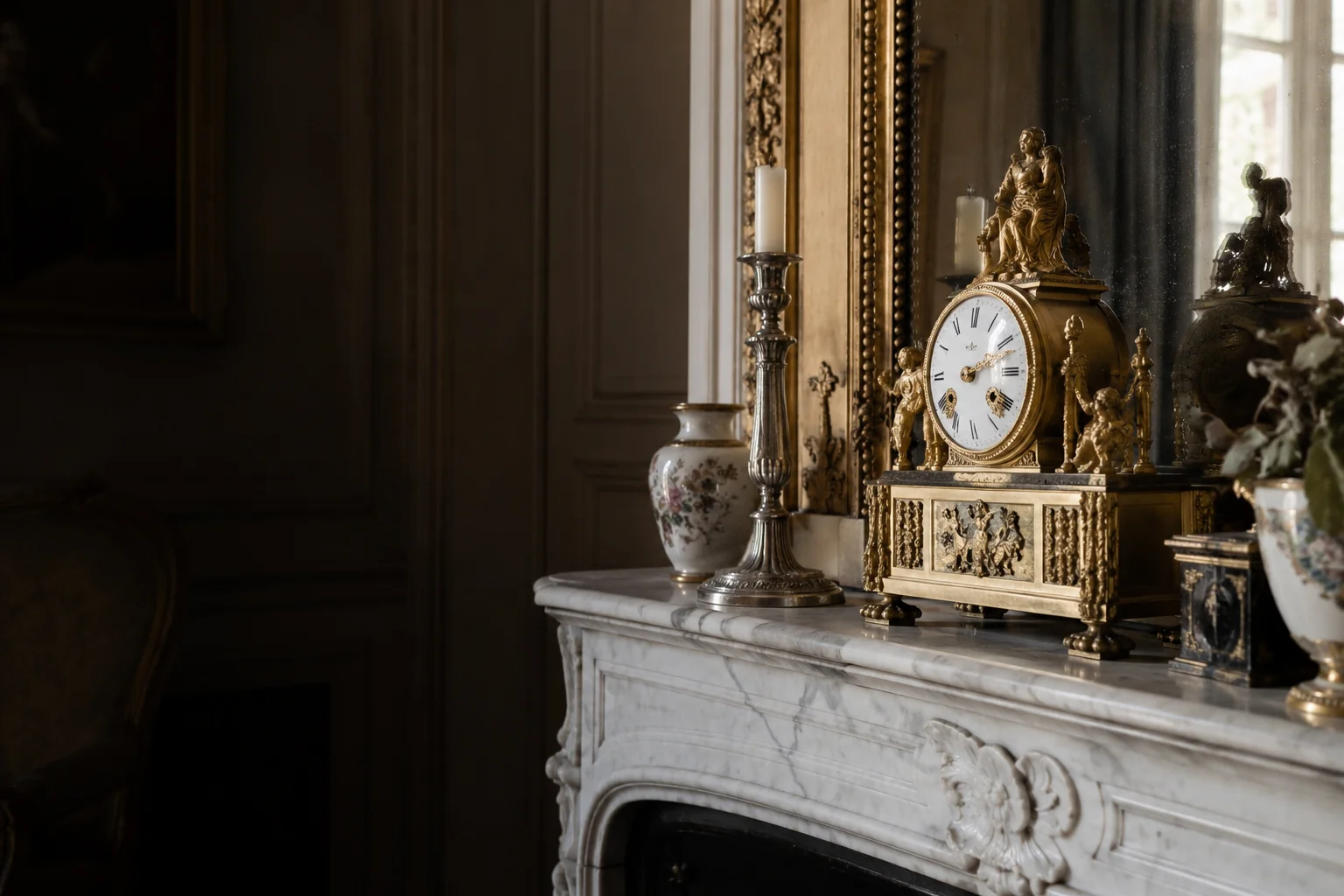
- Louis XVI (1774 to 1792): straight lines, classical decoration, garlands, borne (block), lyre or portico clocks, often in gilt bronze and white marble.
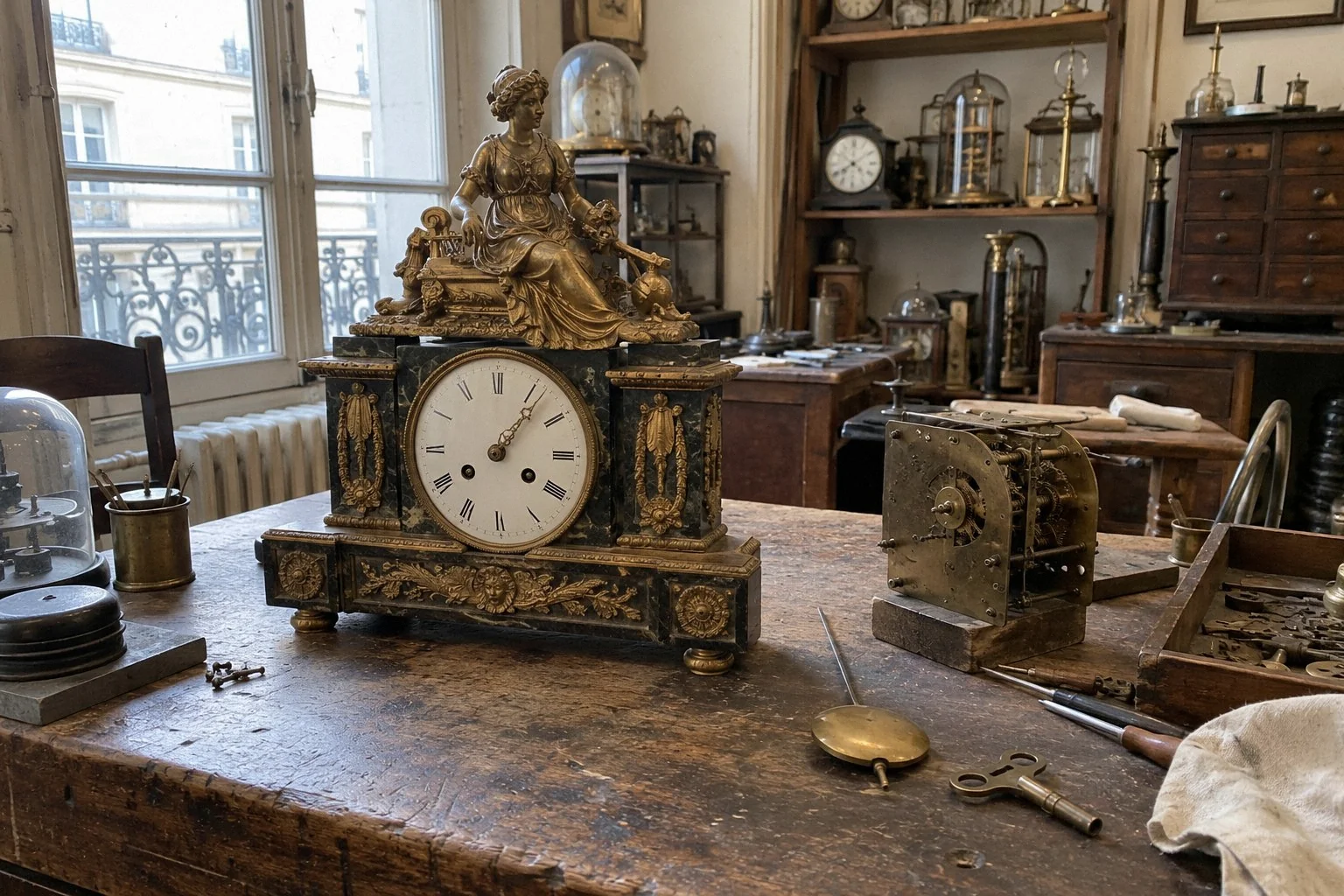
- Empire (1804 to 1815): figural clocks, with mythological or allegorical figures in gilt bronze, crisp chasing and a rectangular base.
- Restoration (1815 to 1830): gilt bronze is still used, and the subjects become more sentimental. You also see portico clocks in marble or wood, often shown under a glass dome.
- Napoleon III (1852 to 1870): all the old styles come back, from Louis XV to Louis XVI. Black marble, red marble and patinated zinc become common, with larger production.
Gilt bronze, spelter, marble: how do you recognise the material?
Bronze or spelter?
Many 19th century clocks have figures in patinated zinc, usually called spelter (régule in French). This is not a flaw in itself, but it weighs on the value.
A few simple clues:
- The metal under the patina: on a chip or under the base, spelter is light grey and bronze is yellow.
- The weight: for the same size, bronze is heavier.
- The details: on good quality bronze, the hair, folds and leaves are finished by hand with a chasing tool. On spelter, everything comes from the mould and looks softer.
The quality of the gilding
Until the middle of the 19th century, bronze was usually fire gilded (mercury gilding). This gilding has a warm, deep colour, often with a play between matt and burnished areas. From the 1840s, electroplated gilding spread: it is thinner and wears faster.
Look at the raised parts. Original gilding that is a little worn on the high points is normal. Gilding that has been redone, or worse, gold paint, changes the assessment a lot.
The marble
White, black or red marble: check for chips at the corners, cracks and repairs where pieces were glued back. A rebuilt base or a replaced slab often shows as a colour that does not match the rest.
What movement does your clock have?
The movement is the engine of the clock. To see it, open the back door or the bezel, without taking anything apart.
Silk suspension or Brocot suspension
The pendulum (the weight that swings) hangs from a suspension. On clocks from the late 18th century and the first half of the 19th, it is often a silk thread.
From the middle of the 19th century, the Brocot suspension spread, named after the clockmaker Achille Brocot. It uses a small spring blade, and you adjust whether the clock runs fast or slow with a small square placed above the XII on the dial.
A clock described as Empire with a Brocot suspension is not necessarily fake: many movements were modified in the 19th century. But it is a clue worth checking.
Original or replaced movement?
A replaced movement, unnecessary holes in the case or screws that do not match lower the value. A quartz movement fitted in place of the original mechanism makes it drop sharply.
Where do you find the signature on a clock?
Look in three places:
- The enamel dial, often with a name and a town, for example "à Paris".
- The back plate of the movement, with an engraving, a stamp, sometimes a number or exhibition medals.
- The bronze itself, where a founder or sculptor sometimes signed the base.
Be careful: the name on the dial is often that of the clockmaker who sold the clock, not always the one who made the movement. A signature that fits the period and the quality is a real plus. A signature alone is not enough.
The enamel dial: what faults should you look for?
The white enamel dial is fragile. Look for:
- hairlines, those fine cracks on the surface;
- chips around the winding holes;
- retouched paint on the numerals;
- the hands, which should match the style of the clock.
An original dial in good condition counts for a lot. A repainted or replaced dial often shows itself through lettering that is too crisp.
Is your clock complete?
Before any valuation, gather:
- the pendulum;
- the winding key;
- the glass dome and its stand, for clocks made to sit under a dome;
- the small parts: bezel, glass, bell (the bell of the striking mechanism).
The dome is fragile and is often missing. If you have it, keep it with the clock.
Clock garniture: should you keep the set together?
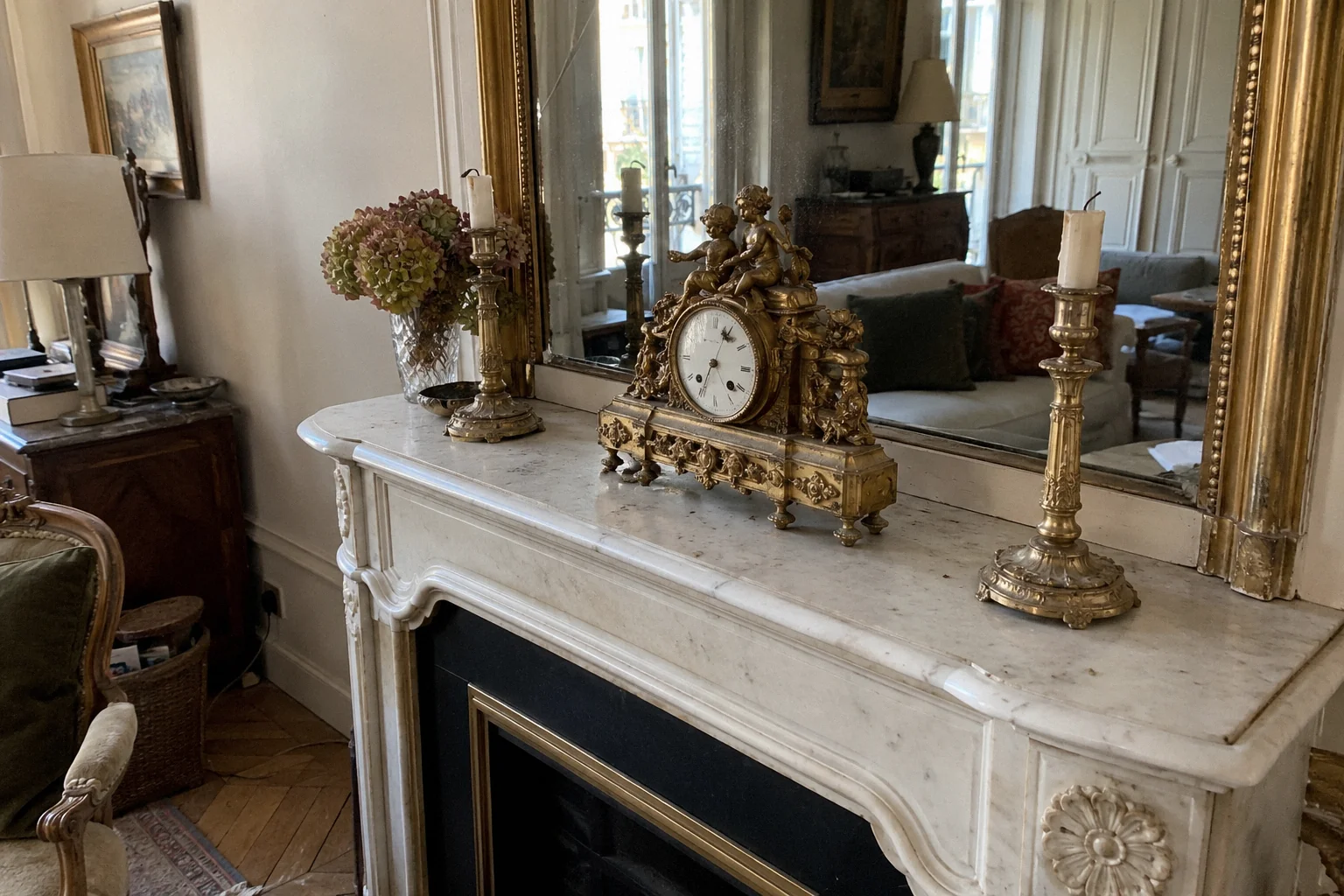
A clock garniture (garniture de cheminée) is the clock and its companions for the mantelpiece: a pair of candelabra, vases or cups, made in the same materials with the same decoration. A complete garniture generally sells better than its pieces sold separately. Do not split them up before the valuation, even if one candelabrum is damaged.
Condition and restoration: what lowers the value
A service of the movement by a clockmaker is normal and rather a good thing. On the other hand, these weigh on the value:
- gilding rubbed with an abrasive product or painted over;
- marble that was broken and badly glued;
- a movement that is modified, incomplete or replaced;
- added parts that are not from the same model.
Our advice: do not clean gilt bronze with a household product, do not take the movement apart, and do not fully wind a clock that has stood still for years.
How do you get your antique clock valued?
A few photos are enough for a first opinion:
- the whole clock, from the front;
- the dial close up, with the signature;
- the back open, to see the movement and the suspension;
- the underside of the base;
- the pendulum and the garniture pieces, if there are any.
Clocks are one of our specialities, and we go into more detail on our page about antique clock valuation. The valuation is free and without obligation, from photos or at your home. If you decide to sell, we can buy the clock with immediate payment. Is it part of an estate with other furniture? Read also what to do with furniture from an estate.
You have a clock to be valued? Send a few photos on WhatsApp to 06 24 56 38 58 (from abroad: +33 6 24 56 38 58), or call us on the same number. We travel free of charge in Paris and the Ile-de-France.