By Baptiste Murier, antique and second-hand dealer in Île-de-France.
To appraise a Napoleon III clock, four points matter: the quality of the decoration (gilt bronze, marble, onyx, enamels), the movement and its marks, the overall condition, and how consistent the whole piece is. Many Second Empire clocks were made in large numbers, and two pieces that look alike can be very different up close. A clear photo of the dial, the back and the underside is enough for a first opinion. Here we explain what to look at before showing it to a professional.
What is a Napoleon III clock?
The Napoleon III style belongs to the Second Empire in France, from 1852 to 1870. The period liked to revive the styles of the past: Louis XIV, Louis XV, Louis XVI, Renaissance. Clocks followed that taste. Makers, mostly in Paris, produced for a middle-class clientele who wanted a handsome object on the living room mantelpiece.
Which shapes are the most common?
- The pillar clock (pendule borne), compact, in marble or bronze, with an enamel dial.
- The portico clock, with columns framing the movement, which is sometimes visible.
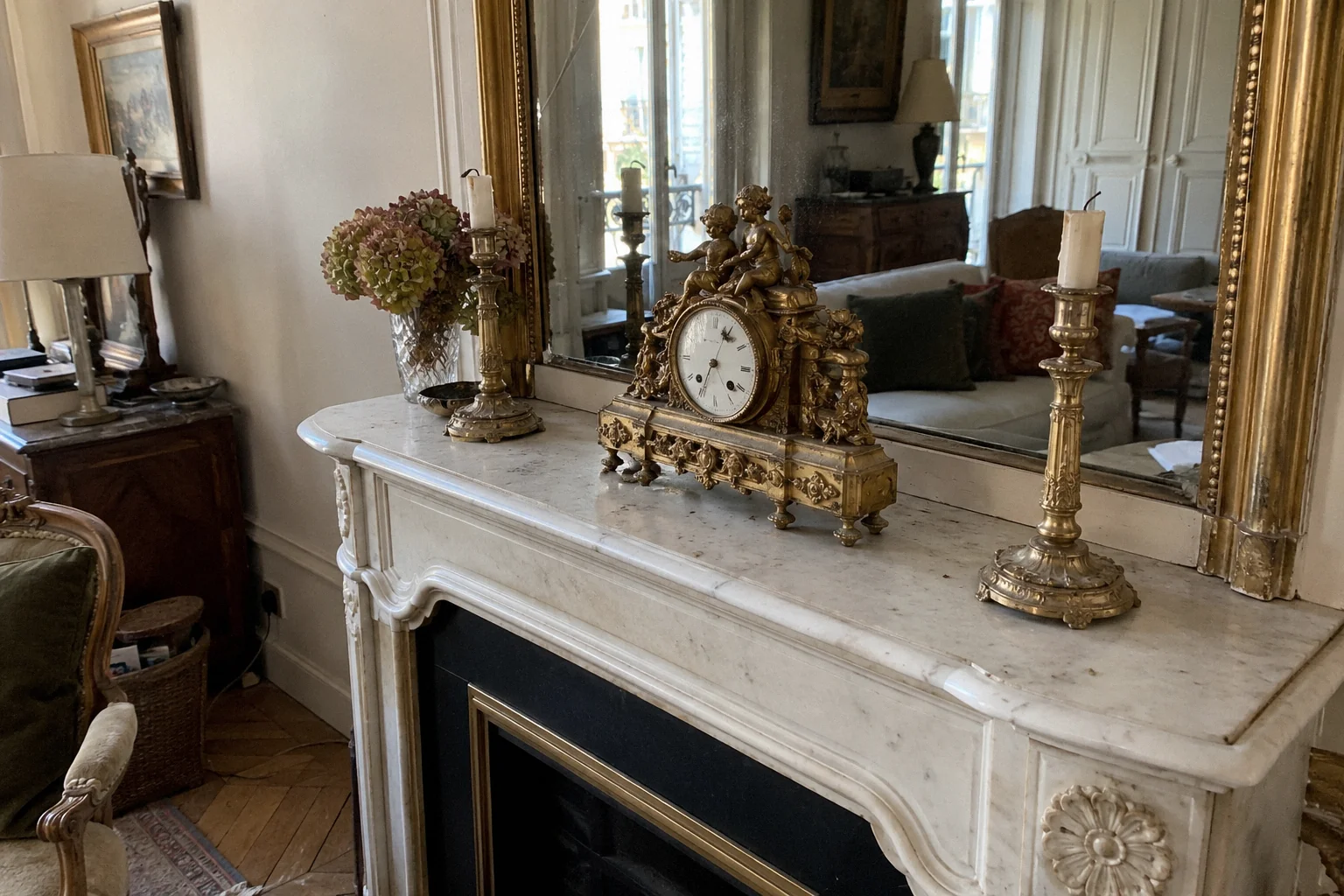
- The gilt bronze clock, with scrollwork, foliage or cherubs, in the Louis XV style.
- The black marble or onyx clock, more restrained, often set off with bronze.
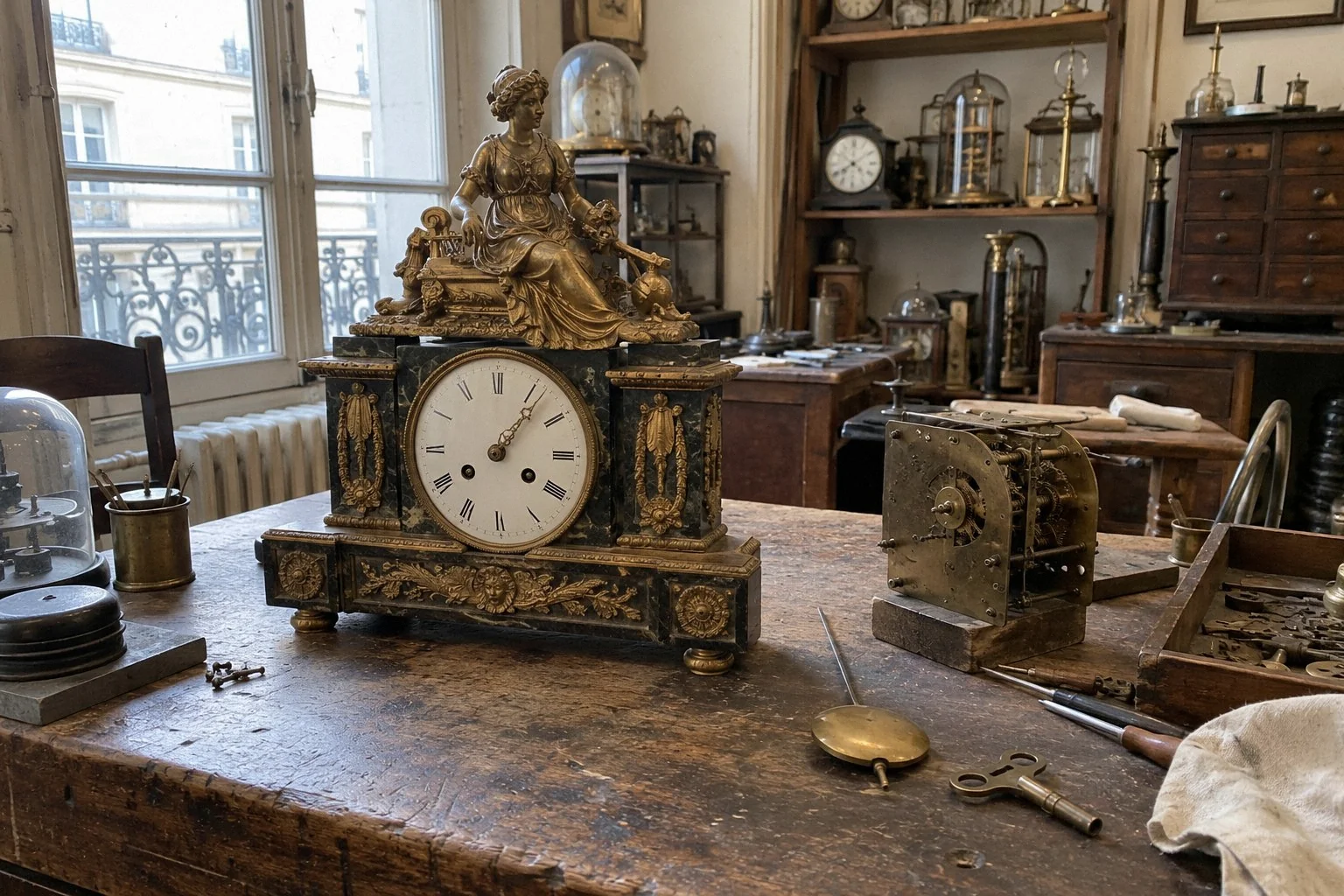
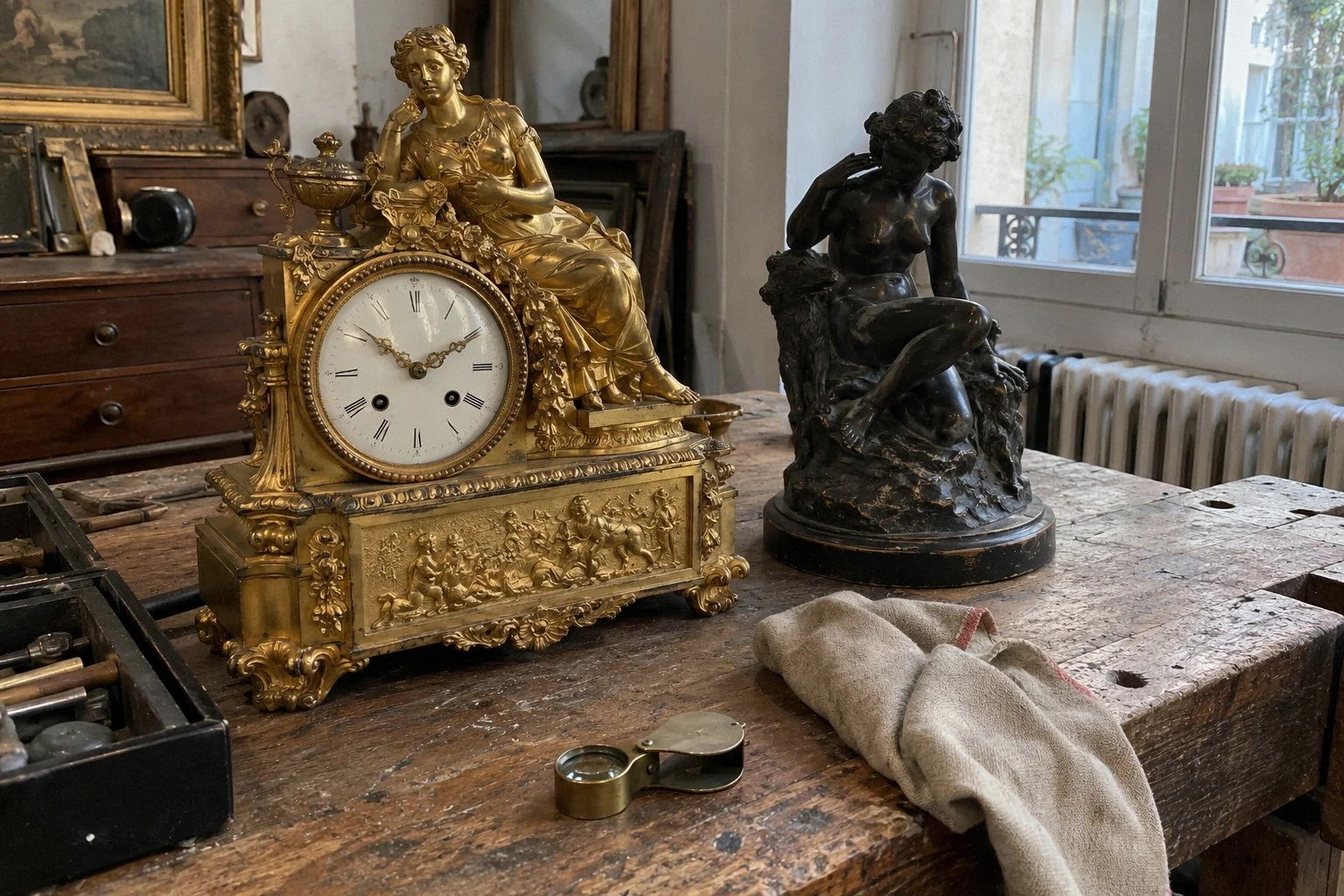
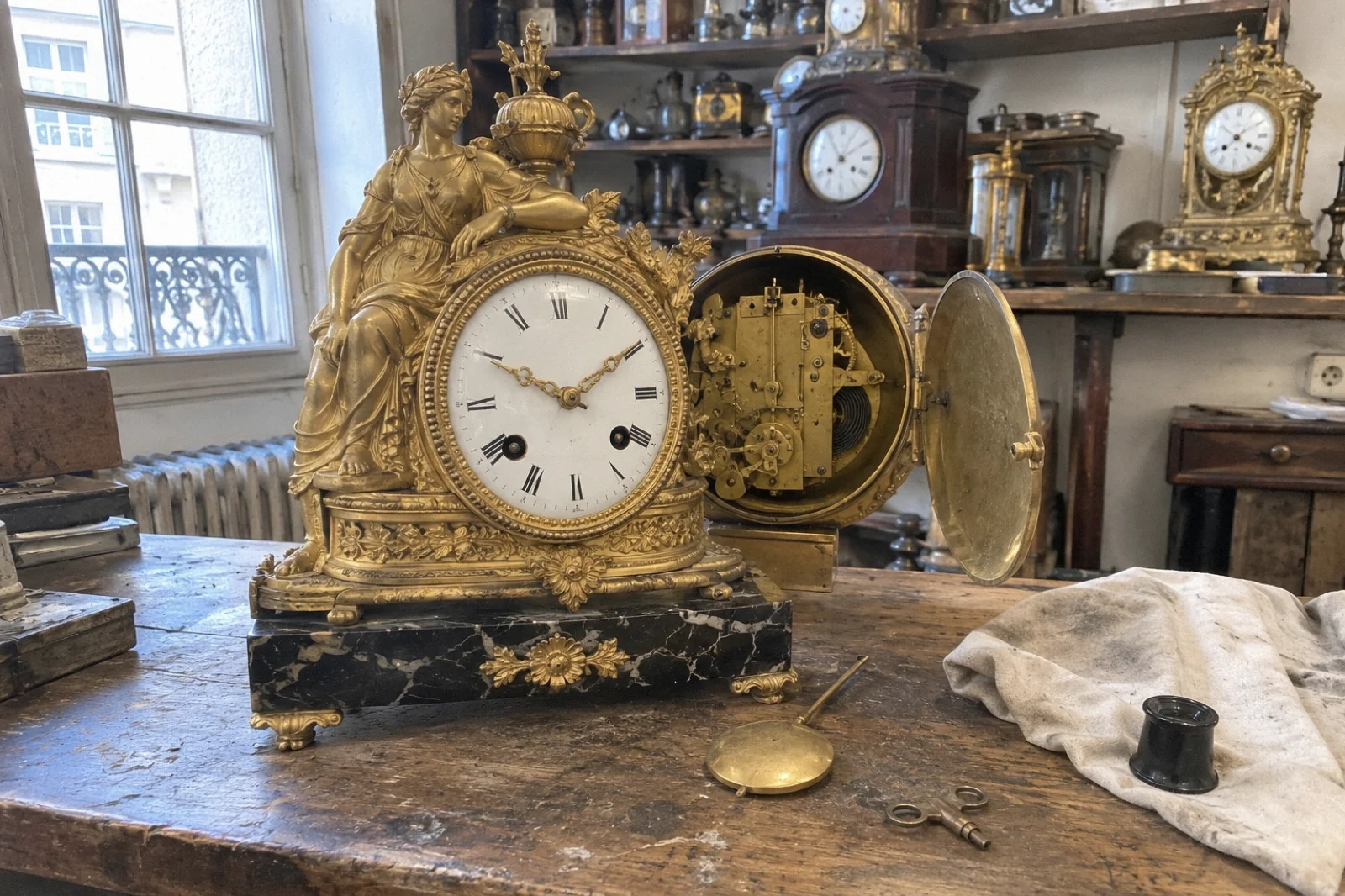
- The figural clock, with a bronze or spelter figure: an allegory, a mythological scene, a musician.
- The blackened wood clock, with brass or mother-of-pearl inlays.
Some clocks were sold with two candelabra or two vases, to form a mantelpiece set. If you have kept all three pieces together, tell us: the set is more complete.
How do you recognise a Napoleon III clock?
No single clue is enough. We cross-check several elements:
- The decoration: it is generous, sometimes heavy, and copies older styles.
- The materials: gilt bronze, marble, onyx, blackened wood, sometimes porcelain or enamels.
- The dial: in white enamel, with Roman numerals, or made of enamel cartouches for each hour.
- The hands: slender, pierced, often in gilt brass or blued steel.
- The movement: round, with a plate that carries marks (see below).
A Louis XV style clock does not necessarily date from the 18th century. In the 19th century, a great many were made in that style. It is one of the questions we are asked most often, and we talk about it more widely in our guide to appraising an antique clock.
What should you look at on a clock movement?
The movement is the heart of the clock. To see it, you often have to open the back door or lift the clock off its base. Do it carefully, on a table covered with a cloth.
The marks on the plate
On the back plate, you often find:
- the name of the movement maker or of the clockmaker;
- the mention of Paris;
- a serial number;
- sometimes engraved medals, recalling awards received at exhibitions.
Houses such as Japy Frères supplied movements to many clock makers. A well-known name is a good clue, but it does not tell the whole story: the quality of the case and of the chasing counts just as much.
The type of movement
Many clocks from this period have a "Paris" type movement: round, striking the hours and half hours on a bell. The dial sometimes carries a signature, which may be that of a retailer rather than the maker. There is nothing unusual about that.
An original movement?
Check that the movement seems to have always belonged to the clock. Unused fixing holes, recent screws or a dial that does not sit well in the centre raise doubts. A replaced movement does not rule out a sale, but it changes the assessment.
Gilt bronze, spelter or zamac: how can you tell them apart?
This is often where the appraisal is decided. A finely chased and gilded bronze does not rank the same as a spelter figure, a softer alloy that is sometimes patinated or gilded to imitate bronze.
A few pointers:
- bronze is heavy, and its chasing is precise, even in hidden details;
- spelter is lighter and its details are softer;
- a scratch that shows a grey metal underneath deserves attention;
- old gilding is fragile: do not rub it.
We go into these differences in our article on the difference between bronze and spelter.
What makes the value of a Napoleon III clock vary?
Here are the elements we look at:
- the quality of the chasing and of the gilding;
- the materials: bronze, marble, onyx, enamels;
- the signature of the maker, the bronze founder or the clockmaker, when there is one;
- the condition of the dial: a cracked or restored enamel weighs in the assessment;
- the condition of the gilding: worn, rubbed or redone;
- the movement: original, complete, working or not;
- the rarity of the model: an original shape stands out from a very common model;
- the accessories: key, pendulum, glass dome, matching set.
A fine clock is not necessarily the largest or the most ornate. A well-proportioned model with delicate chasing often attracts more interest than a massive piece with heavy decoration.
Can a clock without its key or pendulum be sold?
Yes. The key and the pendulum are parts that can be found again or replaced, and their absence lowers the value a little without preventing a sale. Likewise, a clock that no longer runs can be sold: its movement may need servicing, which is possible.
What weighs more are major losses: torn-off bronze, a broken dial, incomplete decoration. State clearly what is missing during the appraisal, it avoids surprises.
Should you clean or repair it before selling?
The best thing is to do nothing. A few tips:
- never force the winding if the key resists;
- do not oil the movement yourself;
- do not rub the gilt bronze with a household or abrasive product;
- simply dust it with a soft brush;
- do not have the marble or the wood repainted or revarnished.
Clumsy cleaning can wipe out an old patina or gilding, and there is no going back.
How do you prepare the appraisal of your clock?
Gather these elements:
- photos from the front, back, side and underside;
- a close-up photo of the dial;
- a photo of the movement and of the inscriptions on the plate;
- the approximate dimensions;
- what you know of its history: inheritance, purchase, where it was kept.
Also note what is missing or broken. The more honest the description, the fairer the opinion.
Where can you have a Napoleon III clock appraised?
We appraise clocks, wall clocks (cartels) and watches at your home or from photos, free of charge and with no obligation. Our page on antique clock appraisal explains how it works. If you have several objects to show us, the home appraisal lets us look at everything at the same time, and we travel free of charge in Paris and Île-de-France.
If you wish to sell, we can buy your clock with immediate payment. And if the clock comes from a family house, our page on estates and inheritances in Île-de-France tells you how we proceed.
For a free appraisal, call us on 06 24 56 38 58 (+33 6 24 56 38 58 from abroad) or send a few photos of your clock on WhatsApp to the same number. We will reply with a first opinion, with no obligation.