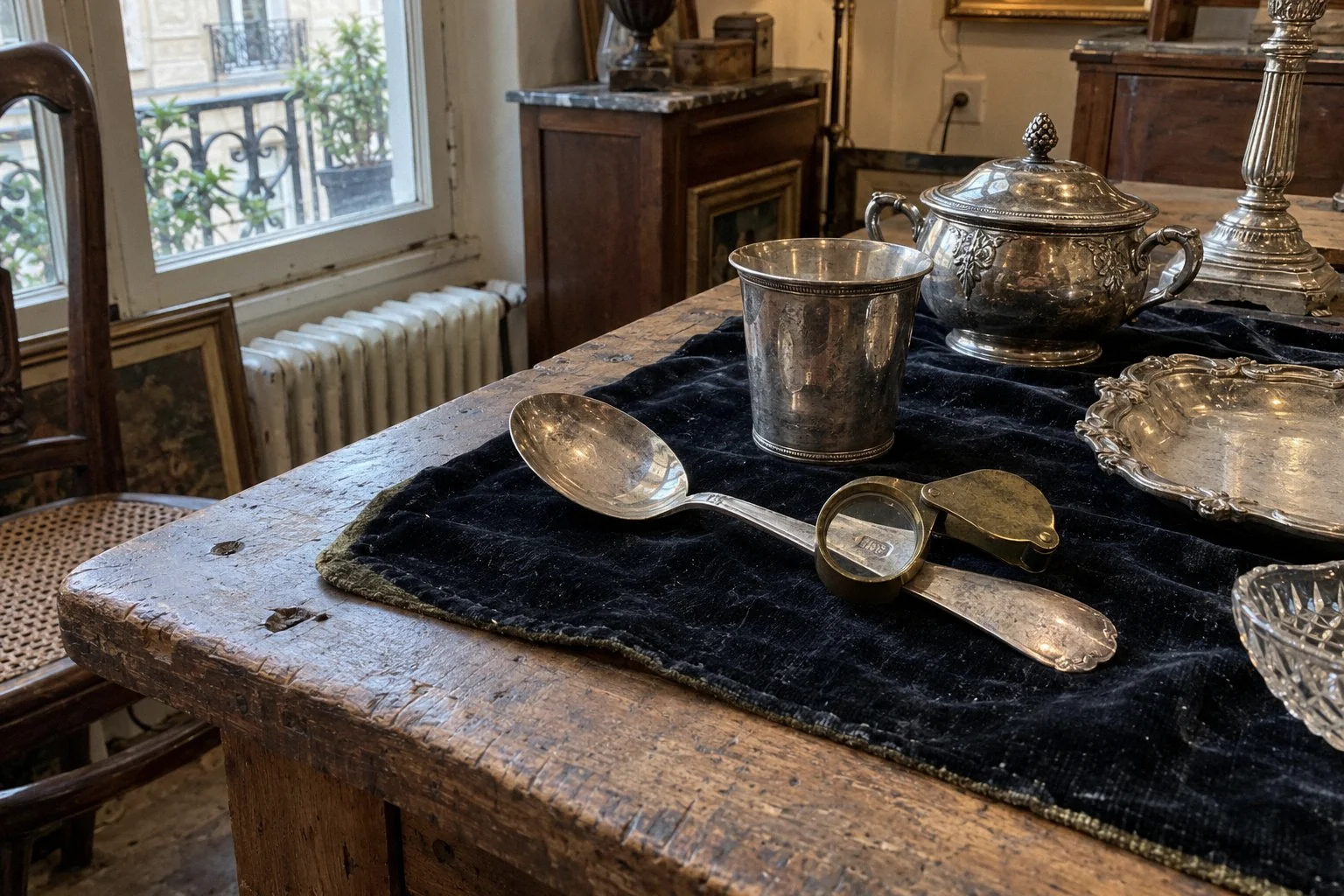
By Baptiste Murier, antique and second-hand dealer in Île-de-France.
The Minerva hallmark is the official mark for solid silver in France. It is struck by the French State, not by the maker. When you find it on a spoon, a dish or a beaker, you know the piece contains at least 800 thousandths of pure silver. It is the first thing Baptiste Murier, antique and second-hand dealer, looks at when someone shows him silverware.
This guide explains where the hallmark comes from, how to read it in detail, and how to avoid confusing it with the marks on silver plate. For an overview of all the hallmarks, you can also read our guide to recognising solid silver from its hallmarks.
Where does the Minerva hallmark come from?
The first guarantee marks of this period were the cockerel, then the old man's head. The Minerva head hallmark appeared in 1838 and replaced them. It shows the Roman goddess of wisdom and the arts, in profile, wearing her helmet. It was slightly redrawn in 1973, but it is still in use today. This means that a piece with a Minerva can date from any time between 1838 and now: the hallmark tells you the metal, not the year.
How do you read the Minerva hallmark in detail?
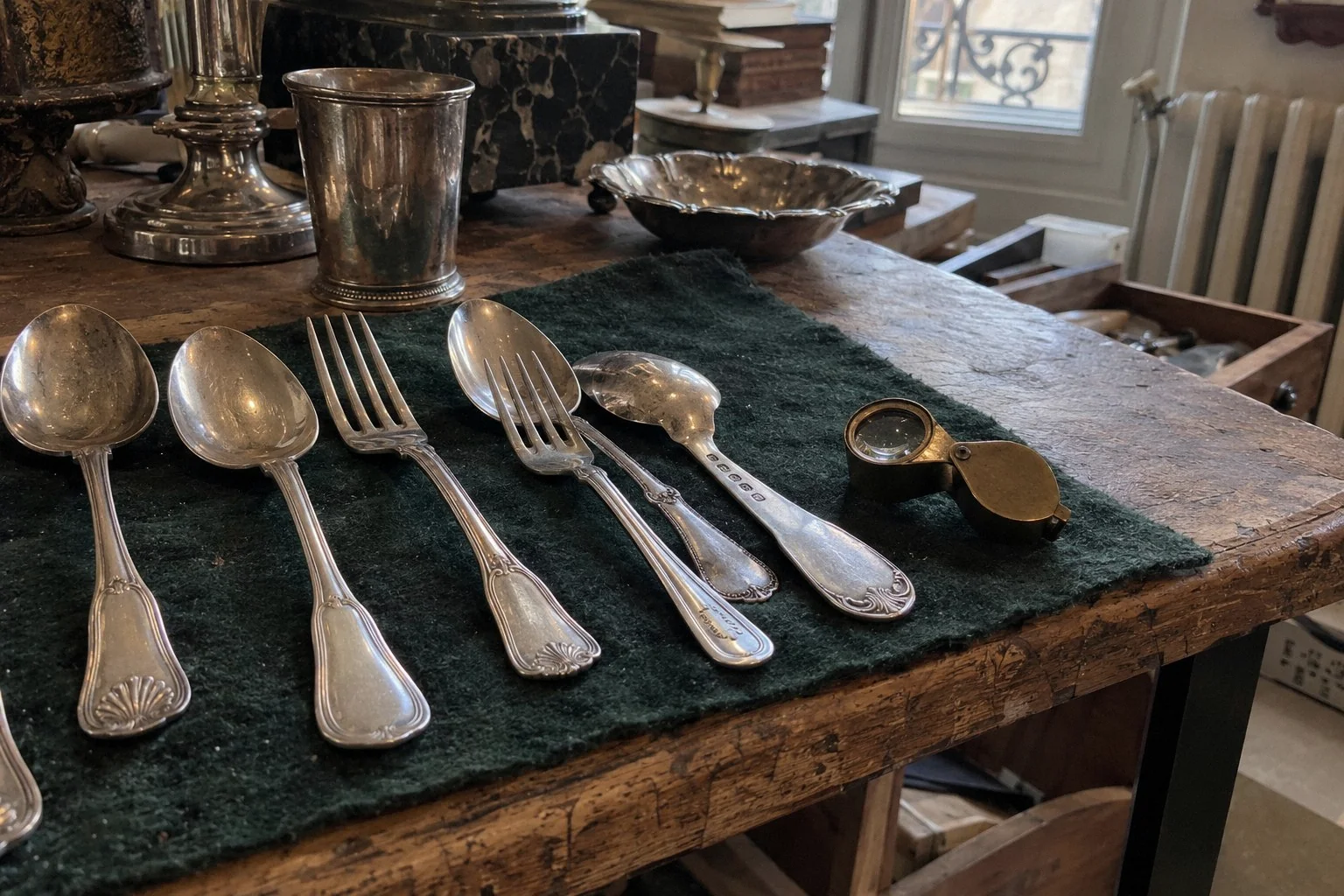
With the naked eye, you only see a small helmeted head, often two to three millimetres across. With a magnifier, several details appear, and each one tells you something.
The standard number: 1 or 2
The standard is the share of pure silver in the alloy, given in thousandths. Pure silver is too soft for cutlery, so a little copper is added.
- Number 1, in front of Minerva's forehead: first standard, 950 thousandths of silver. It is the most common on good quality antique table services.
- Number 2, behind the neck: second standard, 800 thousandths. You find it more often on simpler or more recent pieces.
Since 1995, the legal silver standards in France are 999, 925 and 800 thousandths. So a recent piece at the first standard is 925 thousandths. For antique silver, the kind we are talking about here, the first standard is still 950.
The shape of the frame
The Minerva hallmark is struck inside a small frame, usually octagonal or almost oval, depending on the period and the size of the object. A clean outline and even relief are good signs. A blurred hallmark with smudged edges deserves a closer look: it may have been transferred from another piece, or copied.
The second mark: the maker's lozenge
A piece of solid French silver always carries a second mark, the maker's mark. Since 1797, it has been shaped like a lozenge (a diamond shape). Inside, you can read the silversmith's initials and a small symbol of their own: a star, a key, a bird, a tool. The maker strikes this mark before the piece goes to the assay office.
The lozenge matters for two reasons. First, it confirms the Minerva: silver plate never has a lozenge mark. Second, it lets you identify the workshop. Houses such as Puiforcat, Odiot, Cardeilhac or Christofle each have their own lozenge, and the silversmith's name weighs in the valuation. Many lesser known workshops also left fine pieces, and directories of hallmarks often make it possible to trace them.
The other French hallmarks you may come across
Not every mark on French silver is a Minerva. Here are the most common ones.
- The boar's head: a small guarantee mark for small objects at 800 thousandths, such as napkin rings, salt cellars or handles. Outside Paris, a crab was used for the same purpose. These marks are tiny, but they do guarantee silver.
- The swan: struck since 1893 on imported silver objects when their origin could not be established. A swan therefore means silver, but not French silver.
- The cockerel and the old man's head: guarantee marks from before 1838. A piece that carries them dates from the late 18th or early 19th century, and often turns out to be more interesting than a Minerva piece.
- Pre-Revolution marks: fleur-de-lis, date letter, charge and discharge marks. Reading them takes real research. If you see them on a family piece, do not clean it, and show it to us.
Minerva or silver plate: how not to get it wrong
This is the most common confusion, and it is easy to understand. Silver plate is a base metal, often nickel silver or brass, covered with a thin layer of silver by electrolysis. It shines exactly like solid silver. Only the hallmarks settle the question.
On silver plate, the maker's mark is in a square or a rectangle, never in a lozenge. You often read the name of the house and a number, for example 84 or 90, which shows the amount of silver used for the plating. You may also find the words "métal argenté", "argenté" or "alfénide". Above all, there is no Minerva head.
A few more traps:
- Fake hallmarks. Some silver plated pieces carry small marks that vaguely look like a head. Under a magnifier, the design is not Minerva and the maker's lozenge is missing.
- Foreign hallmarks. The number 925 with a lion is English sterling silver. 800 with a crescent and a crown is German silver. 84 in a frame is the Russian zolotnik. All of these are solid silver, but under a different standard from the Minerva.
- Knives. A silver handle with a Minerva hallmark may be "filled", meaning packed with resin or putty to give it weight. The blade is steel. So a knife contains much less silver than it seems.
Where should you look for the hallmark on each object?
The assay offices struck the hallmark where it was least in the way. So you need to know where to look.
- Forks and spoons: on the back of the handle or on the stem, near the flat end.
- Knives: on the handle, often near the ferrule (the metal collar).
- Dishes, plates, trays: under the base or on the underside of the rim.
- Teapots, coffee pots, sugar bowls: under the base. The lid is usually hallmarked separately, and that is a good test: a lid without a hallmark may be a replacement.
- Beakers, egg cups, napkin rings: under the foot or near the rim.
Work in good light, with a jeweller's loupe if possible. A close-up photo on your phone, taken slightly at an angle to catch the relief, is often enough for a first reading.
What if the hallmark has worn away?
A century of washing and polishing can make a Minerva almost invisible. In that case, there are still clues: the maker's lozenge, often better preserved, the weight of the piece in your hand, the clear ring of silver, and no red or yellow wear on the edges, a sign that would point to silver plate whose layer has worn through.
If the marks cannot be read, have the piece examined before you clean or scratch it. A photo alone does not always allow a conclusion.
What the hallmark does not tell you
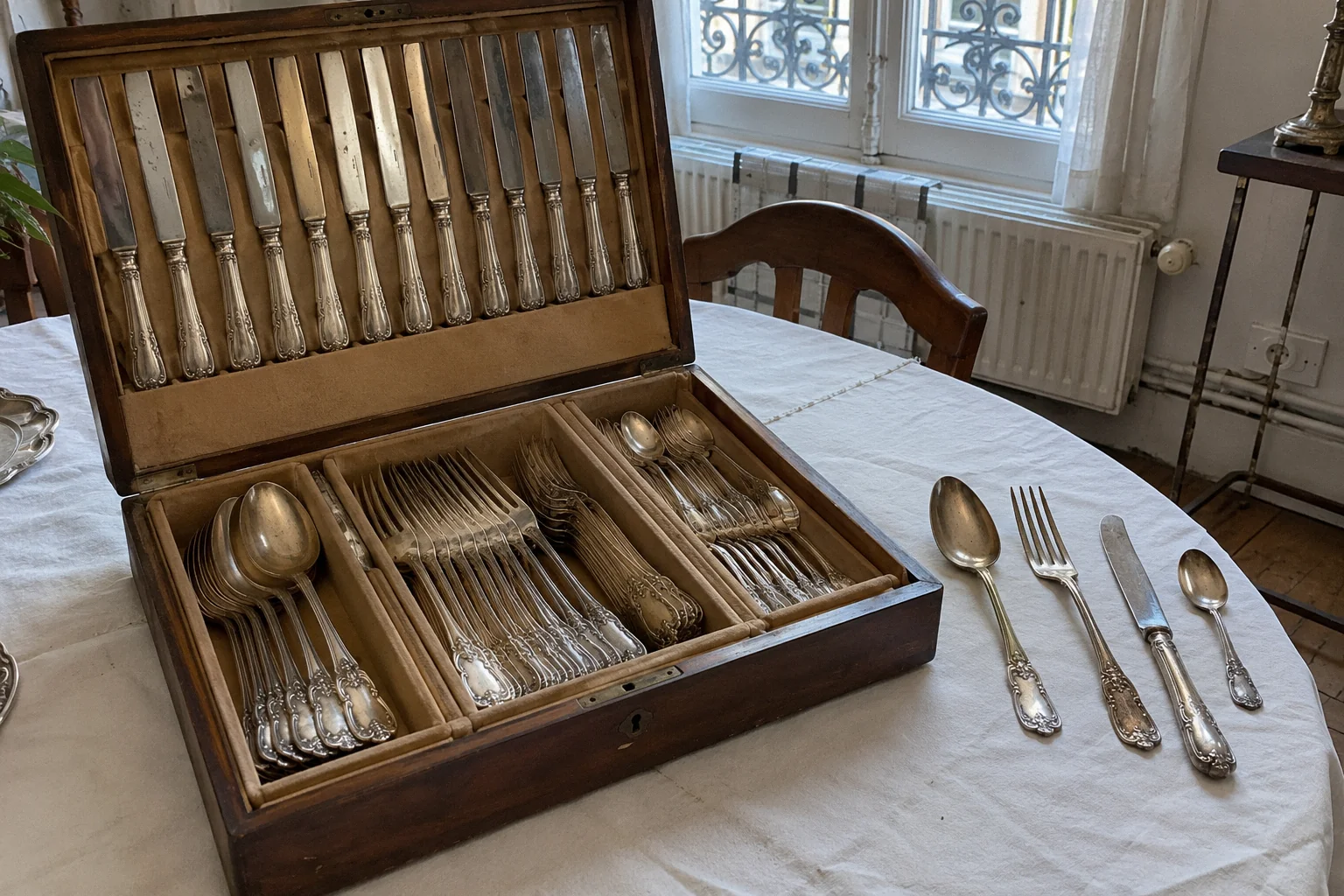
The Minerva guarantees the metal, and that already says a lot. But it says nothing about the rest. A badly damaged piece at 950 thousandths is worth less than a fine piece at 800 thousandths signed by a great workshop. A complete service of twelve place settings in its case sells much better than odd pieces. Style, period, decoration and rarity also count. That is why an antique silver valuation looks at the whole piece, and not only at the hallmark.
In a French estate, silverware is often among the objects to be listed before the heirs share things out. We help families with this: antique dealer for estates in the Île-de-France. And if you want to sell, we offer cash purchase of silverware and antiques, with immediate payment by bank transfer.
Have your hallmarks read by an antique dealer
Not sure about a Minerva head, a lozenge you cannot read, or a service whose origin you do not know? Send us photos of the hallmarks and of the whole piece on WhatsApp, or call us on 06 24 56 38 58 (+33 6 24 56 38 58 from abroad). The valuation is free and with no obligation, from photos or at your home, anywhere in Paris and the Île-de-France.