By Baptiste Murier, antique and second-hand dealer in Île-de-France.
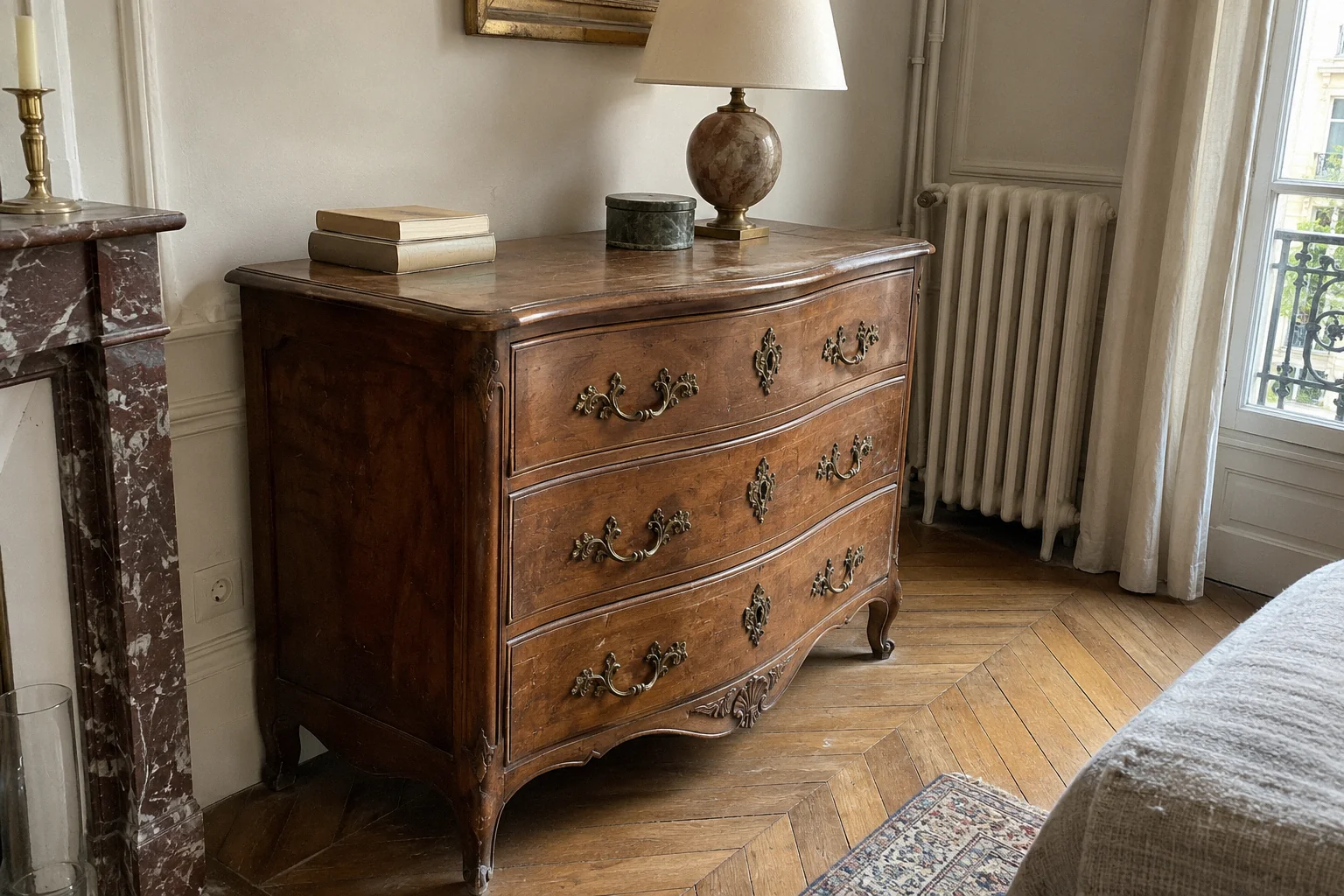
The Louis XV commode is one of the high points of 18th century French furniture. It appeared during the Régence and flourished during the reign of Louis XV, breaking with the stiffness of the formal furniture of the previous century. Its lines soften, its legs curve and its outline takes on an elegant swell that follows the curves of the rocaille taste. Among the different forms of this iconic piece, the sauteuse commode holds a special place for art lovers and collectors.
When we are asked to value a Louis XV commode, we look at a set of precise elements: the construction of the piece, the quality of the veneer or marquetry, the finesse of the bronzes, the type of marble and whether there is a cabinetmaker's stamp. Whether you have inherited a family piece or want to know the value of a commode kept in your home, we explain how the appraisal of such a masterpiece of period cabinetmaking is carried out.
What is a sauteuse commode from the reign of Louis XV?
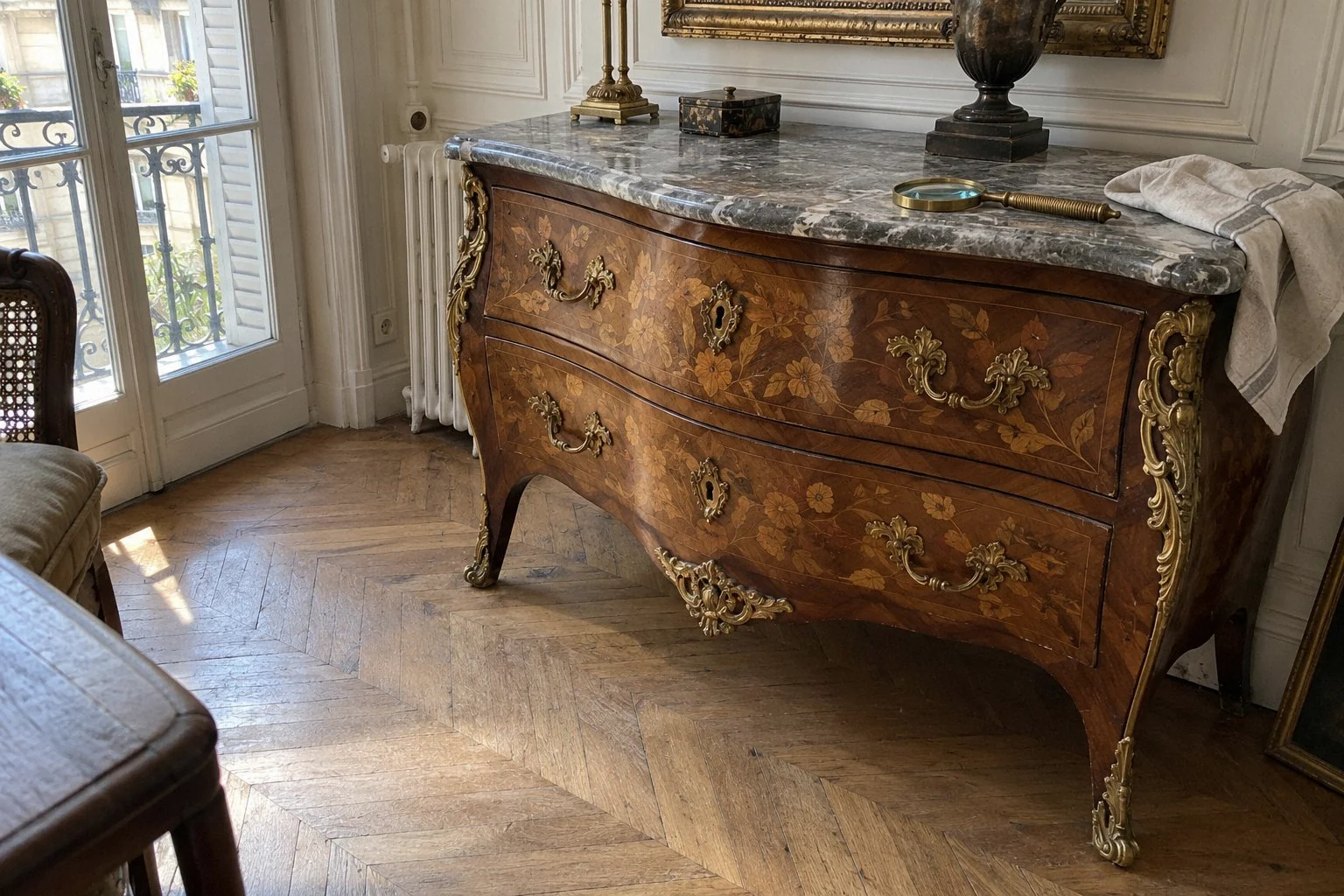
The sauteuse commode stands out at once from the heavier models known as commodes tombeaux. While a commode tombeau usually has three rows of drawers coming down very close to the floor, the sauteuse has only two rows of drawers. It stands on long, raised, curved legs that give it a light look, as if the piece were springing up from the floor.
Another key feature of a fine period sauteuse is that there is no visible rail between the two drawers. 18th century cabinetmakers managed to hide the horizontal structure to give a continuous front. This technical feat lets the craftsman lay out a marquetry design in one piece across the whole front, with no visual break.
What are the key criteria for valuing a Louis XV commode?
Valuing an antique piece of furniture never rests on a single detail, but on an overall look at how it was made, whether it is authentic and what condition it is in.
Marquetry and the choice of woods
18th century cabinetmakers used precious woods imported from the colonies, or worked local woods with great skill. To value a commode, we look closely at the veneers:
- Floral and scroll marquetry: made of kingwood (bois de rose), amaranth, satinwood, boxwood or stained sycamore, it calls for cutting of extreme precision.
- Parquetry veneers (frisage): veneers laid out as butterfly wings, diamonds or patterned grounds bring out the natural grain of the wood with refinement.
- Vernis Martin or Far Eastern lacquer: commodes decorated with Chinese or Japanese lacquer panels framed with bronzes are especially sought after.
The quality of the chased and gilt bronzes
The bronzes do not only decorate the piece: they protect the most exposed areas, such as the corners, the feet and the keyholes. On a period Louis XV commode, the bronzes are cast by the lost wax method, then chased by hand and fire gilt (mercury gilding).
We check whether the set of bronzes is complete and original:
- The corner mounts (chutes) and espagnolettes that decorate the upper uprights.
- The bronze sabots fitted to the bottom of the curved legs.
- The drawer handles and keyhole escutcheons matching the rocaille motifs or acanthus leaves.
- The central apron mount (cul-de-lampe) placed in the middle of the lower rail.
It is essential to tell these period mounts apart from more recent pieces in spelter (régule) or industrially cast bronze. To understand this difference better, see our article on the difference between bronze and spelter.
The original marble top
The Louis XV commode is almost always topped with a thick marble slab, cut to the curve of the piece and moulded round its edge with a bec-de-corbin profile. The choice of marble added colour and prestige to the piece:
- Rouge du Languedoc or Rouge Griotte.
- Brèche d'Alep or Brèche violette.
- Rance marble or Sainte-Anne marble.
The thickness of the marble, an old patina under the top and a perfect match between the cut of the marble and the frieze of the commode are major signs of authenticity.
How do you find and read a cabinetmaker's stamp?
From the royal edict of 1743, reinforced in 1751, Parisian master cabinetmakers had to strike their personal mark with a hot iron on the furniture they made. This mark, called the estampille, is often joined by the mark of the guild wardens of the master cabinetmakers, shown by the letters JME.
On a Louis XV commode, the stamp is never on the front. To find it, the marble top has to be lifted off. It is usually struck:
- On the top edge of one of the front or back uprights.
- At the top of the oak back panel.
- More rarely on the upright under the frieze.
An identified stamp, attributed to a great name such as Mathieu Criaerd, Jean-Philippe Carel, Jacques Dubois or Charles Cressent, adds considerable historical and artistic interest. However, some superb period commodes carry no stamp: this is the case, for example, of pieces ordered directly by the Crown, or made by provincial cabinetmakers who were not bound by the rules of the Paris guild.
How do you tell an 18th century piece from a 19th century copy?
In the 19th century, especially under the Second Empire and the Napoleon III period, the taste for the Louis XV style came back into great favour. Very fine furniture in the style was produced at that time.
To tell a period Louis XV piece from a 19th century one, we examine the internal structure of the commode:
- How the drawers are joined: in the 18th century, dovetails were cut by hand, often wider and slightly irregular.
- The drawer bottoms and structural woods: the carcass of an 18th century piece is usually made of northern oak or fir, with marks of hand ripsawing on the back panels.
- The screws and nails: 18th century screws have a flat head slotted by hand, with an irregular thread, unlike the industrial screws of the 19th century.
- Natural wear: the underside of the feet, the drawer runners and the inside of the locks should show wear consistent with more than two centuries of life.
How much does condition affect the valuation?
Condition plays a decisive part in the appraisal of an antique commode. A piece in perfect original condition, still with its original French polish and gilt bronzes that have never been stripped, attracts strong interest.
On the other hand, some faults need particular attention:
- Lifting or missing veneer: the solid wood of the carcass moves over time, which can cause cracks or lifting of the marquetry.
- Broken or replaced marble: a marble repaired long ago is still acceptable if it is original, but a top replaced at a later date makes the whole less consistent.
- Missing bronzes or bronzes regilded by electroplating: replacing original bronzes with later casts changes the value of the piece.
When an estate is being settled, it is common to find antique furniture that needs a careful inventory. In that situation, we help families value each piece at its fair worth. You can read our advice on what to do with the furniture in the home or use our service as an antique dealer for estates.
Have your Louis XV commode valued by Murier Antiquités
If you own a curved commode, a marquetry sauteuse or any other antique piece of furniture, we come directly to your home to examine it in depth. Baptiste Murier studies the structure, the veneer, the marble and the bronzes of your piece on site, to give you a reliable and objective opinion.
Across the Île-de-France, we offer a home valuation of antiques that is entirely free and with no obligation. We also buy antique period furniture if you are thinking of a direct sale with immediate payment. To learn more about all the pieces we are looking for, visit our page on valuing period furniture.
For a first free assessment of your Louis XV commode, call us on 06 24 56 38 58 (+33 6 24 56 38 58 from abroad), or send several sharp photos (overall view, marquetry, bronzes, marble) directly on WhatsApp to the same number.