By Baptiste Murier, antique and second-hand dealer in Île-de-France.
To tell whether a picture is a painting or a print, three checks are enough to start. Look at the surface under a magnifier: a print shows a pattern of small, regular dots, while a painting shows brushstrokes. Tilt the picture in raking light: a painting has relief, a print is flat. Finally, look at the back. No single test is enough on its own, but together they give an answer in most cases.
What is the difference between a painting and a reproduction?
A painting is made by hand, with material laid onto a support: oil, watercolour, gouache, pastel or acrylic. A reproduction is a mechanical copy of an existing image. It can be printed on paper, on card or directly on canvas.
Two cases sit in between:
- engravings and lithographs, which are printed but designed as such by an artist, so they are not simple reproductions;
- a hand-painted copy after a well-known painting, which is a real painting, but not the work of the original artist.
So the question "is it painted?" is not the same as "is it an original?".
How do you recognise a printed reproduction with a magnifier?
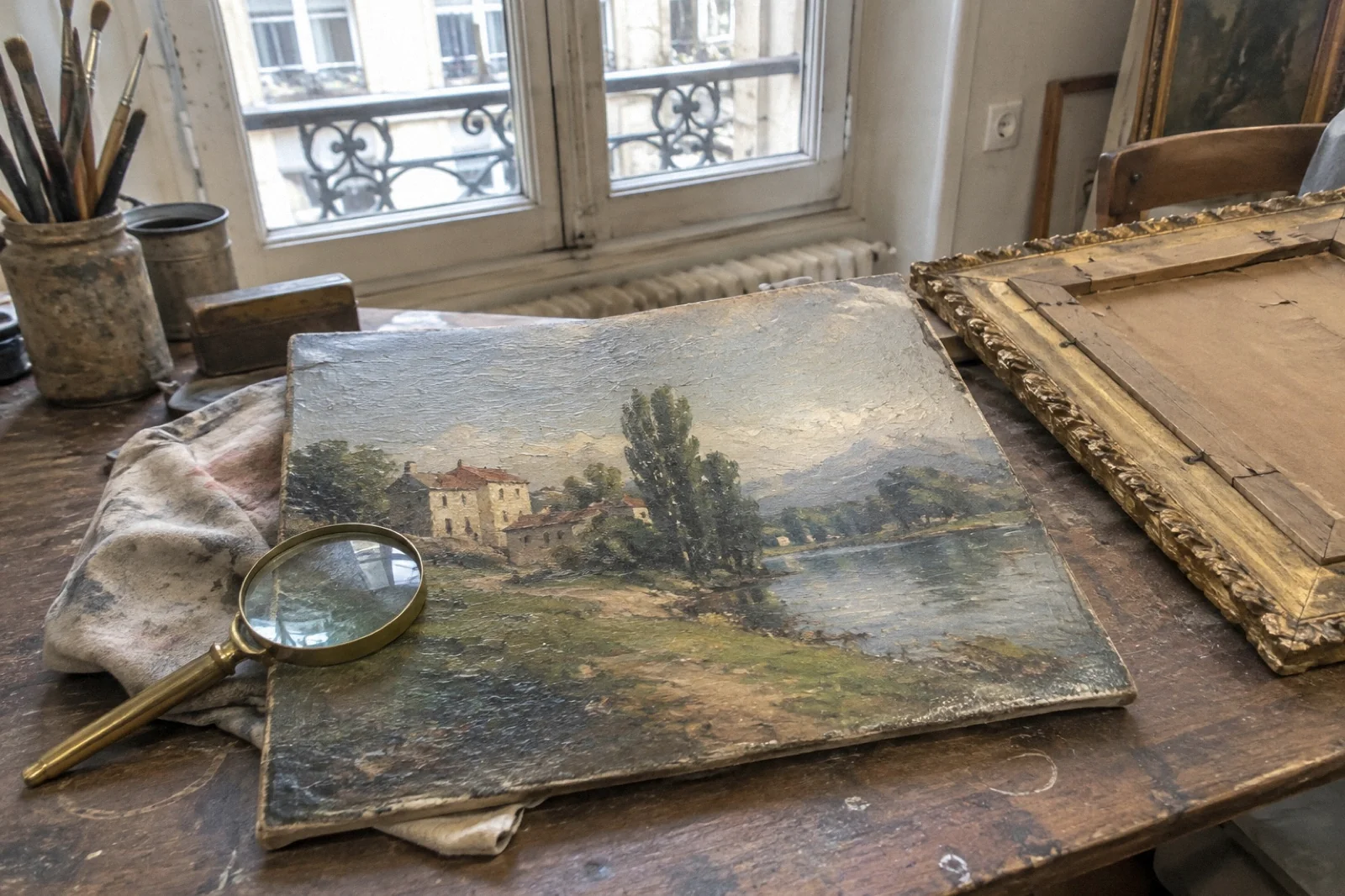
This is the first test to do. A magnifier is enough, or your phone's zoom in good light.
- On a print, you see a pattern of small, regular dots, often arranged in a rosette. On an inkjet print, you see fine droplets that all look alike.
- On a painting, you see brushstrokes, uneven thickness, and colours that overlap and blend. The edge of each stroke is irregular.
Check several areas: a sky, a face, a dark corner. One area can mislead you, three rarely do. On some good-quality reproductions the dots are very fine, so take your time.
What does raking light show?
Place the picture near a window, or light it from the side with a lamp, tilting it slightly.
An oil painting has relief. Some strokes form small ridges, known as impasto, and their shadow is easy to see. A print on paper is flat, with a uniform look.
Two cases call for caution:
- some reproductions on canvas are given a varnish or gel that imitates relief, but this relief is regular and does not follow the image;
- a very thin painting, such as a watercolour or a pastel, has little relief. The magnifier then takes over.
What does the back of the picture tell you?
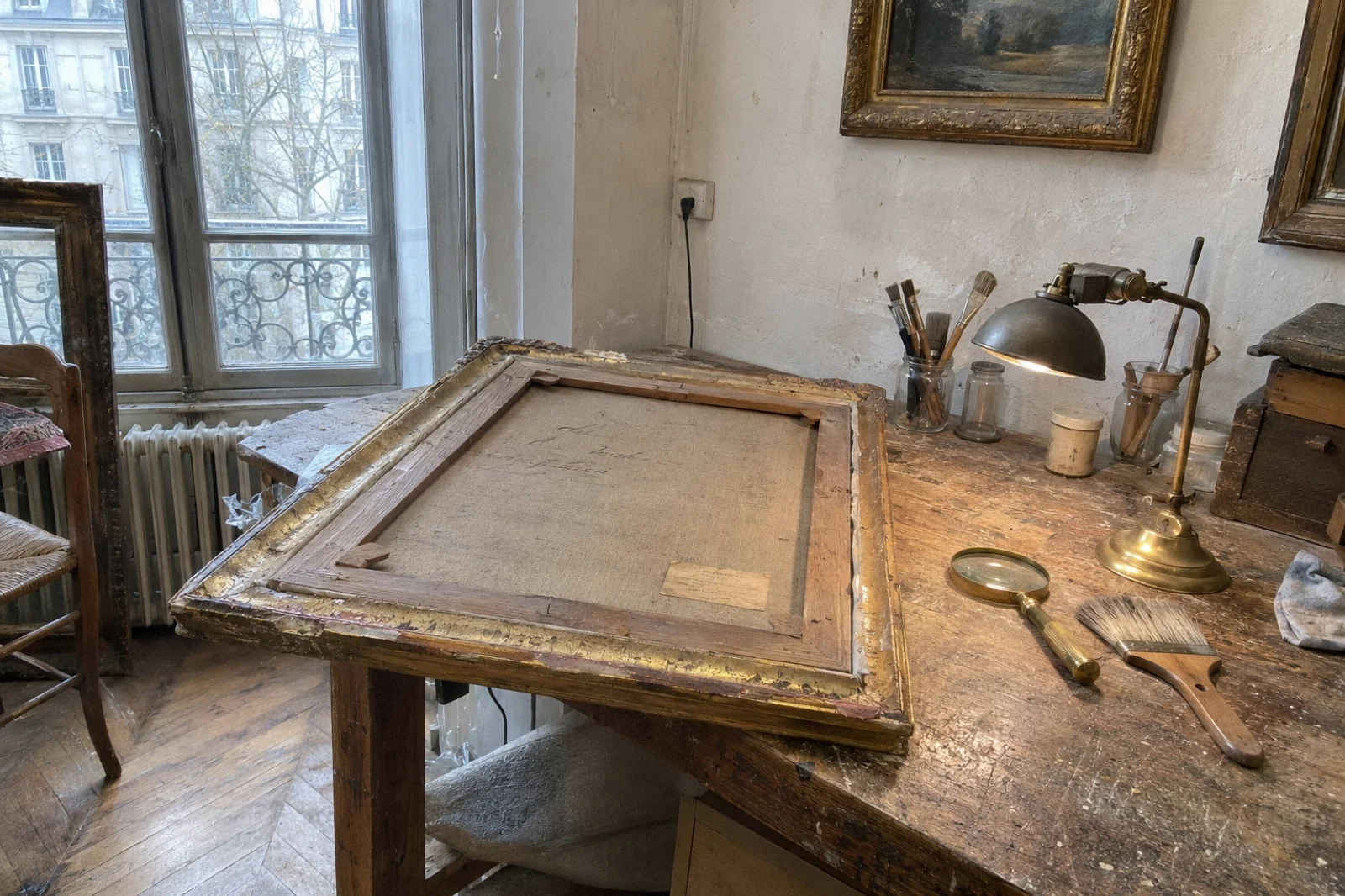
Turn the picture over carefully, without forcing the frame.
- Canvas stretched on a wooden frame: normal for a painting, but also for a print on canvas. This clue has to be combined with the others.
- Image that continues around the edge: common on prints on canvas.
- Wooden panel: people have painted on wood for a very long time. Solid wood, sometimes split or warped, is rather reassuring.
- Cardboard or fibreboard glued on the back: an image glued to this kind of support is often a decorative reproduction.
- Labels and stamps: they tell a story, but prove nothing on their own, because a label can be added or moved.
On an old picture, the back also shows its age: old dust, dark wood, irregular nails. Staples or recent materials do not make a picture fake, as they can come from reframing or restoration. But they are a reason to look more closely.
How do you spot a hand-embellished reproduction?
Some reproductions receive a few touches of paint, sometimes under a varnish, to give the effect of a painting. These are called embellished reproductions.
To spot one, look for the dot pattern between the touches of paint. If the fine details are printed (faces, foliage, lettering) and paint is only found in places, it is a retouched print. A few touches on a print do not make it an original, and its value generally remains modest.
Does the signature prove anything?
Not by itself. On a reproduction, the signature is part of the image: it is printed with the rest, and the magnifier shows the same dot pattern there. On a painting, the signature is painted, sometimes with a slight relief from the brush.
But a painted signature may have been added later, and many authentic paintings are not signed. If the name is hard to read, our guide on an illegible painting signature will help you.
How do you tell an engraving or lithograph from a reproduction?
A print is printed, but that does not make it a decorative reproduction. An original engraving or lithograph is made by the artist, or under their supervision, and produced in a limited run. It often carries a pencil signature in the margin and sometimes a numbering, for example 12/100.
A few pointers:
- a signature printed within the image, which the magnifier shows as dots, is a sign of a reproduction;
- a lithograph often shows an irregular grain rather than a regular dot pattern;
- in an intaglio engraving, the paper often keeps the imprint of the plate.
These clues take practice, and late impressions exist. For a signed print, an in-person opinion is better.
Is a painting always old?
No. Once you know the picture is painted, you still need to find out its period and who painted it. A painting can be a workshop copy, a picture "in the style of", the work of an amateur, or a recent decoration.
- Cracks: an old oil painting develops an irregular network of cracks. Fake, manufactured cracks exist, so they are not enough.
- Frame and back: a frame and a back that have aged together are reassuring. An old frame around a canvas that looks new raises questions.
- Style and subject: they place a period, without proving the artist.
Only the whole set of clues allows a judgement, and for a precise attribution, a specialist in the artist may be needed. We tell you when that is the case.
Is a reproduction worth anything?
Generally not much, especially if it was printed in large numbers. Some old reproductions, such as period posters, can however interest collectors. And the frame may be of interest on its own.
Knowing that you have a reproduction is therefore not bad news: it spares you false hopes. If the picture comes from an estate, do not throw it away before a professional has looked at it.
What should you do before having your painting appraised?
- Do not clean, rub or varnish it: you risk damaging the surface.
- Photograph the front, the back, the corners, the signature and any labels.
- Note where it came from: family home, estate, flea market.
- Keep the frame, even if it is damaged.
With these photos, we can already give a first opinion. Our page on appraisal of old paintings explains how we work, and the article on appraisal from photos shows how to take good pictures.
Who can settle the question when in doubt?
For a picture that matters to you, an in-person opinion remains the safest. We look at the surface, the support, the signature and the frame, and we tell you what we see, with no promises. We can also come to you: the home appraisal is free, and so is our travel, in Paris and throughout Île-de-France.
Unsure about a painting? Call us on +33 6 24 56 38 58 (06 24 56 38 58 from within France) or send a few photos on WhatsApp to the same number: the appraisal is free and with no obligation.