By Baptiste Murier, antique and second-hand dealer in Île-de-France.
To read the signature on a painting, start by looking in the right places: the corners of the paint, sometimes the edge, sometimes the back of the canvas. Use a magnifying glass and raking light, and never rub or clean the surface. If the letters stay illegible, the support, the frame, the labels and the style offer other leads. Here is the method we follow.
Where should you look for the signature on a painting?
Most often, the signature is at the bottom, on the right or the left, painted with a brush into the picture. But it can hide elsewhere:
- in an upper corner;
- in the middle of the bottom edge, sometimes on a stone, a boat or a painted piece of furniture;
- under the frame: if the painting was framed after the fact, the rabbet may have covered a few millimetres of paint, and the signature with it.
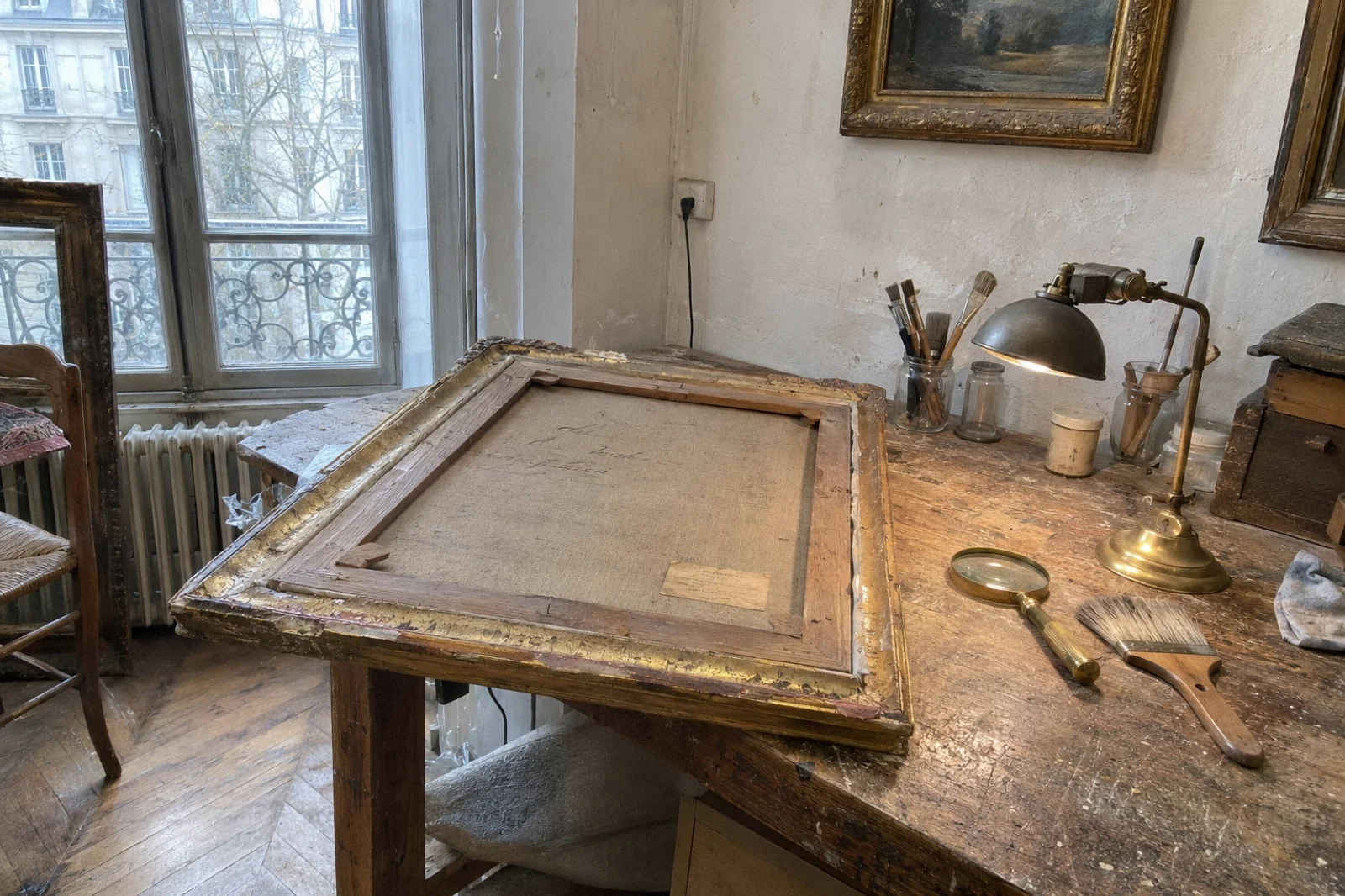
The back matters as much as the front. Look at:
- the canvas, where you sometimes find an inscription in paint or pencil;
- the stretcher or the wooden panel, with numbers, initials or a name;
- labels: gallery, exhibition, salon, dealer, former owner;
- stamps, for example from a canvas maker.
A label is not a signature, but it gives a name, a place or a date. It is a valuable lead, and you should photograph it first.
How can you make a signature legible without damaging the painting?
First, what not to do. Do not rub, and do not use a damp cloth, alcohol or household cleaner. An old varnish or fragile paint can come off in a few movements, and what is removed does not come back. A signature may also be veiled by grime: only a restorer can decide whether to clean it.
What is safe:
- a magnifying glass, with good light;
- raking light: a lamp held to the side, almost parallel to the surface, brings out the relief of the paint, and a signature has relief even on a background of the same colour;
- a photo: take a close-up with your phone, then increase the contrast. The screen sometimes reads better than the eye;
- another angle: tilt the painting slightly, because a reflection can get in the way.
An ultraviolet lamp can reveal retouching and additions, but it takes practice to interpret what it shows. Do not rely on a single test.
Initials, monogram, date: what can you read there?
Not all artists sign with their full name. On an old painting, you may come across:
- a surname alone, with no first name;
- initials, sometimes intertwined as a monogram;
- a date, near the signature or beside it;
- a place;
- a dedication to someone, which does not name the artist.
Be careful: a name written on a painting is not necessarily the painter's. It may be that of an owner or a dealer, added later. So read the inscription in context: its colour, its material and its position relative to the paint.
How do you decipher a difficult signature?
Proceed step by step:
- Copy what you see, letter by letter, marking your doubts. Some letters look alike, such as u and n, or l and t.
- Count the letters and note the ones you are sure of.
- Compare the result with the subject, the technique and the period of the painting.
- Search reference works: artist dictionaries such as the Bénézit, museum catalogues, public auction records.
- Compare with known signatures by the same artist, from several periods, because a signature changes over the course of a career.
Beware of namesakes. Several artists may share the same name, or a similar one, and a resemblance to a famous name is not enough. An honest doubt is better than a hasty conclusion.
What if the signature is illegible or missing?
Other elements help place a painting:
- the support: canvas, wooden panel, cardboard, copper;
- the technique: oil, watercolour, pastel, gouache;
- the subject and style: portrait, landscape, still life, genre scene;
- the frame, which gives a hint of the period but proves nothing, because a frame may have been replaced;
- the condition of the paint: cracks, varnish, restorations;
- inscriptions and labels on the back.
For an engraving or a print, look in the margin. The signature is often written in pencil, below the image, sometimes with an edition number. So it is not found within the picture itself.
For a sculpture, reading is different: we explain it in our article on the signature and founder's mark of a bronze statue.
Does a signature prove that the painting is authentic?
No. A signature can be added after the fact, and some are forgeries. Conversely, a genuine signature may have disappeared through an overly vigorous cleaning.
A few signs should give you pause:
- a signature that is sharper or fresher than the rest of the paint;
- a signature that runs over the cracks, which suggests it was written long after the painting;
- a colour or material different from that of the painting;
- handwriting that resembles no known signature of the artist.
None of these signs is enough on its own. Our eye as antique dealers gives a first opinion, but it does not replace formal authentication. For a work that seems important, we tell you frankly when the opinion of a specialist in the artist is useful.
Can an unsigned painting be valuable?
Yes. The quality of the paint, the subject, the period, the condition and the history of the painting also count. A painting signed with a little-known name may be worth little, and an unsigned painting can be very interesting.
Without a signature, a work cannot always be tied to a specific artist. You then come across wordings such as "attributed to", "workshop of", "school of" or "after". They do not mean the same thing, and none is worth a certain signature. Always ask what the wording used means.
Should you clean or restore a painting before having it appraised?
In general, no. Show the painting as it is. Cleaning or retouching done at home can change the look of the paint and sometimes damage or hide the signature. If a restoration is useful, we can discuss it afterwards, once we have seen the painting.
Which photos should you send for an appraisal?
An appraisal from photos is possible, as we explain in free appraisal of antiques from photos. For a painting, send:
- an overall view, from the front, in full light and without reflections;
- a close-up of the signature, from two or three angles;
- the whole back of the painting;
- labels, stamps and inscriptions, in close-up;
- one corner of the frame;
- the height and width, with or without the frame;
- any flaws: tears, flaking, holes, stains.
To see how we look at a painting, visit our page on appraisal of antique paintings. If the painting is too large or too fragile to move, the home appraisal is free, and so is our travel, in Paris and Île-de-France. And if the idea of selling occurs to you along the way, know that we also buy antique paintings, paid on the spot: everything is detailed on the page buying antiques.
For a free appraisal with no obligation, call us on 06 24 56 38 58 (+33 6 24 56 38 58 from abroad) or send a few photos of your painting, signature and back included, on WhatsApp at the same number.