By Baptiste Murier, antique and second-hand dealer in Île-de-France.
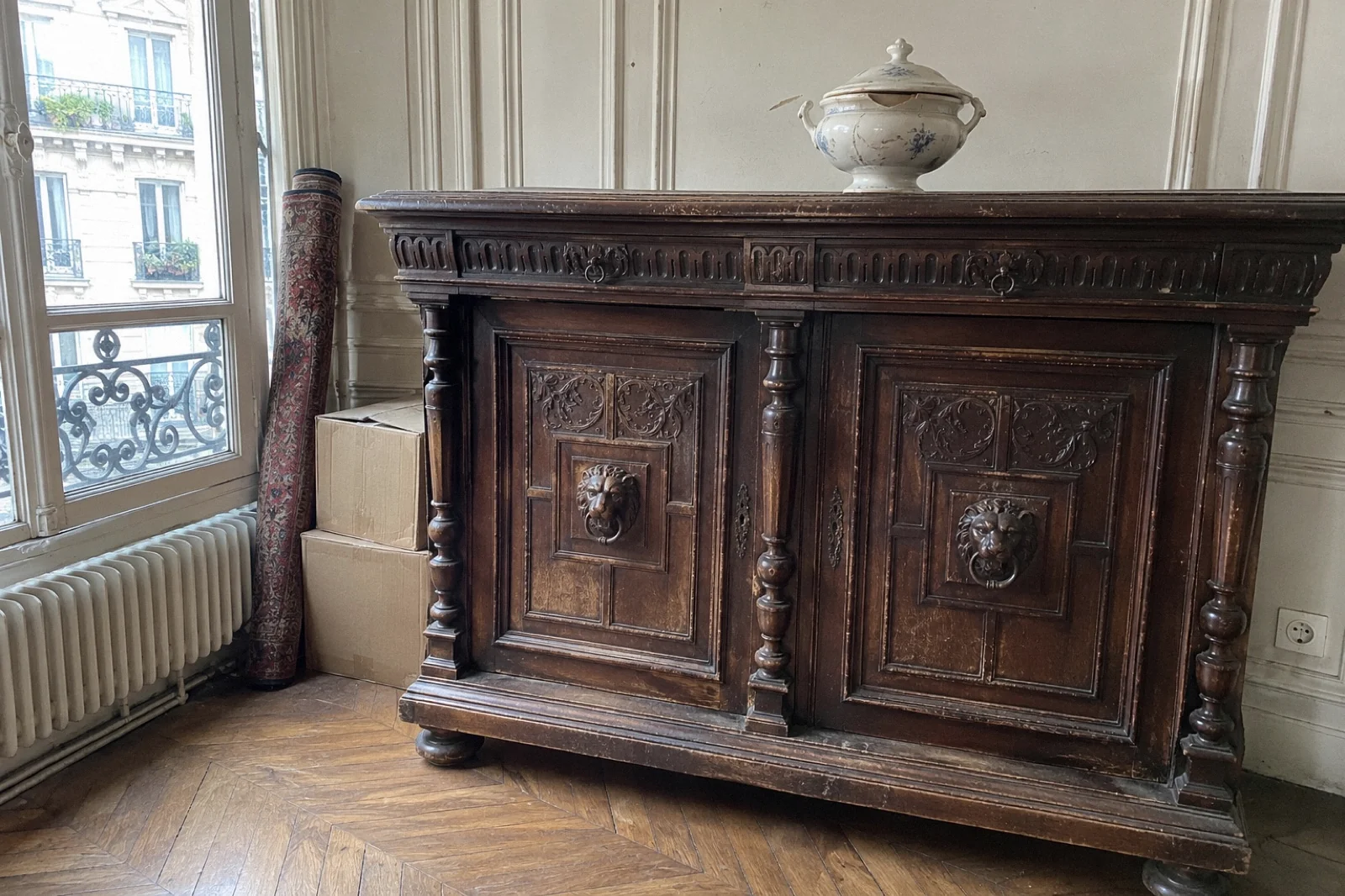
An Henri II sideboard usually sells for little. In most cases it dates from the late 19th or early 20th century, it was made in large numbers and it is very bulky. Its value therefore depends on the quality of the carving, the condition of the wood and the room it can find in a home today.
A well-carved, sound and complete example can interest a collector. An ordinary or damaged sideboard will be harder to place. One photo is enough to tell which case you are in.
What is an Henri II sideboard?
The name comes from King Henri II, who reigned from 1547 to 1559. Yet the great majority of pieces called "Henri II" do not date from that period. They were made much later, mostly in the second half of the 19th century, when the Renaissance taste came back into fashion. This is known as the neo-Renaissance style.
Here is how to recognise one:
- a tall piece, often in two sections: a lower part with doors and drawers, an upper part with doors;
- walnut or oak, sometimes stained dark;
- columns, mascarons (carved faces), lion heads or carved figures;
- fruit, foliage and medallions in relief;
- massive feet and an imposing look.
In a dining room of the period, it was often accompanied by an extending table and matching chairs.
What is an Henri II sideboard worth?
We do not give a figure without seeing the piece, because every example is different. What we can do is explain what raises or lowers the interest people take in it.
What works in the piece's favour
- fine, deep carving, cut by hand;
- solid, sound wood;
- a complete piece: doors, locks, keys, carved elements;
- good proportions and an old patina;
- reasonable dimensions, which are easier to place.
What works against it
- shallow ornaments, all identical, sometimes added on or glued;
- woodworm that is still active;
- broken, missing or badly reglued parts;
- thick varnish, overly harsh stripping or a smell of damp;
- a size that fits neither through the door nor up the stairs.
The style still has admirers, for example for a large dining room, a country house or a dark, rustic atmosphere. But this audience remains small.
Why do Henri II sideboards sell so little?
Three reasons come up again and again.
- There are many of them. They were made in very large numbers, so supply is wide.
- They are bulky. Tall, deep and heavy, they need a large room and easy access.
- Taste has changed. Today's interiors are often lighter and plainer, and a dark, heavily carved piece appeals less.
The result is simple: many families own one, few people want to buy one.
Is an Henri II sideboard really from the Renaissance?
Rarely. A genuine 16th-century piece is rare, and is found mostly in museums and specialised sales. If you think you have one, it needs to be examined closely.
A few clues help, but none is enough on its own:
- The joints: on an old piece they are often mortise and tenon, held by wooden pegs. Modern screws should give you pause.
- The carving: cut by hand, it shows small irregularities. Very regular, shallow carving is more often a sign of recent work.
- The wear: it shows where hands touch the piece, such as the handles, the edges and the feet.
- The back and the underside: the raw wood there often says more than the front.
Some pieces also mix old elements with more recent parts. They have to be seen up close to tell.
How do you get your Henri II sideboard valued?
We offer a free valuation at your home or from photos, with no obligation. Travel is free in Paris and Île-de-France. For antique furniture in general, see also our page on valuing antique furniture and period pieces.
For a first opinion from photos, please send:
- an overall view, from the front and from a distance;
- a side view, and one of the back;
- the inside, with doors open and drawers pulled out;
- close-ups of the carving, the locks and any flaws;
- the height, width and depth, if you can measure them.
Do not try to clean it thoroughly, strip it or revarnish it beforehand. You could unintentionally erase what allows it to be judged. A quick wipe with a dry cloth is enough.
Where can you sell an Henri II sideboard?
There are several options, depending on the condition and appeal of the piece.
- An antique dealer or a brocanteur. If the sideboard is of good quality, we can buy it, with immediate payment. If we are not buyers, we tell you frankly.
- A private ad. It is possible, but you need patience. The buyer has to come and collect it and plan for dismantling and transport.
- An auction. Best kept for a piece of exceptional quality or one that is truly old, after getting an opinion.
- A donation. If the piece is sound, some charities may accept it.
What can you do with an Henri II sideboard nobody wants?
This is the most common situation, and it has solutions.
A full clearance
When the sideboard is part of a home to be emptied, it can be taken with the rest. In our house clearance service, we make a free visit, we value, we sort, we buy what has value and we remove the rest. The amount of the purchase is deducted from the clearance, which can be free when the purchase covers it.
Donation
Items in good condition that we do not buy can still be useful. We pass them on to Emmaüs, the Secours catholique, the Armée du Salut or nearby ressourceries (charity reuse centres). These organisations choose according to their space and needs, so a very large piece is not always accepted.
Recycling
A sideboard that is damaged, eaten by woodworm or too deteriorated goes into the appropriate channels, whether the waste recycling centre or wood recycling.
Before any removal, empty the drawers and the cupboards. They sometimes hide papers, tableware, cutlery or small objects.
What should you do with an Henri II sideboard in an estate?
In a family home, the sideboard is often a piece with more memories than value. Take the time to agree among the heirs before selling or throwing away. We discuss this in our guide Inheritance: what to do with the furniture and objects in the home.
On the tax side, article 764 of the French General Tax Code (Code général des impôts) provides for a flat-rate valuation of furniture when there is no inventory. This applies under French law, for estates handled in France. The details are in our article on the flat-rate furniture allowance. For your specific situation, speak to the notary (notaire) in charge of the estate.
An Henri II sideboard to have valued?
Do you have an Henri II sideboard and do not know what to do with it? You can reach us by phone on 06 24 56 38 58 (+33 6 24 56 38 58 from abroad), or write to us on WhatsApp at that same number with a few photos of the piece. The valuation is free and with no obligation.