By Baptiste Murier, antique and second-hand dealer in Île-de-France.
The value of a gold pocket watch rests on three things: the gold of the case (its weight and purity), the quality of the movement together with the maker's signature, and then the condition and rarity of the piece. For an ordinary watch, the gold is what counts most. For a fine signature or a complicated mechanism, the watch can be worth more than its metal.
We do not give figures in this guide. They vary with the gold price and with each watch. Here is what to look at, in the order we follow ourselves.
How is the value of a gold pocket watch worked out?
It is assessed in layers, which are added together or compared:
- the value of the metal: the weight of the gold in the case, according to its purity and the price of the day;
- the watchmaking value: the brand, the quality of the movement, any special functions;
- the collector's value: rarity, decoration, condition, and the history of the piece when it is known.
The first layer is a floor. If the watch is plain, the value stays close to that of the gold. If it is signed by a sought-after maker, the other two layers weigh more.
How can I tell if the case is gold?
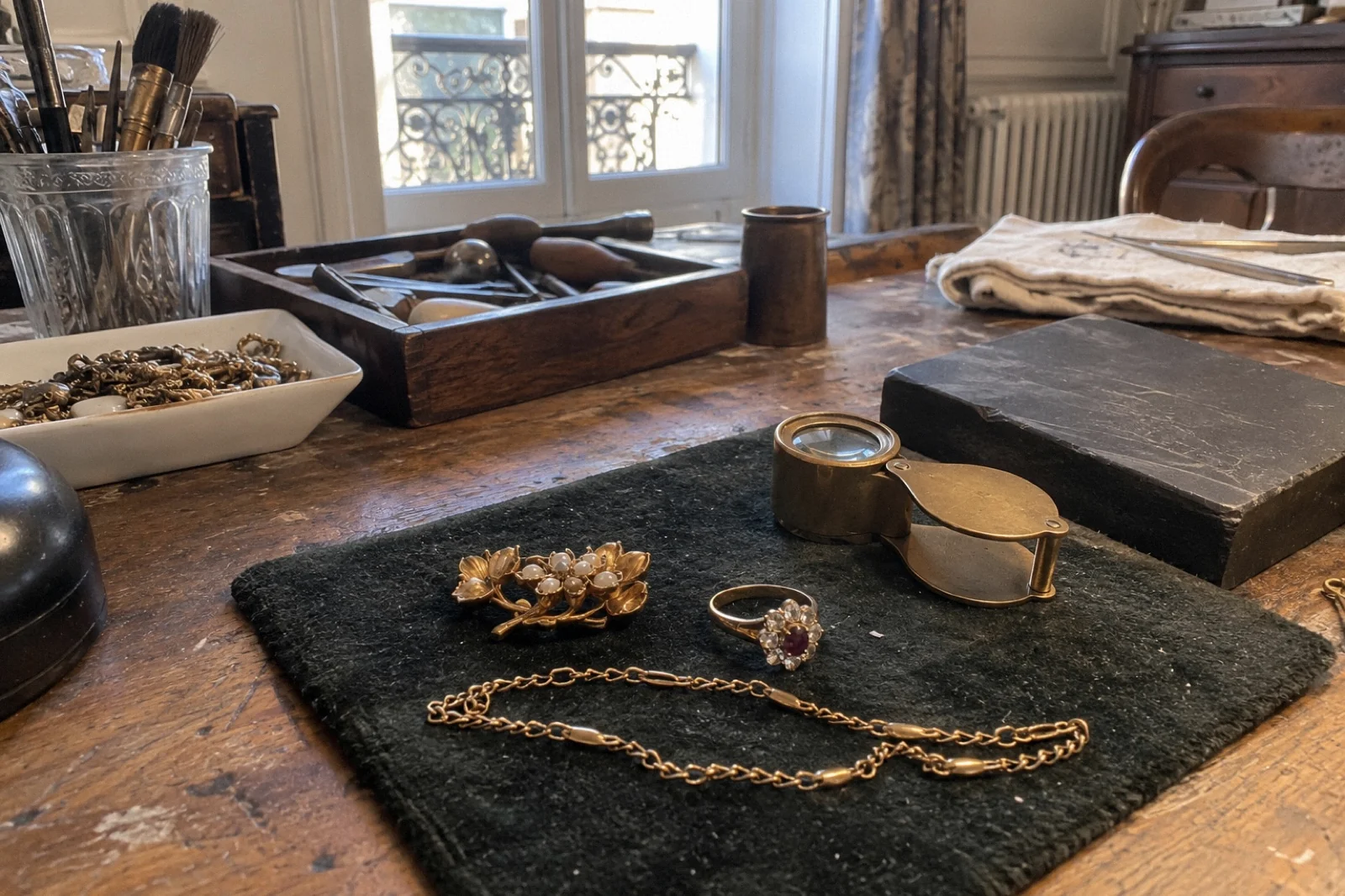
Open the back lid and look inside. Hallmarks are often found on the back, on the rim of the case or on the dome, the small inner cover that protects the movement. They are tiny, so a magnifying glass helps a lot.
What do French hallmarks say?
In France, the eagle's head is the guarantee hallmark for 18-carat gold, that is 750 thousandths. It is the most common mark on French gold pocket watches. We explain how to spot it in our article on the eagle's head hallmark and 18-carat gold.
Older watches may carry other marks, because the rules of control have changed over time. If you do not recognize a hallmark, do not jump to conclusions: photograph it and ask for an opinion.
And on a foreign watch?
A watch from abroad often carries engraved marks rather than French hallmarks: 18K, 14K, 750 or 585, for example. These numbers indicate the purity of the gold. An engraved mark alone does not replace a check in person, because it can be false or misleading.
Solid gold, plated or gold-filled?
Not every yellow watch is solid gold. Some are plated, filled or "gold filled". Their layer of gold is thin and their metal value is low. A few clues:
- a mark such as "doublé", "plaqué" or "filled" on the case;
- wear that reveals a different metal on the edges and hinges;
- the absence of any gold hallmark.
A plated watch can still be pleasant and interesting for its movement. But it is not sold like a solid gold watch.
Does the weight of the gold change the value?
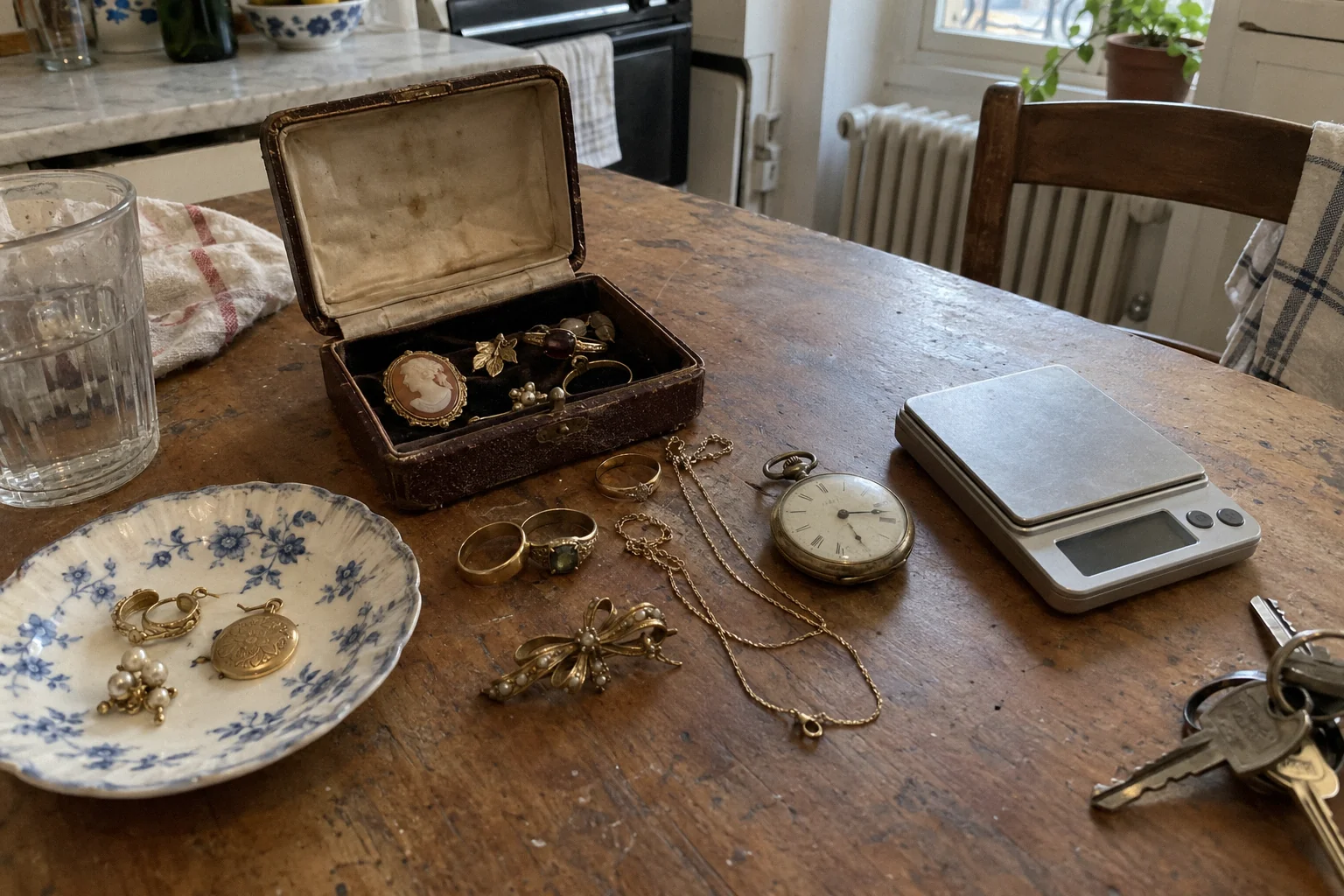
Yes, it is the starting point. The larger and thicker the case, the more gold it contains. But a whole watch weighs more than its gold: the movement is made of brass and steel, and the glass and the dial are not gold either.
That is why you cannot simply put the watch on a scale. The case has to be separated from the rest, and each part checked to see whether it really is gold. The lid, the back and the dome are not always the same metal.
Purity matters too. 18-carat gold contains more fine gold than 14-carat gold, so at equal weight they are not worth the same. In France, payment for the purchase of gold is made by bank transfer, and this is mandatory for gold and precious metals.
To better understand how the gold price and the weight come into play, you can read how antique jewelry prices are set. The reasoning is close for a watch case.
Do the movement and the maker really matter?
A great deal, as soon as the watch is out of the ordinary. Open the dome if it opens easily, without forcing it, and look at the plate. You will sometimes find a name, a serial number or adjustment marks there.
Which signatures should I look for?
The signature may appear on the dial, on the movement or on the dome. Houses such as Patek Philippe, Vacheron Constantin, Audemars Piguet, Longines or Omega are well known to enthusiasts. A famous signature is not a guarantee: some dials have been redone, and famous names have been put on watches that have nothing to do with those houses. The consistency between the dial, the case and the movement is part of what we check.
Which functions make a watch more interesting?
Simple watches are the most numerous. Some functions are rarer and appeal more to collectors:
- a striking mechanism, such as a repeater for the hours and minutes;
- a chronograph, which measures durations;
- a calendar, which shows the date or the day;
- moon phases;
- particularly refined or very thin movements.
These mechanisms are harder to repair, and their condition then weighs heavily in the opinion.
Hunter case or open face?
A hunter-case watch has a lid that protects the dial. An open-face watch, with an open dial, does not. This depends on the fashion of the period, and this detail alone does not say which is worth more. It mostly helps to place the watch in time.
Is a pocket watch that no longer works still worth something?
Yes. The gold case keeps its value whether the watch runs or not. It is even the most common situation: many family watches have been sleeping at the bottom of a drawer for years.
For a signed watch or one with a complication, a stopped movement is not necessarily a serious flaw. A well-built watch can be serviced. On the other hand, a movement that is oxidized, incomplete or fitted with parts from another watch loses its appeal for a collector.
If your watch has stopped, do not force the crown and do not try to wind it at all costs. A fragile spring can break.
Does condition change the valuation?
Yes, especially for the collector's value. Here is what we look at:
- the dial: enamel intact or cracked, clear numerals, original hands;
- the glass: scratched, broken or replaced;
- the case: knocks, dents, weak hinges, engravings still legible;
- the movement: cleanliness, rust, missing parts;
- the accessories: waistcoat chain, winding key, original box.
A cracked enamel dial is a notable flaw. An engraved monogram on the back is not a flaw in itself, but it can reduce the appeal of a watch for some buyers. A gold waistcoat chain is valued separately, with its own hallmarks.
Should I clean or service my watch before selling it?
The safest course is to do nothing. Polishing the case can erase the hallmarks, soften the edges and remove a little gold. A service has a cost, and it is not certain that it improves the opinion on an ordinary watch.
Keep the watch as you found it, with its chain and whatever came with it. Store it away from knocks, in a soft cloth.
How should I prepare for the valuation?
A few minutes are enough:
- photograph the dial, from the front and well lit;
- photograph the back of the case, then the inside of the lid;
- photograph the hallmarks, as close as possible, with a magnifying glass if you can;
- photograph the movement if it is accessible without forcing anything;
- note what you know of its origin: inheritance, gift, purchase.
These elements already allow a first opinion. To go further, a watch has to be looked at in person. If it is part of an estate, we can also examine it together with the rest of the furniture and objects.
Where can I have my gold pocket watch valued?
With a professional who looks at both the gold and the watchmaking, because a watch can be worth something for one or the other. We value pocket watches as part of our work in antique clocks and watches, and we buy antique jewelry and gold.
The valuation costs you nothing and does not commit you to anything. It is done at your home or from photos, and our travel is free in Paris and Île-de-France. If you prefer, you can also show us the watch at the weekend at our stand at the Puces de la porte de Vanves flea market.
If you decide to sell, we pay immediately. Nothing obliges you to sell: you can simply find out what you have.
For a free, no-obligation valuation of your pocket watch, call us on 06 24 56 38 58 (+33 6 24 56 38 58 from abroad) or send a few photos on WhatsApp to the same number. We will reply with a clear first opinion.