By Baptiste Murier, antique and second-hand dealer in Île-de-France.
To sell old postcards, there are four ways: a dealer who buys them, a trader at a market or flea market, an online sale between collectors, or an auction house for large collections. The right choice depends on the size of your collection, the time you have and how much ease you want. In most cases, a first professional opinion before any decision keeps you from taking the wrong road.
Where can you sell old postcards?
Here are the options, with their advantages and their limits.
An antique dealer or flea market dealer who buys
This is the most direct solution. A professional looks at the cards, sorts them, makes a buying offer and pays on the spot. You have nothing to photograph card by card, nothing to wrap, nothing to ship.
The drawback is a logical one: a dealer buys in order to resell, so the offer takes into account the sorting work and the time needed to resell. In return, you gain simplicity. For a medium-sized collection or an inherited one you know little about, it is often the most comfortable route.
We buy old postcards, with immediate payment. You can read more about our buying of antiques and old objects.
Markets, flea markets and collectors' fairs
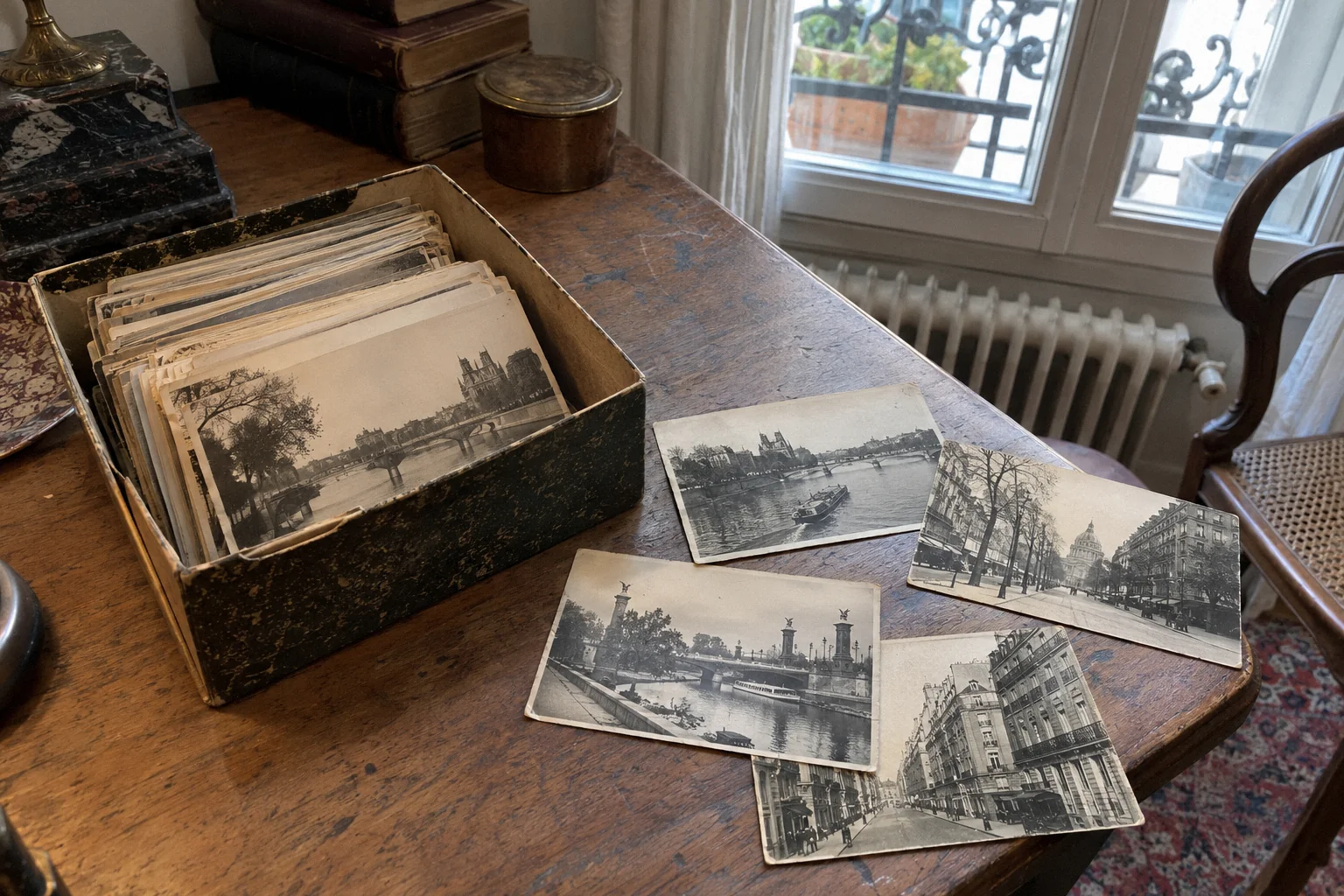
Postcards have long been sold at flea markets, brocantes and collectors' meetings. The principle: you rent a pitch, you display your cards sorted by theme or by place, and you sell them one by one.
This is possible if you have time, patience and a collection you know well. You have to sort, protect, answer questions and accept that the sale will be spread over several outings. For a few cards, it takes a lot of organisation.
Selling online
There are sites for sales between individuals and platforms specialised in collectibles, where postcard enthusiasts gather. They reach a wide audience, sometimes far from where you live.
This route takes work:
- photographing each card, front and back;
- writing an accurate description (place, subject, publisher if shown, condition);
- answering buyers' questions;
- packing and shipping with care;
- allowing for the platform's fees.
It suits someone who knows their cards and has time. For a large collection, the workload quickly becomes considerable.
Auction houses
For a large, well-organised or highly sought-after set, an auction can be considered. The cards are presented in lots, with a description. You need to find out about the conditions: fees, the sale calendar, payment after the sale. For a few ordinary albums, this route is rarely the most suitable.
Which option should you choose?
A few simple guidelines:
- You inherited an album and know nothing about it: have it appraised first. A professional opinion tells you whether there are sought-after cards and which ones deserve a separate sale.
- You want to sell quickly and simply: a buyout by a professional, with immediate payment.
- You are a collector and have time: markets, fairs and online sales let you choose your buyers.
- You have a few remarkable cards in an ordinary set: separate them. They can be sold apart, and the rest as a lot.
- The collection is part of a house to be cleared: look at the whole thing with us, because it is better to deal with postcards, books, furniture and objects in one go. See our page on house clearance after a death.
How do you prepare your postcards before selling?
Good preparation helps, and above all it costs nothing. It also protects your cards.
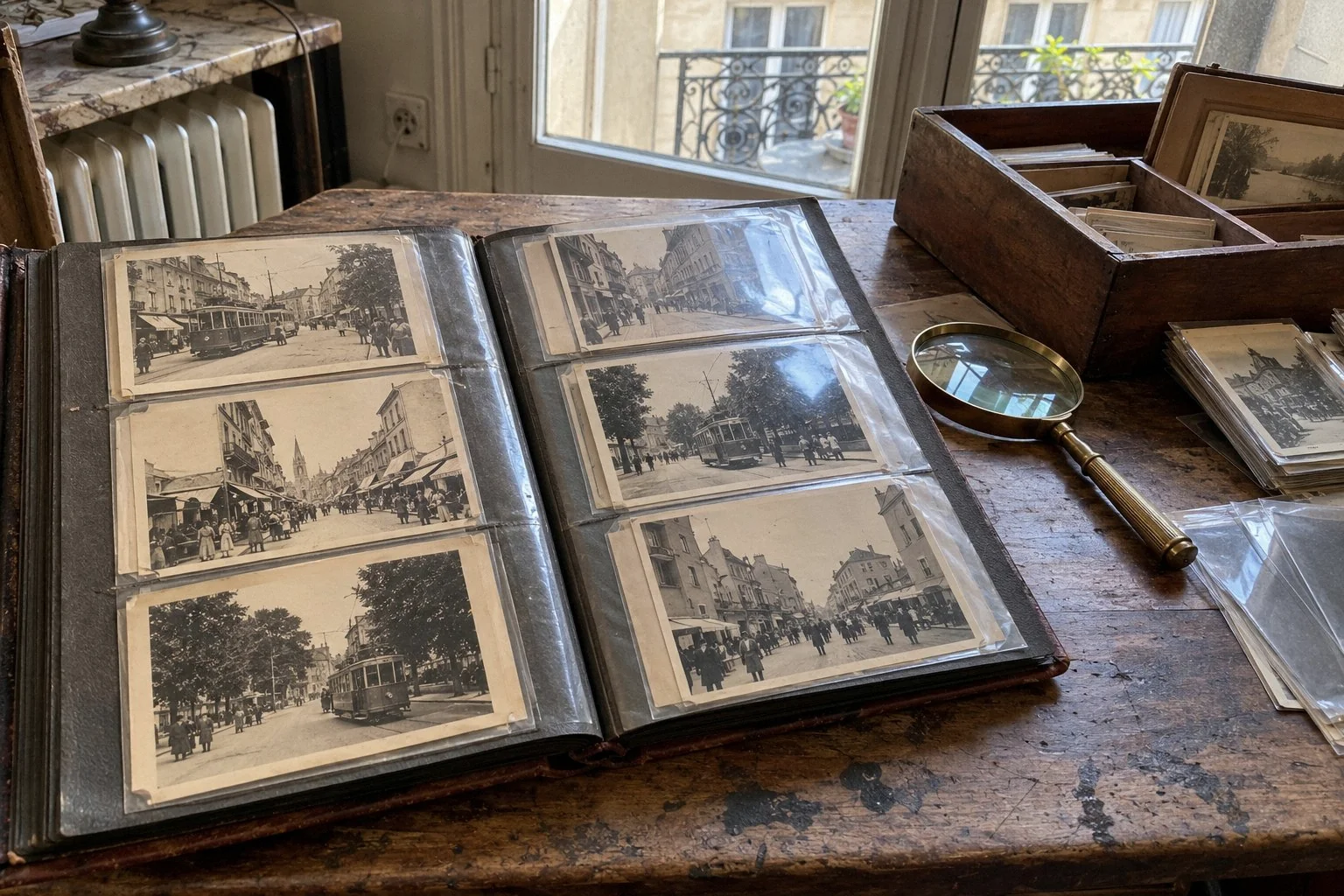
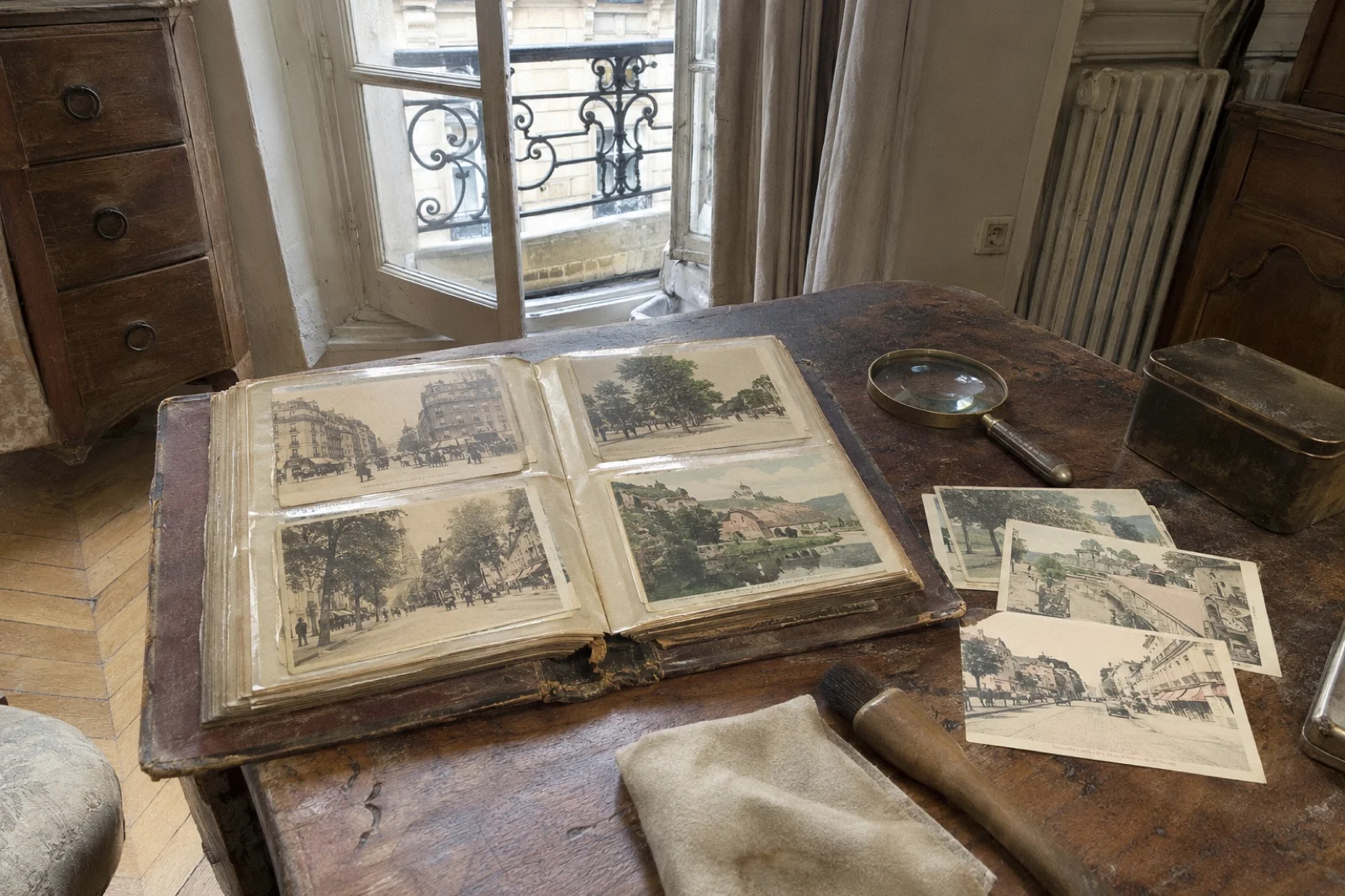
- Do not peel them off. If they are in an album, leave them there. Forcing the corners tears the paper.
- Do not clean them. No eraser, no damp cloth, no sticky tape. A retouched card loses interest.
- Keep the order. A arrangement by town, theme or date tells the story of the collection.
- Store them flat. Avoid rubber bands and piles that bend the corners.
- Keep the papers that come with the collection. A list, a label or the collector's notebook helps us understand it.
- Take clear photos: the album closed, open, a few pages, and the cards that seem the most beautiful to you.
Which old postcards interest collectors the most?
We do not give figures, because everything depends on each card. But we do know what catches enthusiasts' eyes:
- animated views: a market, a café, a shop with its front, people in the street, rather than an empty landscape;
- small trades and scenes of daily life: craftspeople, street traders, workshops, railway stations;
- cards of small towns and villages, often less common than those of big cities;
- themed cards: transport, aviation, events, festivals, advertising;
- cards illustrated by artists: some series are sought after;
- photographic cards, printed in small numbers.
By contrast, very common views, sold in large numbers, are of less interest. To better understand what matters, read our article what are your old postcards worth.
Should you sell one by one or as a lot?
Both are done. Selling one by one lets you highlight the sought-after cards, but it takes time. Selling as a lot is faster, but it sometimes buries the interesting cards in an ordinary set.
Sorting into three piles helps you decide:
- cards that seem sought after;
- decent cards, to be sold together;
- very common or damaged cards.
If you are not sure about the sorting, ask for an opinion. That is exactly what an appraisal does. Our page on the appraisal of old postcards explains what we look at.
Can you sell postcards that are written on or damaged?
Yes. A card that has been written on is not necessarily less interesting. The message, the postmark or the stamp can appeal to some collectors, and many old cards were sent through the post. What weighs most is the subject, the publisher, the rarity and the general condition.
Flaws still matter: broken corners, creases, stains, tears, damp. A very rare damaged card can keep its interest, whereas a common damaged card has little. Describe the flaws honestly, whichever way you choose to sell.
Where can you sell old postcards near Paris?
If you are in Île-de-France, you have the advantage of being able to show your cards in person. At the weekend, you can come to our stand at the Vanves flea market with a few cards or with photos on your phone. We give you a first opinion on the spot.
If the collection is too bulky to carry, we can come to your home, in Paris or in Île-de-France. Travel is free, like the appraisal, and with no obligation.
How does an appraisal with us work?
It takes place in a few steps:
- you send us photos, or we arrange a visit;
- we look at the whole: subjects, publishers, condition, how the collection is organised;
- we tell you what seems interesting to us and what is less so;
- if you wish, we make you a buying offer, with immediate payment.
You are free to say no. The appraisal is free and with no obligation. To find out how to do it without travelling, see our article on the free appraisal from photos.
What if you are still unsure?
Do not sell in a rush. Take an opinion, compare, and decide afterwards. A postcard collection is often a family memory before it is something to sell, and it is natural to want to think about it.
For a free appraisal with no obligation, call us on 06 24 56 38 58 (+33 6 24 56 38 58 from abroad), or send a few photos of your cards on WhatsApp to the same number. We will reply with a first opinion.