By Baptiste Murier, antique and second-hand dealer in Île-de-France.
To sell antique silverware in Île-de-France, the safest approach is to have an antiques dealer examine it first. They look at the hallmarks, the condition, the style and the silversmith, then tell you whether it is solid silver or silver plate. You then know what you own and can choose how to sell with full knowledge. Other routes exist: auctions, online sales, jewellers, precious metal buyers. Each has its advantages and limits, which we detail below.
What are the options for selling antique silverware?
There are roughly five possibilities:
- an antiques dealer or second-hand dealer, who buys on the spot after examining the pieces;
- an auction house, for important pieces;
- a private sale, online or at a flea market;
- a precious metal buyer, who weighs the silver and buys it for its metal;
- a consignment shop, which keeps the item until a buyer comes along.
None of them is right for everyone. It all depends on what you own: a full canteen of cutlery, a single piece of silverware, a few odd cutlery pieces, a family serving dish.
Why show your silverware to an antiques dealer first?
Because silverware is a field where mistakes go both ways. Many people think they have solid silver when it is silver plate. Others think they have ordinary cutlery when one of the dishes is signed by a sought-after silversmith.
An antiques dealer looks at several things at once:
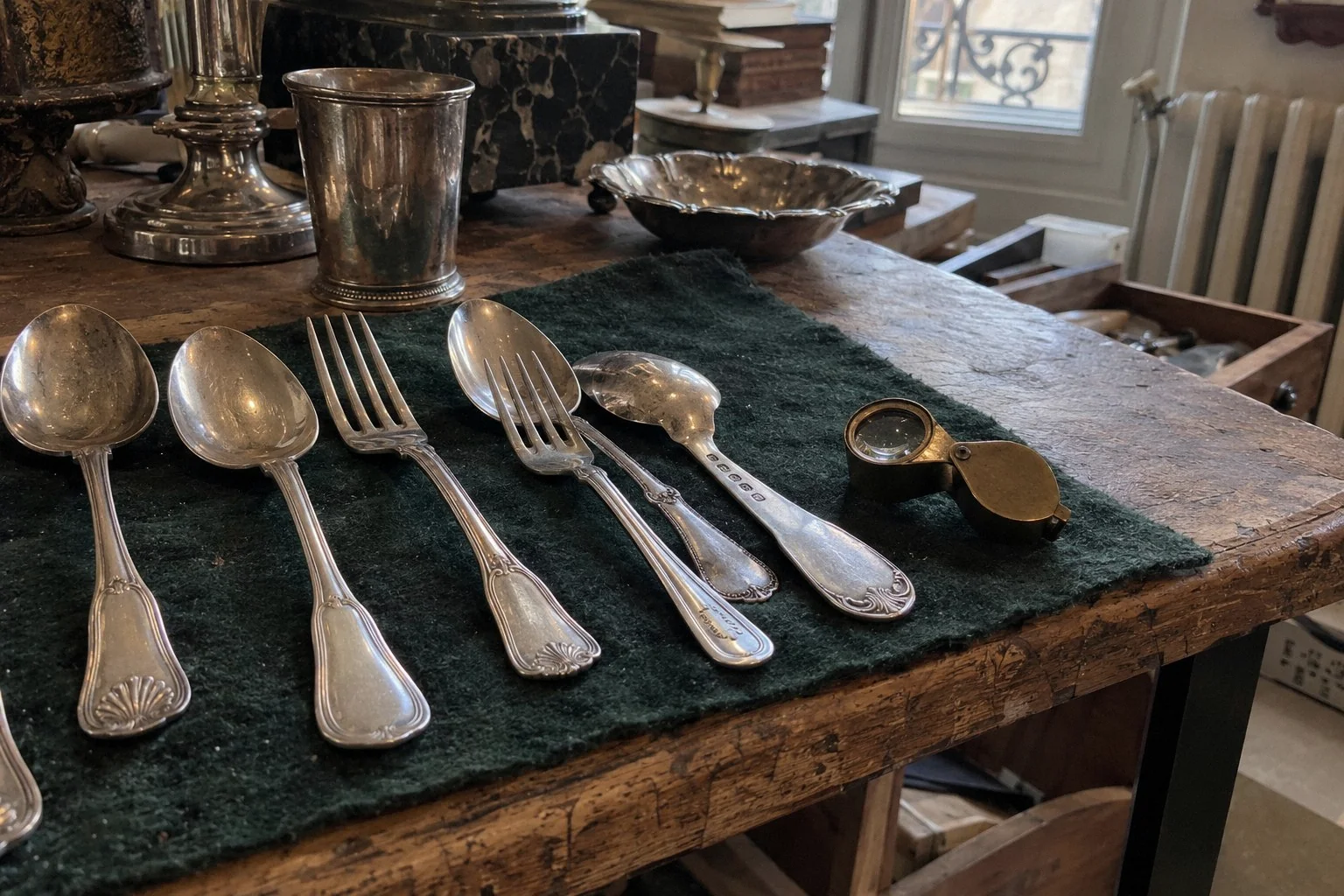
- the hallmarks, which show the metal and often the workshop;
- the style and period, which matter for fine pieces;
- the condition: dents, solder, repairs, wear to the decoration;
- any engraved monogram or coat of arms, which can be a drawback or an interest depending on the case;
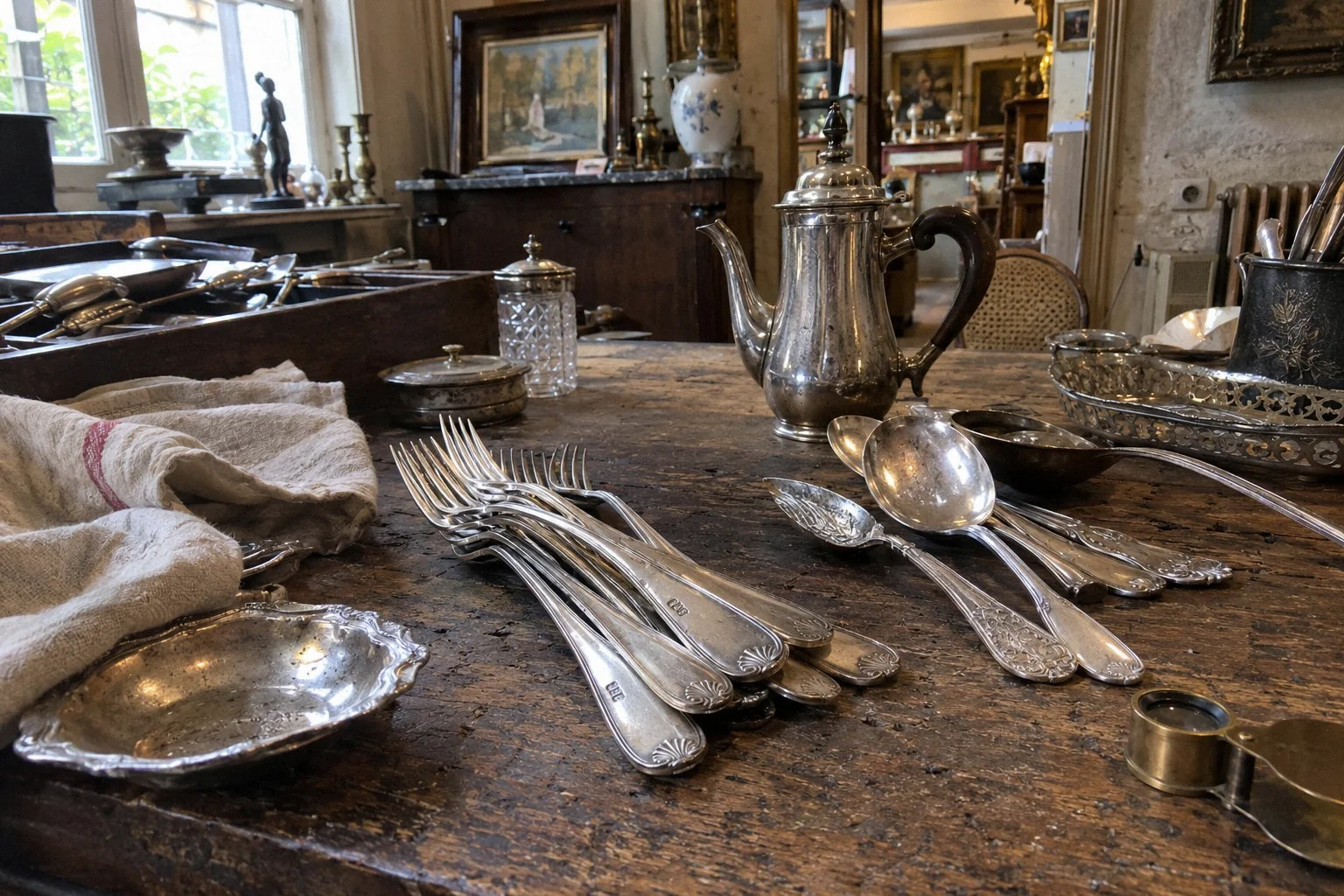
- completeness: a full set is easier to place than single pieces.
With us, a home valuation is free and without obligation, and so is the travel in Paris and Île-de-France. You can also send photos by WhatsApp.
Solid silver or silver plate: what can you sell?
This is the first question to settle, because everything else depends on it.
Solid silver
This is an item made entirely of silver. In France, it generally carries official hallmarks, including the hallmark that shows the silver standard. To recognise them, our article on solid silverware and its hallmarks shows the most common marks. A solid silver item always has some metal value, even when damaged.
Silver plate
This is an item made of a base metal covered with a thin layer of silver. It is often marked with the maker's name, sometimes with a mention such as "silver plated", and its hallmark is of a different kind from those of solid silver. Our guide on the difference between silver plate and solid silver explains how to tell them apart.
Silver plate therefore has little to do with the price of silver. It sells for its quality of manufacture, its maker, its style and its condition. A fine complete set from a well-known maker can attract interest. Odd, worn pieces whose plating has gone are harder to place.
If you are unsure
A magnet is not enough to decide, and a home test can damage the item. It is better to photograph the underside of the pieces: that is where the marks are most often found.
Should you sell your silverware by weight?
The question comes up often, and the answer depends on the piece.
By weight, silver is sold as a metal. The result follows the price of the day and the weight of the piece. It is a logical method for damaged or broken items with no decorative interest, or for very common pieces.
Beyond weight, we look at the value of the object itself. Some pieces are worth more than their metal:
- a piece signed by a known silversmith;
- an old piece of fine workmanship;
- an item with an original shape, such as a teapot, a serving dish or a table centrepiece;
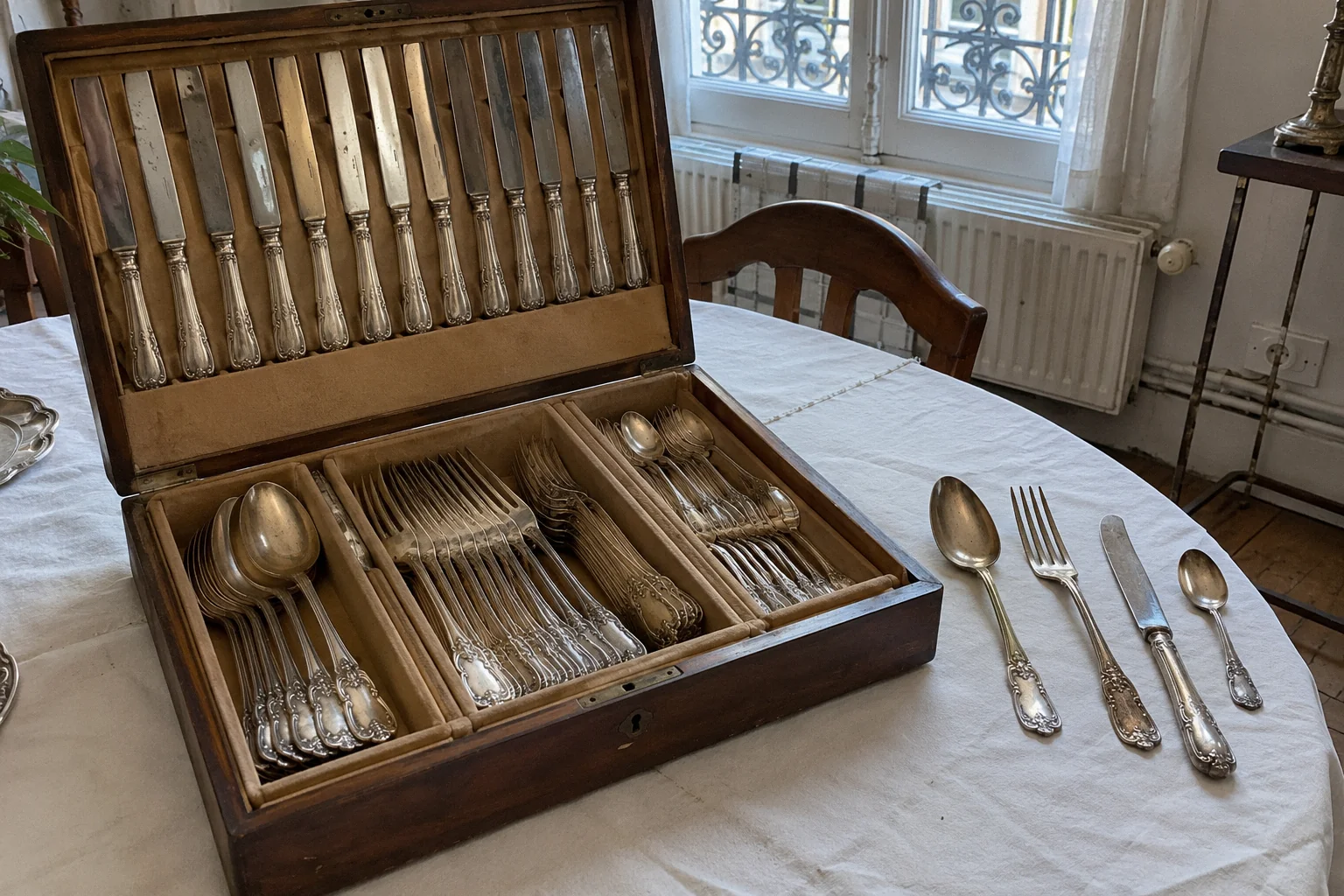
- a complete set in its original case.
Melting down or selling a fine piece by weight is a loss, and a permanent one. That is why we always advise having it looked at first. If, after examination, the piece has only metal value, we tell you plainly.
How do you prepare your silverware before selling?
There is little to do, and mostly things to avoid.
- Do not polish it hard. Vigorous polishing wears down hallmarks and chasing. Dusting is enough.
- Gather everything. Cutlery, dishes, ladles, boxes, cases: the whole group presents better than single pieces.
- Keep the boxes and cases. They are part of the object and help identify it.
- Photograph the marks. The underside, the handle, the rim: a sharp photo in good light.
- Do not separate what goes together. A complete set generally sells better than separate pieces.
Silver tarnishes over time. This is normal and takes nothing away from its value. Do not try to make it shine before the valuation.
Where to sell silverware in particular cases?
An important piece or a collection
If you think you have a remarkable piece of silverware, an antiques dealer's opinion is a good first step. If it turns out to be exceptional, an auction sale can be discussed. It involves fees, a waiting period and a result that is not guaranteed.
Inherited silverware
In an estate, silverware is often among the belongings to sort with the rest of the furniture. Take the time to look at it, share it among the heirs if needed, then have it valued. We support families in this situation: see our page on the antiques dealer for estates.
A lot among other items
When silverware comes with a whole house or apartment to clear, we can look at everything at the same time: furniture, jewellery, clocks, paintings. See the house clearance service, where the amount of the purchase is deducted from the price of the clearance.
How does a sale with Murier Antiquités work?
Baptiste Murier, antiques dealer and second-hand dealer, based in Issy-les-Moulineaux, generally proceeds as follows:
- You contact us by phone or WhatsApp, with a few photos if possible.
- We give a first estimate from photos, or we come to your home.
- We examine the pieces: hallmarks, condition, period, completeness.
- We tell you what is solid silver and what is silver plate, and what we offer to buy.
- You decide. The valuation is without obligation, and you are not committed to anything.
- If you sell, payment is immediate, by bank transfer, which is mandatory for silver and precious metals.
If some pieces do not interest us, we tell you and you keep them. Our service for buying antiques works the same way for other items.
Which areas do we cover?
We travel free of charge in Paris and Île-de-France: Paris (75), Hauts-de-Seine (92), Val-de-Marne (94), Yvelines (78), Essonne (91) and Seine-et-Marne (77). At weekends, you can also show us your pieces at our stand at the Vanves flea market, in the 14th arrondissement of Paris.
What happens to what we do not buy?
A piece of no interest to us is not necessarily of no interest to others. Items that are still usable go to charities such as Emmaüs, the Secours catholique or the Salvation Army, or to nearby resource centres. What is truly beyond use goes to the appropriate recycling and disposal channels.
Good to know before you decide
- Do not sell on impulse a family piece whose history you do not know.
- Be wary of buyers who announce a result before they have seen the item.
- Ask for an explanation of what is solid silver and what is not.
- Keep a photo of each piece before selling it.
- If you hesitate, take your time: a valuation commits you to nothing.
To find out where to sell your antique silverware, call us on 06 24 56 38 58 (+33 6 24 56 38 58 from abroad) or send a few photos on WhatsApp to the same number. We will reply and offer you a free valuation without obligation.