By Baptiste Murier, antique and second-hand dealer in Île-de-France.
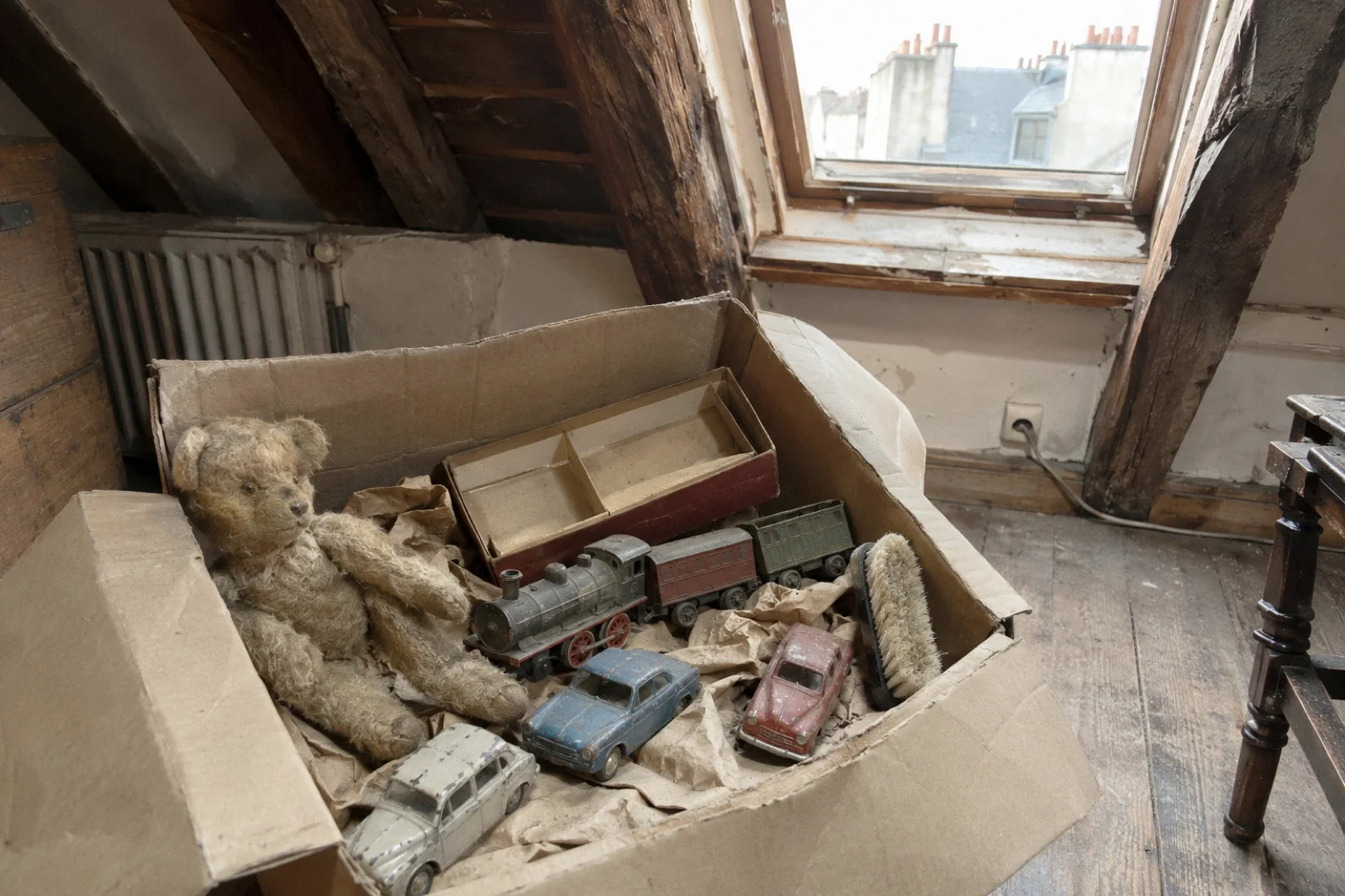
A valuable antique toy is first of all a toy that has kept its original condition: complete, not repainted, not repaired, and ideally with its box. The brand, the series and the rarity come next. In an attic, the pieces that interest collectors most are often model cars, trains, tin toys, dolls and teddy bears from known makers. Do not throw anything away before you have looked closely, and above all do not clean thoroughly.
Which antique toys are worth something?
There is no closed list, but a few families come up again and again among collectors. They are also the ones most often found in attics and cellars.
Model cars and vehicles
The best-known brands are Dinky Toys, Solido, Corgi, Norev and Matchbox. A rare model in good condition and with its box draws more attention. Variations in colour or detail can matter, but only a specialist knows which ones.
A little car that was played with a lot, with bent wheels and chipped paint, is generally of less interest.
Model trains
Märklin, Hornby, Jouef, LR or Fleischmann: these names appear on many children's train sets. A locomotive, wagons, track, a transformer and the original boxes make up a set. Keep everything together, because a complete train is valued more than scattered pieces.
Tin toys and mechanical toys
Wind-up toys made of lithographed tin have a special charm. Among the known makers, we can mention Lehmann, Bing, JEP or CIJ. Check that the mechanism is there and that the key has not gone missing. Rust and missing parts weigh on the value.
Dolls, teddy bears and soft toys
Porcelain-headed dolls can be valuable depending on their brand, condition and original clothes. We cover this in our guide to the antique porcelain doll.
Among teddy bears, the Steiff brand is well known. A button in the ear is a clue worth looking at, but it is not enough on its own to date the bear.
Figurines, games and construction sets
Lead soldiers, figurines, complete board games, Meccano boxes or early Playmobil and Lego can also interest enthusiasts. Toys tied to a film, a series or a comic from the childhood of today's collectors are often sought after.
Does the original box really matter?
Yes, and often a great deal. For a collector, a toy in its original box is rarer and better documented than a toy on its own. The box also shows that the item has not been replaced or modified.
So keep:
- the box, even if it is damaged or torn;
- the cardboard inserts and wrapping papers;
- the instructions, catalogue or assembly sheets;
- the accessories supplied with the toy: keys, track, figurines.
Do not repair a torn box with adhesive tape. Store it flat, with the toy, in a sleeve or an envelope.
What gives an antique toy its value?
Several criteria work together:
- the brand: a maker known to collectors;
- the condition: paint or lithography, mechanism, no rust;
- completeness: all the parts, the accessories, the instructions;
- originality: no touching up, no replaced parts;
- the box: present, legible, complete;
- rarity: a short production run, an uncommon variant, a model that was little distributed;
- demand: some toys are in high demand, others far less, even very old ones.
Age is not enough. A toy that is several decades old may attract little interest if it was made in very large numbers and played with a lot. Conversely, a more recent but rare toy, in its box, can draw attention.
Should you clean or repair an antique toy?
No. It is the most common mistake, and it costs value. A toy that has been repainted, reglued or had a part replaced is no longer in its original condition, and collectors pay close attention to this.
What you can do:
- dust it dry with a soft brush;
- remove batteries carefully, as their contents can damage the metal;
- put loose parts in a bag, kept with the toy.
What is better avoided:
- water, household cleaners and solvents, especially on tin and paper;
- paint, varnish and glue;
- polishing a metal toy, which can wipe off the patina or the paint;
- forcing a wind-up mechanism that resists, at the risk of breaking it.
If in doubt, do not touch it, and show the toy to a professional first.
How do you sort and store toys in the attic?
Before moving anything, take a few photos of everything where it stands. Then proceed step by step:
- Take the boxes out one at a time, without crushing them.
- Separate branded toys, complete games and original boxes.
- Set aside what is fragile: porcelain, thin tin, paper, celluloid.
- Wrap in paper, without squeezing. Avoid closed plastic bags if the item is damp.
- Keep everything away from damp, heat and sunlight.
Celluloid is a fragile and flammable material: keep it away from any source of heat.
How can you tell whether a toy is really old?
Look first for a brand, a maker's name or a manufacturing mention. They are often found underneath the toy, on the body or on the box.
Look at the material too. Tin, lead, wood, celluloid or Bakelite point more towards old toys. Plastic appeared later, but plastic toys that are several decades old are also collected.
Be careful: there are reproductions of old toys, especially in tin. A toy that looks new, with no sign of wear, deserves a second look. A single clue is never enough.
Do all antique toys have value?
No, and we should say so honestly. Many old toys are above all of sentimental value. That is no reason to throw them out without looking, but it is not the promise of a good sale either.
A toy that is badly damaged, incomplete, repainted or without a legible brand interests collectors very little. In that case, keep one or two for the family. For the rest, think about donating.
What can you do with toys nobody wants?
Toys in good condition can be useful to others. During a house or apartment clearance, we give what is not bought but can still be used to Emmaüs, the Secours catholique, the Salvation Army or nearby ressourceries (reuse centres). The rest goes to the appropriate channels, recycling centre or recycling.
If you are sorting things yourself, ask these charities first: each has its own rules for donations.
How do you get antique toys valued?
A valuation from photos is enough for a first opinion. For each toy or each lot, send:
- an overall view;
- the brand or inscription, often underneath;
- the box, from the front and the sides;
- the flaws: rust, missing parts, chips, repairs;
- the accessories and instructions.
We explain the process in our article on free valuation of antique items from photos.
For a whole attic or a collection, we can also come to you. The home valuation is free and without obligation, and so is the trip, in Paris and Île-de-France.
Some very specialised toys belong to the world of dedicated collectors. We will tell you what we know, and what we prefer not to claim. If you are interested in selling, we can also buy these toys from you and pay on the spot.
Do you have toys sleeping in your attic and are unsure whether to keep them? Call us on +33 6 24 56 38 58 (06 24 56 38 58 from within France), or write to us on WhatsApp at the same number, with a few photos. The valuation is free and without obligation.