By Baptiste Murier, antique and second-hand dealer in Île-de-France.
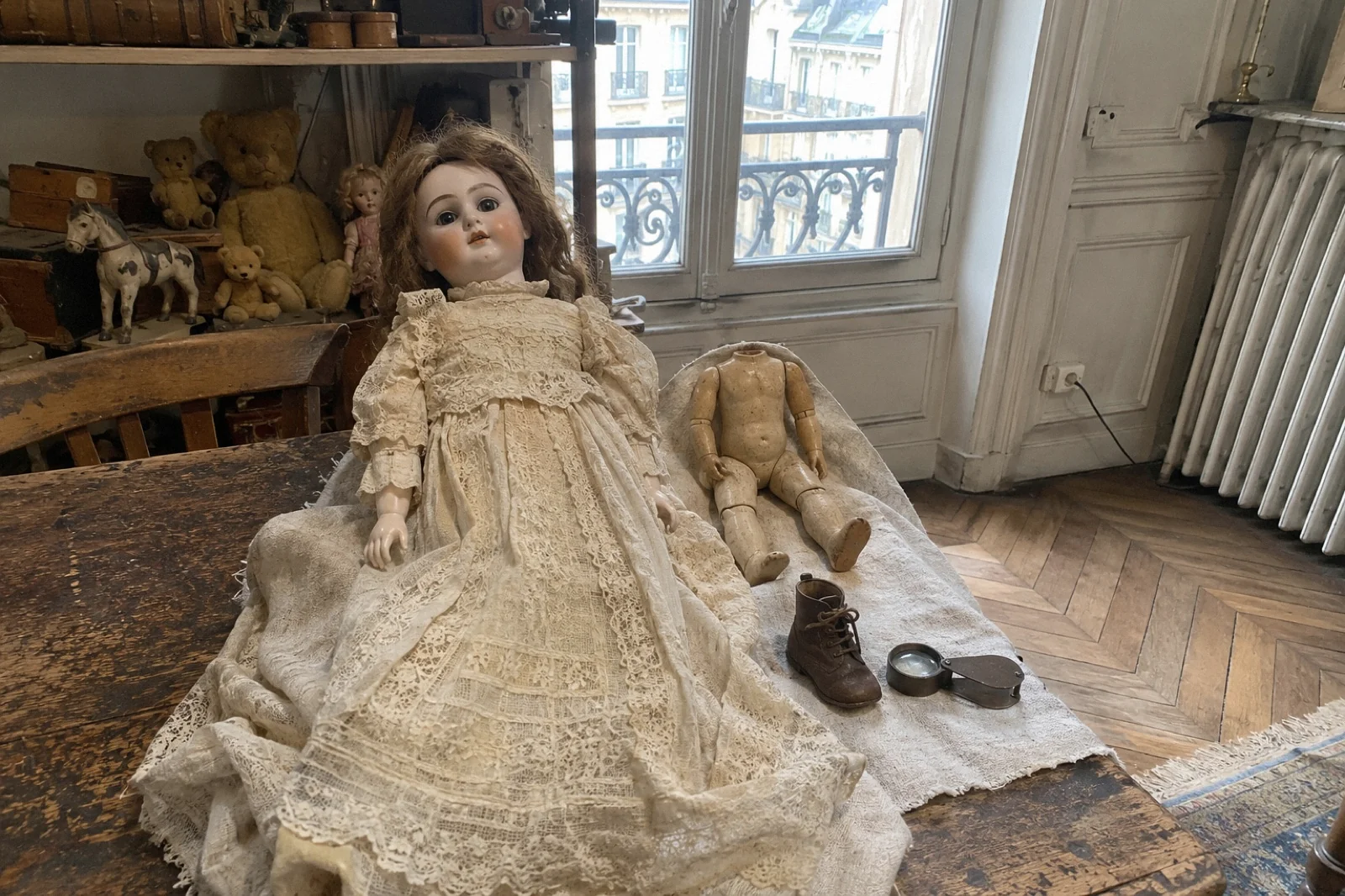
The value of an antique porcelain doll depends first on its mark and model, then on the condition of its head and on whether it still has its original body and clothes. A marked, undamaged, complete doll interests collectors. A doll with no mark, with a crack, or put together from different parts is worth noticeably less.
There is no price list. Two dolls that look alike can have very different values. Here are the points to check at home before asking for an appraisal.
What gives an antique doll its value?
Antique dealers and collectors look at several things, always together:
- the mark: a doll attributed to a well-known maker is more sought after than an anonymous one;
- the condition of the head: no crack, no chip, no repainting;
- the original set: head, body, wig and clothes that belong together;
- the rarity of the model: some faces or sizes were produced in small numbers;
- the quality of the making: fineness of the painting, eyes, mouth, hands;
- the age: a genuine doll from the 19th century or the early 20th century is not a recent reproduction.
One of these points alone is not enough. A fine mark does not make up for a head that was broken and glued back, and very good condition does not save a modern copy.
Porcelain, bisque: what material are we talking about?
Many antique dolls have a bisque head. This is porcelain fired without glaze, with a soft, matte feel. The face is painted by hand, or from a decoration applied before a last firing.
Other heads are in glazed porcelain, which is shiny and sometimes called "china" heads. There are also papier-mâché or composition heads, which are not porcelain but can be old and sought after.
Where do I find the mark on an antique doll?
A mark helps identify the maker, the mould and sometimes the size. Here is where to look:
- the nape of the neck, under the wig or hair: this is the most common place, with letters, numbers or a name incised in the porcelain;
- the back, between the shoulder blades, on a composition body;
- the soles of the feet or the legs, where there is sometimes a stamp;
- the clothes and the box: labels, stamps, original cardboard.
Do not pull on the wig and do not force anything. Gently lift the hair with a flashlight. Photograph the mark up close, straight on, in good light.
Names of French and German makers come up often, such as Jumeau, Bru, Steiner, Simon & Halbig, Kämmer & Reinhardt, Armand Marseille or SFBJ. But a mark alone does not tell the whole story: you have to look at the whole doll.
Does the original body really matter?
Yes. Many dolls have lost their original body, or were given a head that did not belong with it. This assembly, sometimes made long ago, reduces the interest for a demanding collector.
Depending on the period and the model, the body may be:
- in composition (a moulded and painted mixture), often jointed at the hips, shoulders and knees;
- in wood, sometimes with visible joints;
- in kid leather or padded fabric, especially on older models;
- in papier-mâché.
The head should fit the body properly, with no wedge or visible stuffing, and its size should match the body. A replacement body does not make the doll worthless. It simply has to be taken into account, and stated frankly at the time of the appraisal.
Do the original clothes change the value?
A great deal. A doll with its dress, shoes, hat and period underwear is more sought after than a doll redressed later with new clothes or clothes made by the family.
A few tips:
- do not redress it before having it appraised;
- do not wash the fabrics: water can make dyes run and damage silk;
- keep the boxes, labels, scraps of paper or accessories stored with it;
- write down what you know of its family history, without inventing anything.
How can I spot a crack or a restoration?
Porcelain heads are fragile. A fine hairline crack, a repair at the edge of the eye socket or repainting on the cheek are common on antique dolls.
To check at home:
- turn the head under raking light, without shaking it;
- look at the forehead, the temples, the edge of the neck and the eye holes;
- note any areas that are shinier or more matte than the rest;
- do not tap the porcelain to listen to the sound: you could make an invisible crack worse.
If you find a crack, do not repair it yourself. Ordinary glue leaves lasting marks and makes a restorer's work harder. Wrap the doll in tissue paper and keep it safe from knocks.
How can I tell an antique doll from a reproduction?
Many porcelain dolls "in the old style" have been made, and are still made, some of them very well. A few clues:
- the painting: on a recent copy it is often too even, too crisp;
- the mark: some reproductions carry invented marks or modern wording;
- the body and joints: plastic materials, modern screws or recent rubber should raise suspicion;
- the clothes: industrial fabrics and stitching, recent fastenings.
No single clue settles it. The idea is the same for other objects, and our article on antique objects that have value gives more pointers.
Can I clean my doll before having it appraised?
The best approach is to do almost nothing. Gentle dusting with a soft brush is enough. Do not use water on a painted face, no household products, no varnish.
Over-zealous cleaning can remove the patina, wipe off the cheeks or lips, or lift an old wig. A doll that keeps its honest signs of use is often easier to assess than a "freshened up" one.
How can I have an antique doll appraised?
A few photos are enough for a first opinion. Send:
- a front view of the whole doll;
- a close-up of the face, eyes open if possible;
- the nape and any incised or stamped mark;
- the body and the joints, with or without the clothes;
- any flaws you know about: crack, chip, repair.
Our approach is explained in the article on the free appraisal of antiques from photos. For a doll of value, seeing it in person is still better: we can come to you, because the home appraisal is free, and so is the travel, in Paris and Île-de-France.
We tell you frankly what we see, what we cannot confirm and what would deserve a more specialised opinion. If you are interested in selling, we buy objects on the spot, with immediate payment.
What if the doll comes from a house that has to be emptied?
A doll is often found in an attic, a trunk or a child's bedroom, among other toys, linen and keepsakes. Before throwing anything away, set it aside with everything that goes with it: clothes, small suitcases, boxes, albums.
If the whole house has to be cleared, our house clearance service starts with a free visit and a sort. The amount of the buyback is deducted from the price of the clearance, and objects that can still be used are given to charities such as Emmaüs, the Secours catholique or the Armée du Salut (Salvation Army).
Have an antique doll to be appraised? Call 06 24 56 38 58 (+33 6 24 56 38 58 from abroad) or send photos on WhatsApp to the same number. Free appraisal, no obligation.