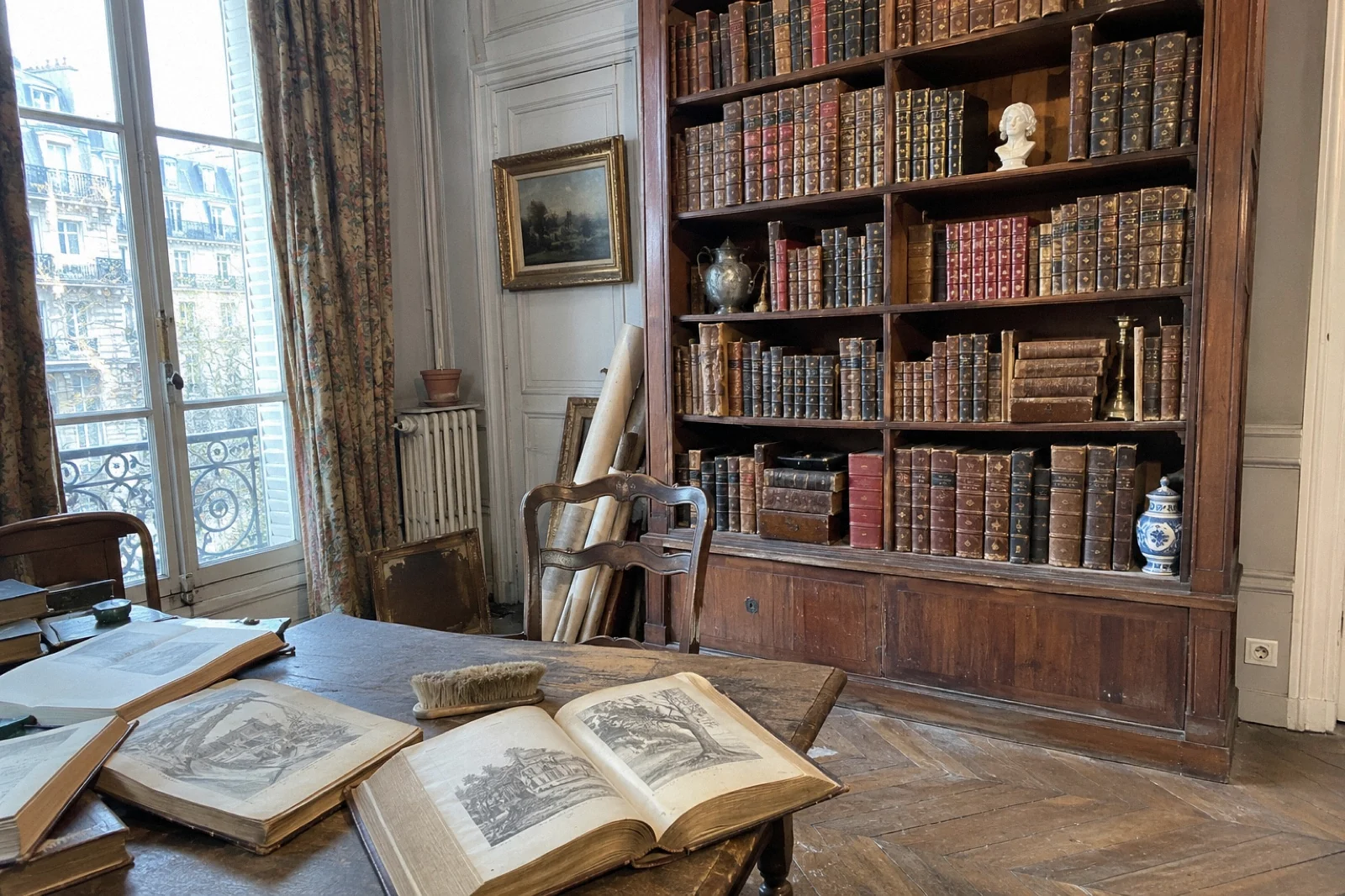
By Baptiste Murier, antique and second-hand dealer in Île-de-France.
An antique book is valuable when several criteria come together: a sought-after edition, real rarity, good condition and, often, a fine binding or fine illustrations. Age alone is not enough. A 19th-century book printed in a large run can be found everywhere, while a first edition by a well-known author, a rare illustrated book or a complete 16th-century work can interest collectors and booksellers. This guide helps you make a first sort and know what to look at before showing your books.
Is an old book always valuable?
No, and this is often the first surprise. A book can be more than a hundred years old and still be very common. This is the case for many family Bibles, encyclopedias, school prize books and bound sets of complete works. They look lovely on a shelf, but the market is well supplied with them.
Conversely, a less old book can be highly sought after: a first edition by a 20th-century writer, a comic book album in its first printing, a book made with an artist. To judge, we look at:
- the edition: first or common;
- the rarity: print run, how many copies have survived;
- the condition: paper, binding, cover;
- completeness: all the volumes, all the plates, all the maps;
- the author and the subject, depending on what collectors are looking for;
- the history of the copy: inscription, bookplate, provenance.
Which antique books are most likely to be valuable?
These are the families that collectors and booksellers look at first. None of them guarantees anything: each copy is judged on its own.
First editions
A first edition is the first appearance of a text as a book. It matters mostly in literature, poetry and for the major texts of science or philosophy. You can spot it from the title page, the date, the edition statement and the colophon at the end of the volume.
But "first" does not mean "rare": some titles were printed in very large numbers. Deluxe copies, on fine paper and numbered, are generally more sought after. The print run statement, when there is one, will tell you.
Very old books
Books printed before 1501 are called incunabula. Works from the 16th and 17th centuries can also be of interest. For these books, completeness weighs heavily: without a title page, or with missing leaves, an old book loses much of its interest.
Illustrated books, atlases and travel accounts
Engravings, hand-colored plates, illustrations signed by a known artist: the images are often what makes the book interesting. Think of botany, ornithology, medicine, fashion, travel accounts, atlases, and books illustrated by painters in the 20th century.
One point to watch: a book whose plates have been removed to be sold one by one has lost most of its interest. Folding maps, for their part, are fragile along the folds, so check whether they are intact.
Bindings and inscribed books
A leather binding with a decorated spine looks handsome, but it does not by itself make a book valuable: many decorative bindings were fitted in series on common texts. It counts for more when it is carefully made, old, or signed by a recognized binder, on a sought-after text.
An inscribed copy, that is, a dedication handwritten by the author, can also add interest, especially if it is addressed to a well-known person.
Which books are rarely valuable?
Without making it a rule, these books are generally very widespread:
- 19th- and 20th-century encyclopedias and dictionaries;
- book club collections and paperback editions;
- school prize books and textbooks;
- journals and magazines, even when bound into volumes;
- common 19th-century Bibles and missals.
A title on this list can be an exception, through an inscription, a binding or a remarkable condition. That is why it is better to look before throwing anything away.
How can I make a first sort at home?
Take one book at a time, with good light and clean hands.
- Open to the title page: note the title, author, publisher, place and date.
- Look for the edition statement and, at the end of the volume, the colophon.
- Check the print run statement, if there is one.
- Leaf through gently: are the plates, maps and pages all there?
- Note the condition of the spine, corners, cover and paper.
- Look for an inscription, a bookplate or a stamp.
- Photograph everything.
One precaution: do not set a value from online listings. A listing shows what someone is asking, not what has actually sold.
Which flaws lower the value of a book?
- damp and mold, which leave stains and a bad smell;
- torn or missing leaves;
- a detached binding, a broken spine, gatherings coming apart;
- insect damage in the paper;
- pen annotations, underlined passages, library stamps;
- a missing original dust jacket or cover on a 20th-century book.
Foxing, those small brown spots, is common on old paper. A slightly foxed book is not doomed, but the overall condition always counts.
What should you never do with an antique book?
- Do not tape it or glue it back together: adhesive damages the paper.
- Do not clean it with a household product.
- Do not try to restore it yourself.
- Do not detach a plate or a map to frame it.
- Do not store it in a damp cellar or a hot attic.
- Do not throw it away before it has been looked at.
A gentle, dry dusting is enough. The rest is a job for a professional.
What should you do with a whole library?
Have it looked at before clearing it. In a library, a few volumes can be worth far more than all the rest, and they are sometimes mixed in with the most ordinary books.
This is a common situation in an inheritance. When everything has to be organized quickly, the books often go into boxes without having been looked at. Our article on what to do with the furniture and objects of an estate gives the first points of reference (the article covers inheritance in France).
If the property has to be emptied, our house clearance service includes a free visit, an appraisal, sorting and a buyout, and what we buy is deducted from the cost of the clearance. In the meantime, leave the books where they are, shelf by shelf, and photograph the shelves. Set aside any inscribed books.
Books that we do not buy but that remain in good condition can be given to charities in France such as Emmaüs or the Secours catholique, or to a local ressourcerie (a reuse and recycling center). The others follow the appropriate sorting channels.
Where can you have antique books appraised and sold?
Several routes exist: a bookseller specializing in antique books, an auction, an antique dealer, or a direct sale between individuals. Each has its advantages and constraints, notably in time and paperwork.
At Murier Antiquités, we look at books as part of a free appraisal, at your home or from photos, with no obligation. If a book seems of particular interest to us, we tell you honestly, and we may advise you to consult a specialist. And if you are interested in selling, we can also buy some of your books and pay you on the spot.
Which photos should you send for an appraisal from photos?
For a first opinion to be useful, send:
- the cover and spine of each book;
- the title page;
- the print run statement or the colophon;
- the plates and illustrations;
- the flaws: stains, tears, damaged corners;
- any inscription, stamp or bookplate;
- a whole bookshelf, if you have a library.
Prefer natural light and sharp photos without glare. How it works is explained in our article on the free appraisal of antiques from photos.
Have books you would like looked at? Call us on 06 24 56 38 58 (+33 6 24 56 38 58 from abroad), or write to us on WhatsApp at the same number with a few photos attached. The appraisal costs nothing and commits you to nothing.