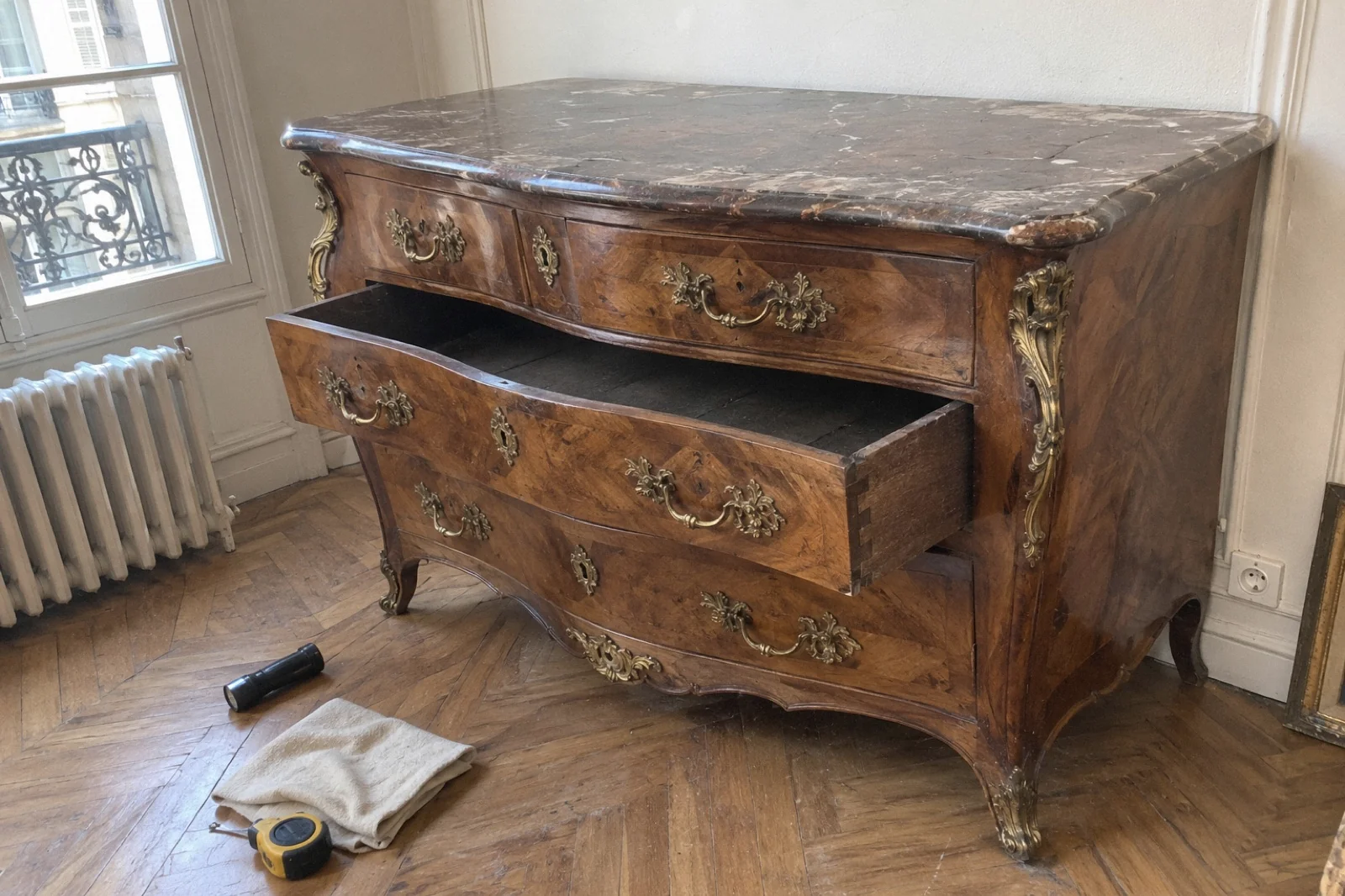
By Baptiste Murier, antique and second-hand dealer in Île-de-France.
To value antique furniture, work in this order: identify the style, examine the woods and the joints, look for restoration, then compare with similar pieces. You can do the first steps at home with a lamp and a phone. The exact value, however, calls for the eye of a professional who has seen a great many pieces.
What do you look at when valuing antique furniture?
Four things matter.
- Authenticity: is the piece genuinely of the period, or only in the style?
- Quality: the finesse of the construction, the decoration and the bronzes.
- Condition: wear, missing parts, restoration.
- Demand: some pieces sell easily, others much less so.
The first three points can be partly checked at home. The last one is judged by knowing the market.
How do you know what period a piece of furniture is from?
Start with the style. A few reference points for French furniture:
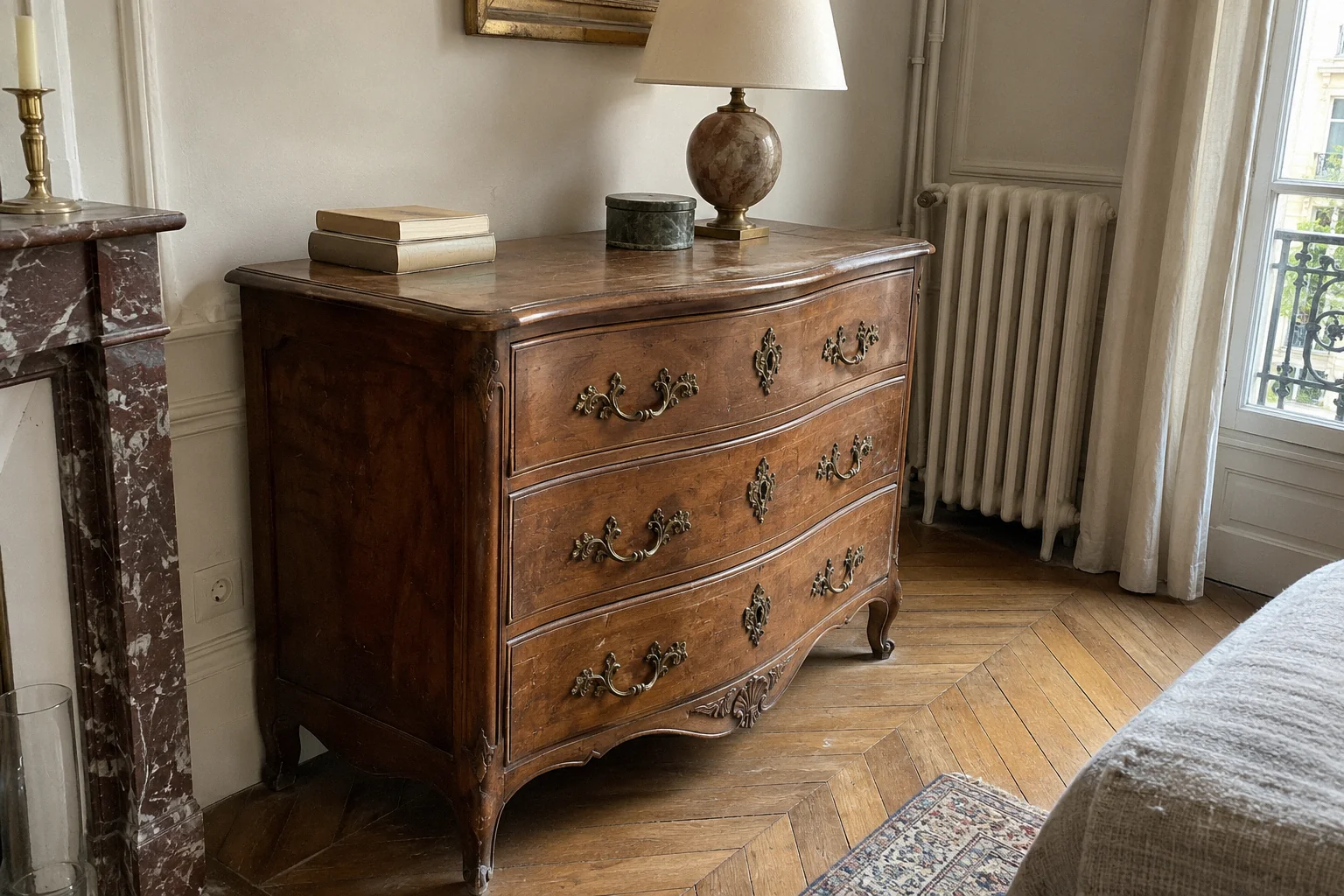
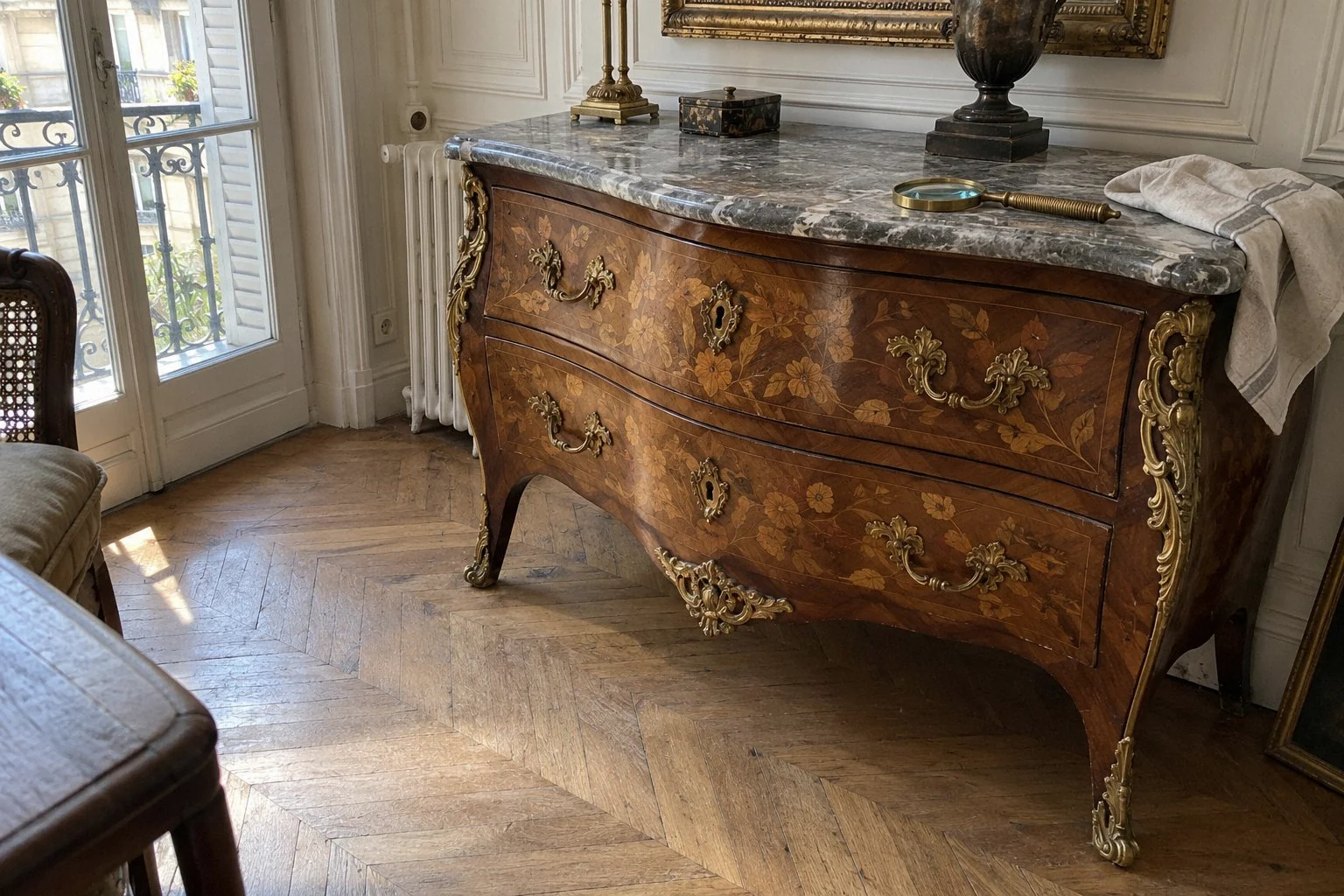
- Louis XV: curved lines, cabriole legs, bombé fronts;
- Louis XVI: straight lines, tapered legs, fluting;
- Empire: massive forms, mahogany, gilt bronzes;
- Louis-Philippe: restrained lines, woods often light or mahogany;
- Napoleon III: a mix of older styles, blackened wood, inlays, buttoned upholstered seats.
Be careful: a style is not a date. Many pieces "in the Louis XV style" were made in the 19th or 20th century. Some are genuine antiques, but they are not 18th-century furniture. For a specific example, we go through the points to check on a curved piece in how to value a Louis XV commode.
Which details show that a piece of furniture is old?
Turn the piece over, open the drawers, look at the back. This is where the clues are hidden.
The joints
On drawers, hand-cut dovetails are often slightly irregular. Perfectly regular dovetails suggest machine manufacture, and so a later date. This is not proof, only a clue.
Mortise and tenon joints, sometimes pegged, are common on old furniture. Metal staples or cross-head screws point to a repair, or to a recent piece.
Tool marks
On the back and underside, old wood shows plane or saw marks. Circular saw marks, in arcs, indicate wood cut by machine, generally from the 19th century onwards. A chipboard back reveals a recent piece, or a repair.
Wear and patina
Wear should be logical: the edges of the top, the handles, the feet, the drawer runners. A perfectly uniform patina, with no marks where people touch the piece, may come from artificial ageing.
Raw wood, inside a drawer or at the back, has often darkened with time. A pale, fresh colour in the same place may indicate a replaced element.
Woodworm holes
Small round holes are common on old furniture. They do not prove age, because they can be imitated. Above all, check whether they come with a fine, pale, fresh dust: the infestation may be active. If so, move the piece away from the other wood in the house and have it treated.
Marks and stamps
Some pieces carry a stamp, that is a name or initials punched into the wood, often on an upright or under a rail. In the 18th century, Parisian cabinetmakers signed their furniture in this way. Photograph the mark without rubbing it. It is a useful clue, but it guarantees nothing on its own: some marks were added afterwards.
Which woods and decoration will you find?
The wood helps to place a piece without dating it by itself. Oak, walnut, wild cherry and beech are often found in country furniture and joinery. Mahogany is very common from the end of the 18th century and in the 19th century.
Cabinetmaker's pieces are often veneered: thin sheets of precious wood are glued onto a more ordinary wood. This is not a flaw, it is an old technique. Marquetry draws patterns with several species of wood. Gilt bronzes, and the marble top of a commode or console table, add to the quality of the piece, provided they are original.
How do you spot restoration?
Restoration is not necessarily serious, but you need to see it. Go over:
- the top: is it a different colour or grain from the rest?
- the feet: shortened, replaced, added?
- the veneer: blisters, re-gluing, replaced pieces?
- the drawers: bottoms or sides redone?
- the hardware: handles, keyhole escutcheons and keys consistent with each other?
- the varnish: shiny and recent on a piece that should have aged?
Raking light from a flashlight shows joins well. A strong smell of varnish or solvent often signals recent refurbishment.
Does restored furniture lose its value?
Not necessarily. Re-gluing a veneer, replacing a key or refreshing a varnish is part of the life of a piece that is several centuries old. Careful, well-executed, discreet restoration is common and accepted.
Value falls rather when the piece has been heavily altered: a replaced top, added feet, a rebuilt front, or a "married" piece, that is one made up of two elements of different origins, for example a base and an upper section that do not belong together.
A simple piece of advice: do not strip, repaint or over-wax before you have an opinion. A gentle dusting is enough.
What makes the value of antique furniture vary?
Several elements work together:
- the authenticity of the period and style;
- the quality of the making and the decoration;
- the condition, the restoration and any missing parts;
- rarity, signature, and provenance if it is known;
- the dimensions and the possible use in a home today;
- current demand.
The market is selective. Some very common large, massive pieces sometimes sell with difficulty, while finer, rarer or better preserved pieces remain sought after. Each type of furniture has its own market. For a regional piece, see for example our article on the old Normandy wardrobe.
How do you make a first valuation yourself?
- Measure the piece: height, width, depth.
- Photograph the whole piece, then the back, an open drawer, the joints, the handles, the feet and any mark.
- Note the style you think it matches, the wood, and any inscriptions, labels or numbers.
- Look for similar pieces that have actually sold, not simply been offered for sale. A listing on display is not a completed sale.
- Gather what you know: where the piece comes from, how long it has been in the family, whether it has already been repaired, whether an invoice or an inventory exists.
This method gives an idea, rarely a reliable figure. Between two pieces that look alike, the difference in value often comes down to details that only a trained eye picks out.
Where can you have antique furniture valued?
You can go to an antiques dealer or to an auction house. Whichever you choose, ask what the opinion given is based on and whether the valuation is free.
At Murier Antiquités, the valuation is free and without obligation, at your home or from photos. Travel is free in Paris and Île-de-France. Our page on the valuation of period furniture explains what we look at on a piece. If you wish to sell, we can buy your items with immediate payment.
If the piece does not interest us, we tell you. And if you prefer to keep it, the opinion is still useful for insuring it or passing it on.
For a free valuation, call us on 06 24 56 38 58 (+33 6 24 56 38 58 from abroad) or send a few photos of your piece of furniture on WhatsApp to the same number.