By Baptiste Murier, antique and second-hand dealer in Île-de-France.
The value of an antique Normandy wardrobe depends on four things: its age, the quality of its carving, the wood used and its state of preservation.
Today, many ordinary Normandy wardrobes sell at a modest level. They are large and heavy, and interiors have changed.
Older pieces, well carved and still in their original state, do catch the attention of collectors. Only an examination of the piece, or good photos, makes it possible to tell them apart.
What is a Normandy wardrobe?
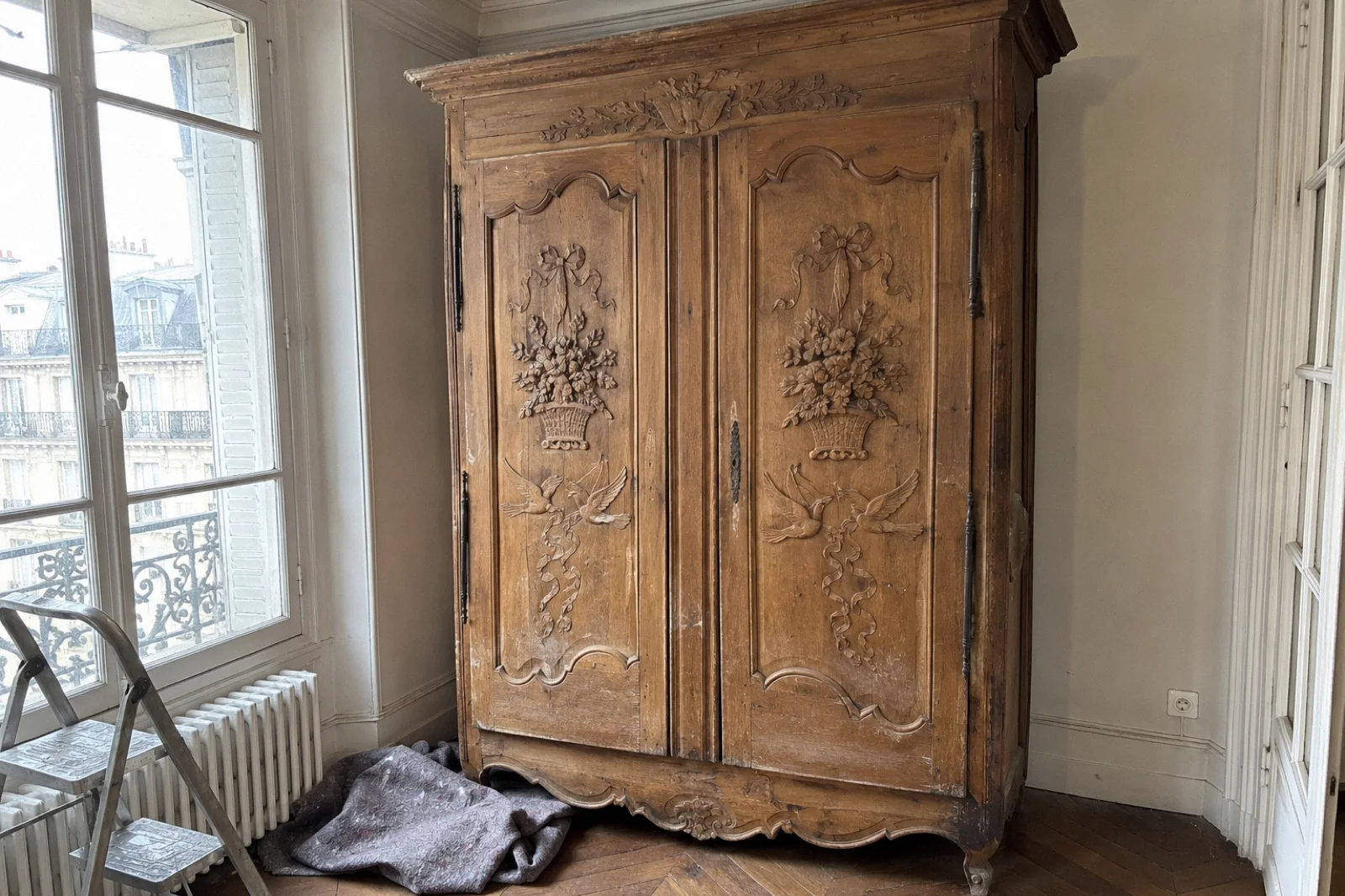
The Normandy wardrobe is a regional storage piece, made mostly of oak, sometimes of cherry or walnut. It usually has two doors, a curved cornice known as a "chapeau de gendarme" (a gendarme's hat) and carved panels.
The decoration repeats motifs found from one wardrobe to the next:
- baskets or bunches of flowers;
- ribbon bows and garlands;
- doves or birds facing each other;
- scrolls and foliage;
- keyhole plates and brass or iron fittings.
Doves and bows are often read as symbols of union. That is why people readily speak of a marriage wardrobe: a piece linked to the bride's trousseau.
Be careful with the name. "Normandy" covers pieces of very different periods and qualities. The model was copied for a long time, and later wardrobes, even reproductions, are also in circulation.
What is an antique Normandy wardrobe worth today?
We do not give a figure in this guide. Two wardrobes that look alike can be valued very differently, and a general range would be misleading.
What we can say is that the market for antique regional furniture is often difficult. Several reasons explain this:
- wardrobes are bulky, and few homes have room for them;
- they were made in large numbers, so supply is plentiful;
- tastes have moved towards lighter, plainer interiors;
- transport and refurbishment take time for the person reselling.
That does not mean a Normandy wardrobe has no value. A fine antique piece, coherent and well preserved, finds a buyer among dealers and private buyers who like original furniture. It is the detail of the piece, not its name alone, that makes the difference.
Which criteria change the value?
The period
An eighteenth-century wardrobe is not of the same interest as one from the early twentieth century. Louis XV, Louis XVI or Directoire styles were copied over a long period, and the date of a piece is not always obvious at first glance.
Mouldings, the profile of the feet and the shape of the cornice give clues. They are not enough on their own.
The wood and the construction
Solid oak, cherry and walnut are well-liked woods for this kind of furniture. We check whether the panels are solid wood, whether the joinery is made with tenons, mortises and pegs, and whether the back is made of planks.
Plywood, staples or modern screws should give pause: they often point to a repair or a more recent piece.
The carving
Fine, crisp carving with a rich design counts for a lot. Soft, shallow or very repetitive carving can indicate a later or mass-produced piece. Handwork shows small irregularities that are less common in machine work.
Condition and authenticity
Collectors like wardrobes that have kept their original elements: locks, fittings, feet, cornice, panels. These are the flaws to watch for:
- woodworm traces, especially if they are recent;
- damp, cracks, warped panels;
- remade feet, a replaced or shortened cornice;
- a wardrobe cut down in height or width to fit into a room;
- excessive stripping that has erased the old patina.
Size and interior
A more compact wardrobe is easier to place and can appeal to more buyers. The interior matters too: shelves, hanging space, drawers. An original interior is appreciated, but alterations made for modern use are common.
The history of the piece
A wardrobe from a family home, with a known history, is easier to place. Note down what you know, even if it is not enough to prove the age of the piece.
How do you tell an antique wardrobe from a copy?
No single sign is enough. Here is what we look at:
- wear: it appears where the piece is touched, such as door edges, handles and the bottom of the panels;
- joinery: visible pegs, tool marks, small irregularities;
- the back and the underside: raw wood planks, an even colour, no recent parts;
- the fittings: locks and hinges consistent with the age of the piece, with no sign of replacement;
- the patina: a deep, slightly uneven tone, rather than a uniform varnish;
- the varnish: a thick, shiny, recent coat can hide repairs.
If in doubt, open the doors and look inside. That is often where the age of a piece shows best.
If your wardrobe is close in style to a chest of drawers, our guide to valuing a Louis XV commode follows the same way of reading a piece: shape, wood, ornament and condition.
Does a restored or altered wardrobe still have value?
Yes, but it all depends on the extent of the changes. Cleaning, waxing or replacing a small damaged part are common interventions on antique furniture.
A wardrobe that has been completely repainted, cut down or converted, for example into a bathroom cabinet, generally loses interest for collectors of antiques.
If in doubt, do nothing before showing it. Do not strip it, do not repaint it, do not apply any product: a poorly chosen restoration can wipe out what made the piece interesting.
Can a Normandy wardrobe be taken apart?
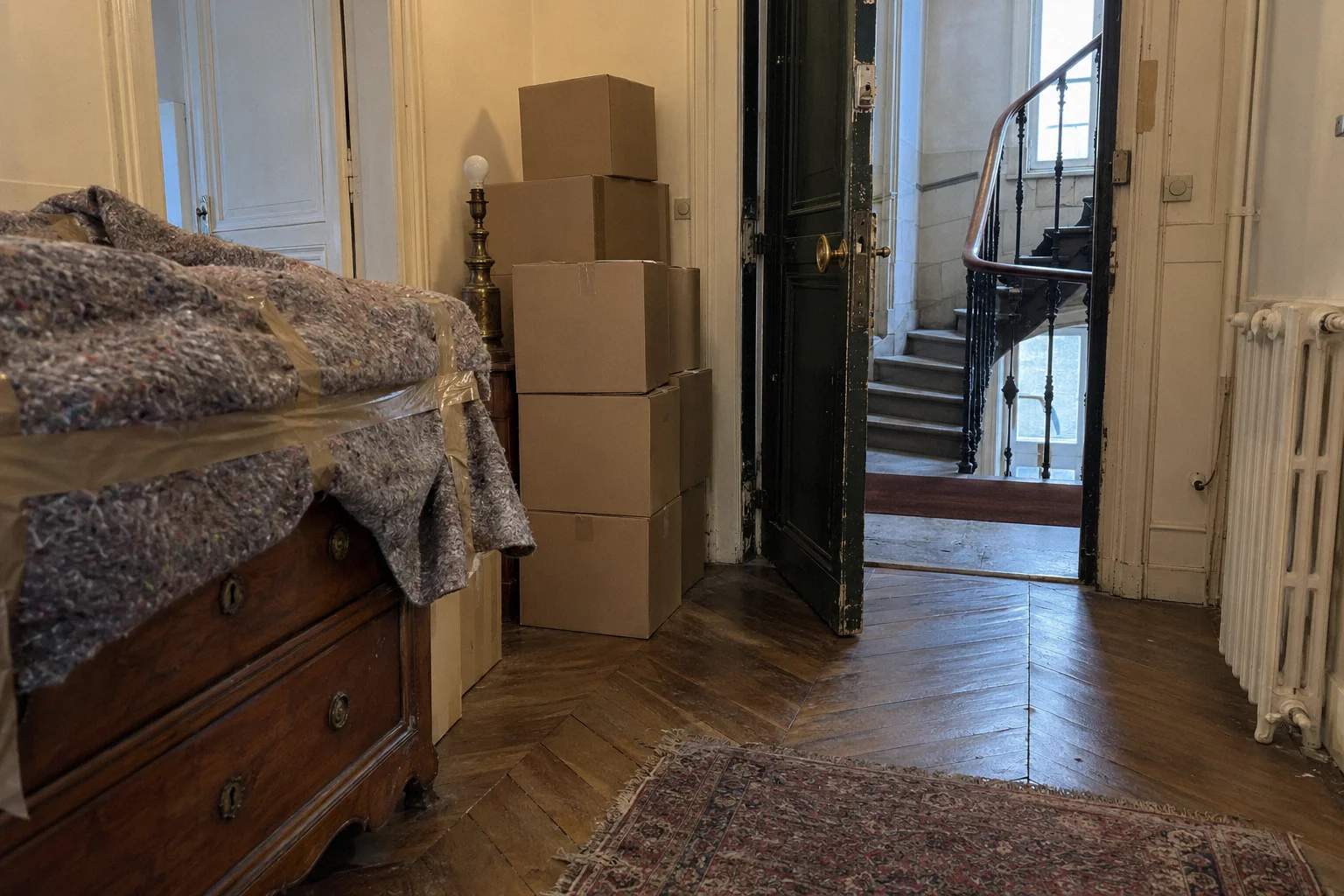
In general, yes. Antique wardrobes are joined with tenons, mortises and pegs, and their parts usually come apart: cornice, sides, panels, and sometimes the doors, which are removed by lifting them off their hinges. That is what makes it possible to get them out of an apartment down a narrow staircase.
Still, do not force it. A poor dismantling can break a peg or split a panel. Each wardrobe comes apart in its own way, and it is better to leave it to someone used to doing so. If we come to collect the piece, it is up to us to take it apart.
How do you get your Normandy wardrobe valued?
A serious valuation starts with good photos. Send us:
- an overall view, from the front, doors closed;
- a side view and a view of the back;
- the interior, doors open;
- close-ups of the carving, the cornice and the feet;
- the locks and fittings;
- the dimensions: height, width, depth;
- any visible flaw: crack, woodworm hole, repair.
With that, we can give you a first opinion. For a fine piece or for a whole house, we travel to you: the valuation of antique furniture and period furniture is free and without obligation, at your home or from photos. Travel is free in Paris and Île-de-France.
What can you do with the wardrobe: sell it, give it away, keep it?
Several options exist.
Sell it to a professional. We buy antique objects with immediate payment, after examining the piece.
Have it removed with a house clearance. If the wardrobe is in a home that needs emptying, its purchase is deducted from the price of the house or apartment clearance. The clearance can even be free when the purchase covers it.
Deal with it in an estate. A family piece sometimes deserves some thought before it is sold. Our article on what to do with furniture and objects in the home (it covers French inheritance in France) helps you ask the right questions.
Give it away. What we do not buy but can still be used is given to Emmaüs, the Secours catholique, the Salvation Army or nearby ressourceries (reuse centres).
Keep it. Even without great market value, a solid antique wardrobe remains a very good storage piece, and it often has more character than a new one.
Do you have a Normandy wardrobe and want to know what it is worth? Call us on 06 24 56 38 58 (+33 6 24 56 38 58 from abroad) or write to us on WhatsApp with a few photos of the piece. The valuation is free and without obligation.