By Baptiste Murier, antique and second-hand dealer in Île-de-France.
The value of Baccarat crystal cannot be guessed from a glance at a single glass. It depends on the mark, the pattern, the condition and the number of pieces together. A signed glass with no chips, in a sought-after pattern, interests buyers. A chipped glass, or one without a clear mark, interests them far less. We do not give a figure without having seen the piece or a good photo, but we can explain what weighs in the appraisal and how to have it done for free.
What is Baccarat crystal?
Baccarat is a French crystal maker, based in the town of the same name in Lorraine. The factory was founded in the 18th century, in 1764. It makes glasses, decanters, vases, chandeliers, perfume bottles and decorative objects.
Crystal is a glass that contains lead oxide. The lead gives it brilliance, more weight and a longer ring than ordinary glass. European regulations also reserve the word 'crystal' for glass that contains a minimum proportion of lead oxide.
How can you identify Baccarat crystal?
No single sign is enough. We combine several clues.
Look for the mark
Turn the piece over and look at the base, the foot or the heel. On many pieces you will find:
- an acid stamp, sometimes very faint, easier to read under a lamp;
- a signature engraved in full;
- more rarely, a paper label, often long gone.
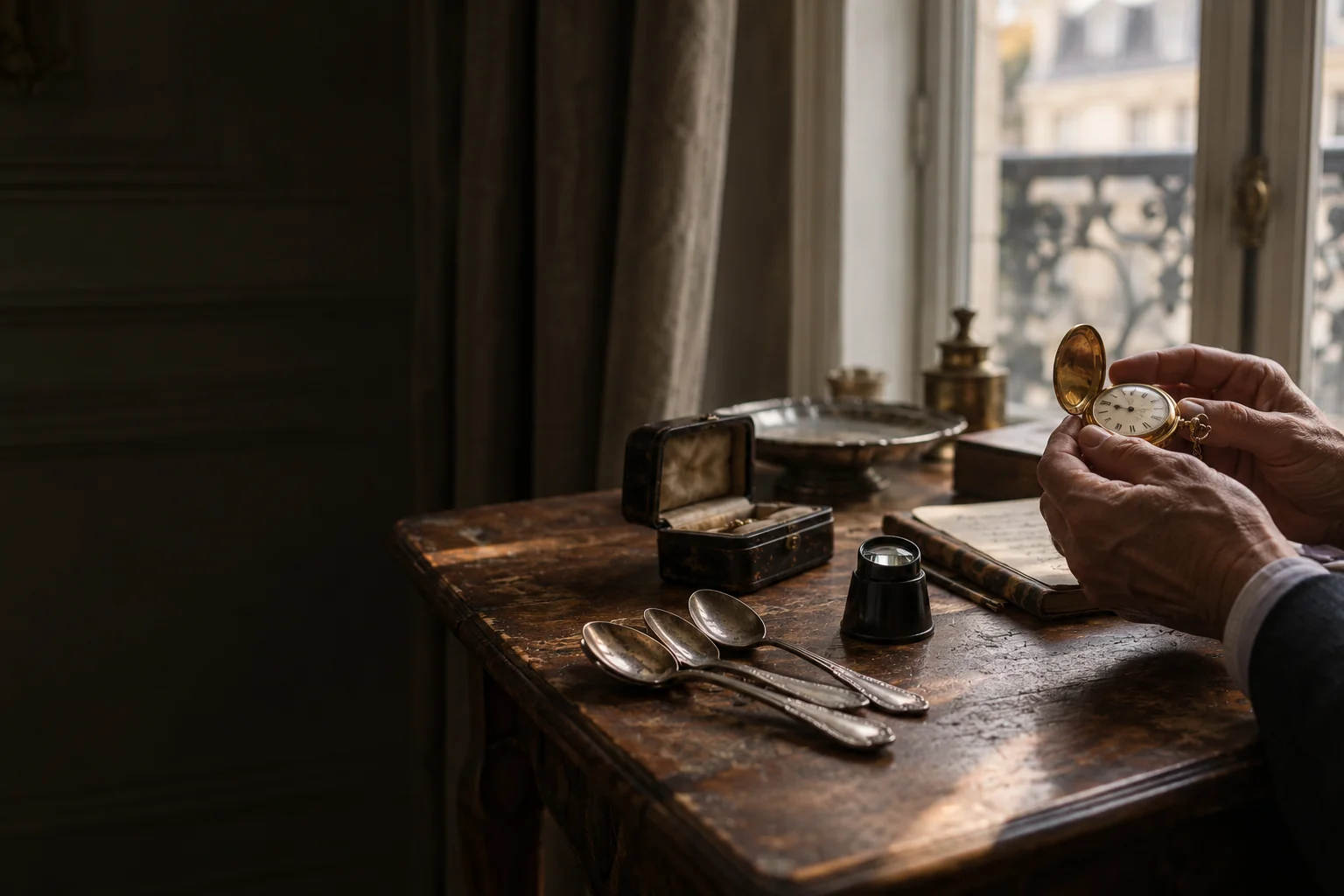
A magnifying glass helps a lot. Hold the piece under a raking light: an acid mark then shows up as a slight matte haze on the glass.
Check the weight and the cutting
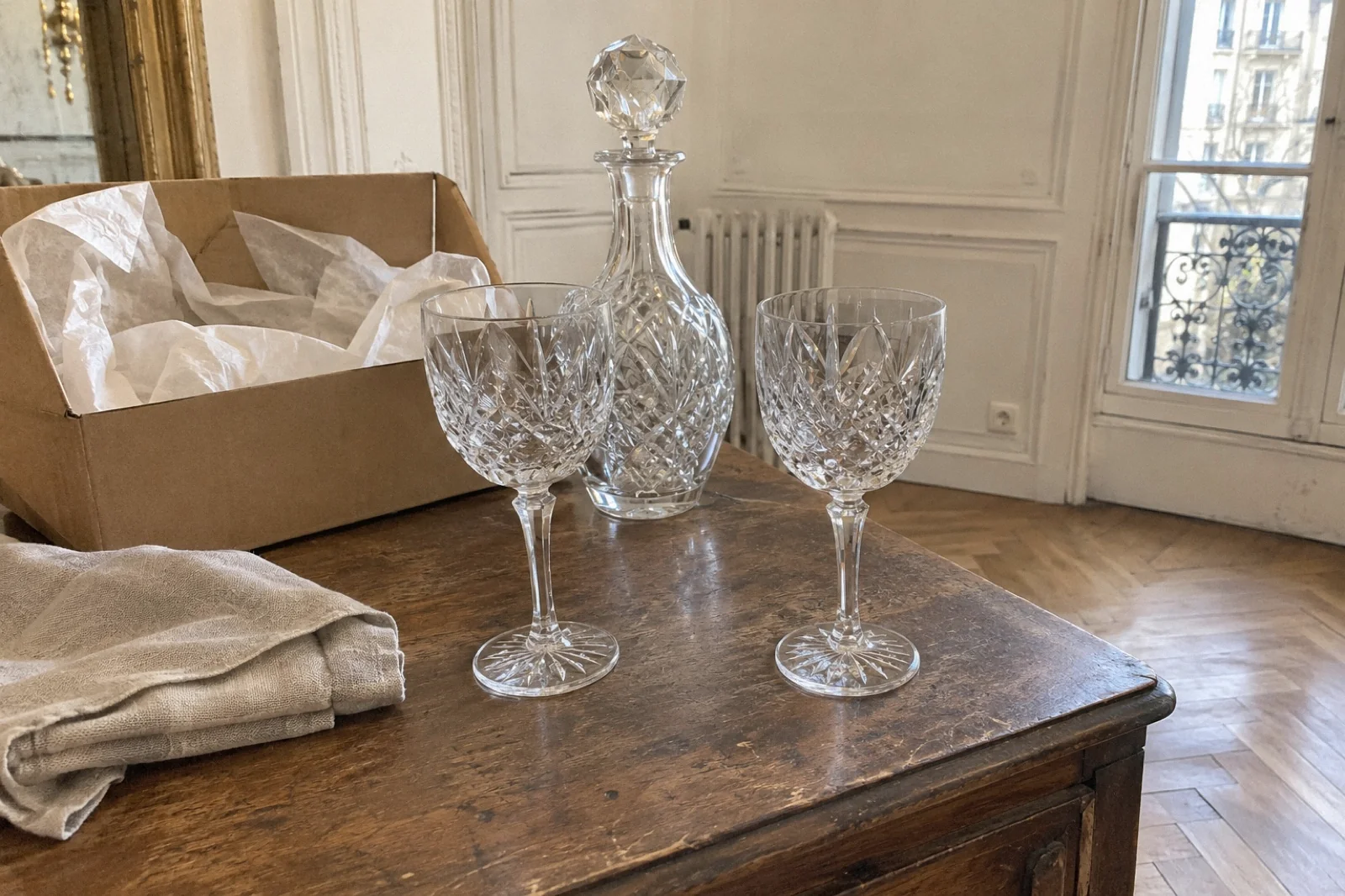
Crystal feels heavier in the hand than pressed glass of the same size. The edges of the cutting are sharp, the facets are even, and the glass is clear, without many bubbles or visible mould marks.
Listen to the ring
Tap the rim gently with a fingernail, or rub it with a wet finger. Crystal usually gives a clear sound that lasts. Ordinary glass sounds shorter and duller. This test is a clue, not proof. Do it gently: a thin or already cracked piece can break.
Old pieces without a mark
Not every old piece carries a readable mark. A piece may also have lost its stamp through wear. In that case we compare the shape, the cutting and the proportions with known patterns. It is a matter of eye and comparison, and it is more reliable with the piece in front of us than from a photo.
Baccarat, Saint-Louis, Daum: how not to confuse them?
Several French and Belgian houses make fine crystal. Think of Saint-Louis, Daum, Lalique or Val Saint Lambert in Belgium. Their pieces sometimes look like Baccarat's, and it is the mark that tells them apart.
Imitations exist too. A pressed glass, moulded to imitate crystal cutting, can fool you at first glance. To the touch, its patterns are less crisp, its angles more rounded, and it feels lighter.
What gives Baccarat crystal its value?
Here are the criteria we look at.
- The mark: a clearly identified piece is easier to appraise and to sell.
- The pattern: some patterns, such as the well-known Harcourt, are recognised and sought after. Others much less so.
- The condition: we look for chips on the rim, the foot and under the base, cracks, scratches and cloudy haze.
- Rarity: an unusual shape, a collector's piece or a limited series carries more weight than an everyday glass from a service.
- Quantity: several pieces in the same pattern make a more interesting group than a single glass.
- Age: an old piece in good condition may be of interest to collectors.
- Accessories: the stopper of a decanter, the lid of a bonbon dish or an original case matter a great deal.
A stopper that does not belong to the decanter, for example, reduces the appeal of the piece.
Does chipped or cracked crystal still have value?
Often, very little. A chip on the rim of a glass can be seen and felt with a finger. It gets in the way of use, and buyers generally refuse it. A crack is even more serious, because it can spread.
There are exceptions. A rare or old piece may keep some interest despite a flaw. In that case we need to see it up close, because a flaw has to be judged by its position and its size.
A small chip under the foot, barely visible, matters less than a chip on the rim. It still has to be pointed out honestly, and we always do so.
Can you sell an incomplete set of glasses?
Yes. Many families keep odd glasses after years of use and wonder whether it is worth mentioning them. The answer is yes.
Some buyers are looking precisely for pieces to complete a set. They may want a water glass, a flute, a wine glass or a decanter in the same pattern. A single glass can therefore find a buyer, as long as it is in good condition and identified.
A complete set, with its different glass sizes, is of course simpler to sell. If you have a complete set, do not split it up before showing it to us.
Glasses in several sizes: should you keep everything together?
Yes, at least until the appraisal. Photograph the whole group, then each size of glass. We will then tell you what forms a coherent set and what sells better separately.
Which Baccarat crystal pieces are in demand?
The pieces we see most often are:
- sets of glasses (water, wine, flutes, digestifs);
- decanters and toilet bottles;
- vases and bowls;
- paperweights and display objects;
- chandeliers and wall lights, more rarely, which need a separate opinion (see how to value an antique chandelier);
- tableware pieces: ice buckets, trays, bonbon dishes.
For tableware more generally, our article on antique tableware that is really worth something gives useful guidance.
How should you clean and store crystal?
Before having your pieces appraised, avoid anything that could damage them.
- Wash by hand, in lukewarm water with a little mild detergent. Dishwashers can dull crystal over time.
- Avoid thermal shock: do not pour very hot water onto a cold piece.
- Dry with a soft, lint-free cloth.
- Do not store glasses stacked rim against rim.
- Do not try to polish out a chip yourself: you risk altering the piece.
If a piece is clouded by deposits, do not rub it with an abrasive product. Show it to us first.
How can you have Baccarat crystal appraised and sold?
The simplest way to start is with clear photos taken in daylight:
- an overall view of the piece or the set;
- a close-up of the mark under the foot;
- a close-up of the rims, to show the condition;
- a photo of the whole group if you have several pieces.
With these images we can already give a first opinion. Our home appraisal is free and without obligation, on photos or at your home. If you decide to sell, we can buy your items with immediate payment.
For items that find no buyer but can still be useful, we give them to charities such as Emmaüs, the Secours catholique or the Armée du Salut.
What should you do with crystal glasses from an estate?
In a family house, crystal is often among the objects kept in a display cabinet, which nobody knows how to value and which people hesitate to throw away. Before giving away or discarding anything, take the time to have it looked at.
If you are handling an estate in France, our article on what to do with the furniture and objects in the home helps you organise things. We can also help with sorting and buying when a whole home has to be emptied: see our house clearance service.
Have your crystal appraised with Murier Antiquités
Baptiste Murier, antiquarian and dealer, examines crystal with the same questions every time: the mark, the pattern, the condition, the quantity. We then explain what we see, piece by piece, and what can be sold.
For a free appraisal without obligation, call us on 06 24 56 38 58 (+33 6 24 56 38 58 from abroad) or send a few photos of your glasses, decanters and vases on WhatsApp to the same number.