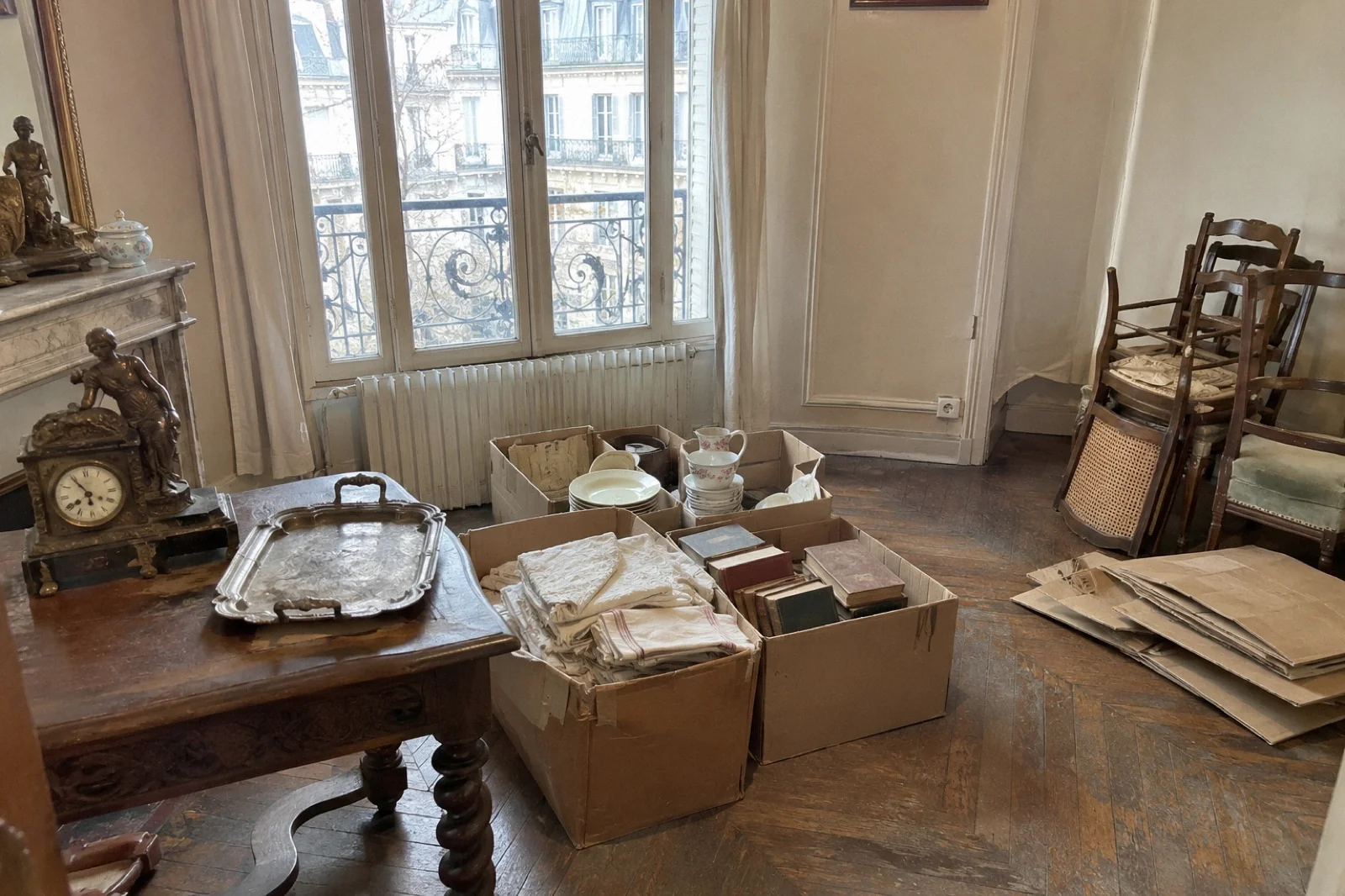
By Baptiste Murier, antique and second-hand dealer in Île-de-France.
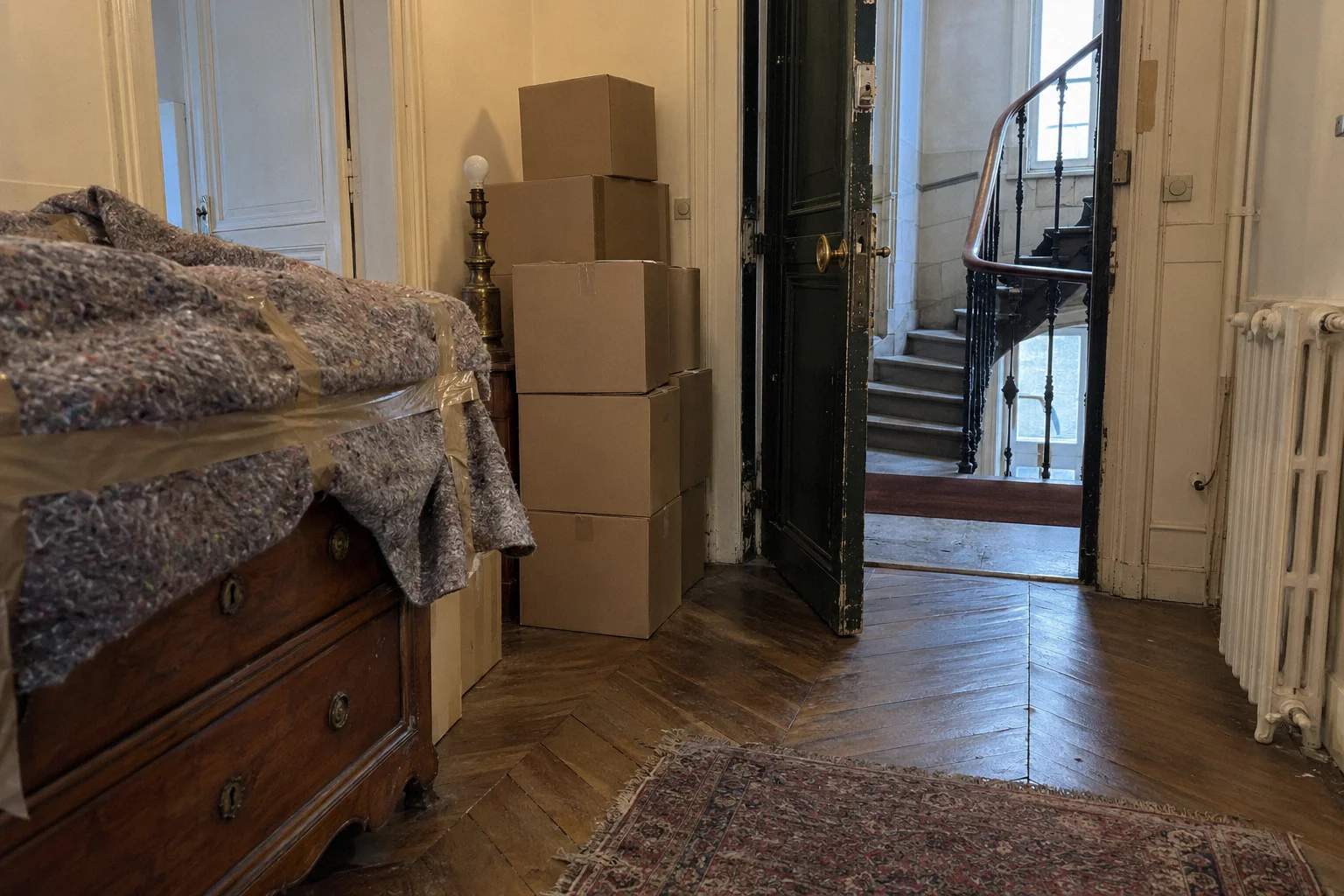
After a house clearance, your belongings follow one of three paths. Anything of value is appraised, then bought. Anything still in good condition that can be used is donated to charities such as Emmaüs, the Secours catholique, the Salvation Army or nearby reuse centres (ressourceries). The rest goes to the proper channels: recycling centre or recycling. Nothing is thrown away at random. Here is how the sorting is done, item by item, and what you can ask before you sign anything.
What actually happens to items after a house clearance?
A serious clearance starts with sorting. Each item is looked at, then sent to one of these three destinations:
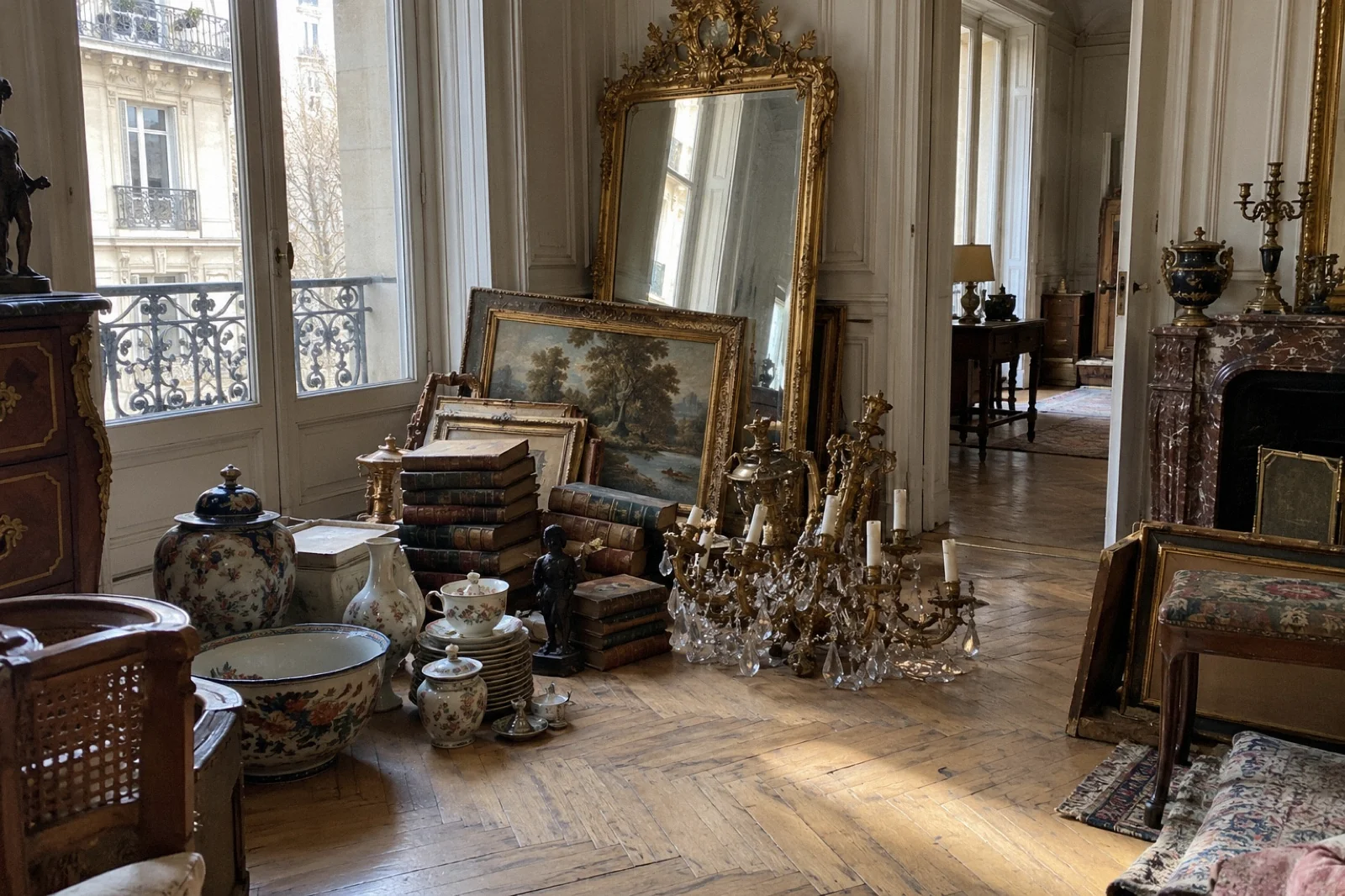
- Sale or buy-out for anything of value: antique furniture, jewellery, silverware, clocks, paintings, postcards, coins, Asian objects.
- Donation for anything clean, intact and usable: everyday crockery, linen, books, small furniture, household items.
- Controlled disposal for anything broken, damaged, soiled or no longer usable.
This approach avoids two common mistakes: throwing everything away without looking, or keeping everything for fear of making a mistake. We follow it for the house and apartment clearances we carry out in Paris and Île-de-France.
Who decides what is kept, donated or disposed of?
You do. The property and its contents belong to you, or to the estate. Nothing should leave the premises without you knowing where it is going.
During the free visit, we go through the property room by room. We tell you what seems to have value, what can be donated and what goes to the recycling centre. You can set aside anything you wish to keep, even an item with no market value.
In an estate, the situation is a little different: several heirs may be involved, and their agreement matters. We come back to this below.
How is the sorting done before the removal?
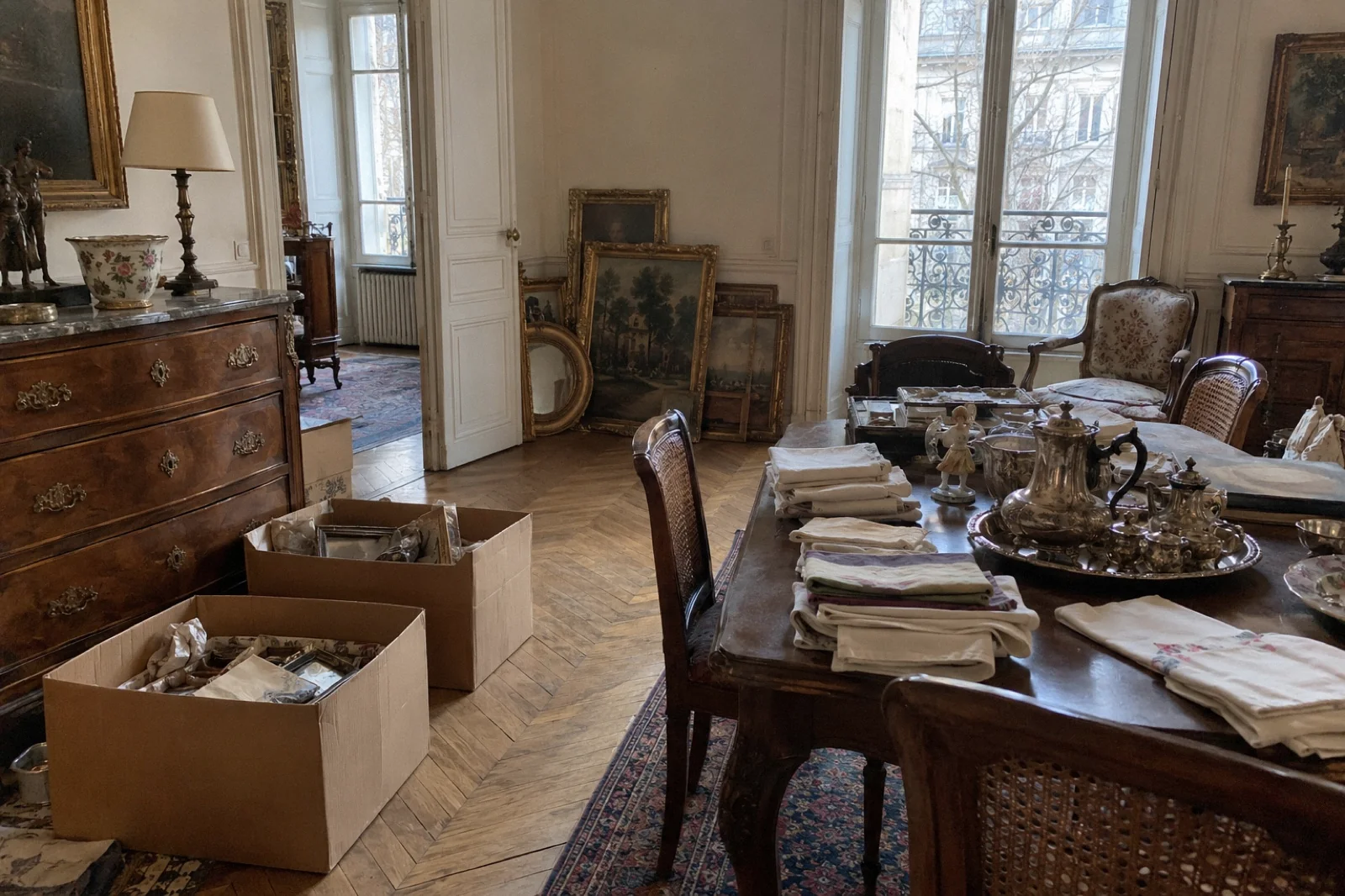
The sorting takes place on site, before anything is taken away. It generally follows this order:
- Personal items: papers, photographs, keepsakes, family jewellery. They are set aside for the family.
- Valuable items: we examine them closely to appraise them.
- Useful items: anything that can be donated.
- The rest: anything that has to be disposed of.
Cellars, attics, garages and outbuildings often need more attention than you would expect. They sometimes hold forgotten crates, boxes of books, suitcases of postcards or objects wrapped in newspaper. It is better to open everything than to assume.
Which items do you buy?
We buy antiques and collectables in our areas of expertise: clocks and watches, period furniture, antique jewellery and gold, silverware, coins and medals, antique postcards, paintings, porcelain, Asian art and curiosities.
An item can be old without being worth much, and a modest-looking item can be a surprise. That is why we prefer to look before deciding. If you would like an opinion on a particular item, the home appraisal is free and without obligation. It can also be done from photos.
When we buy, payment is immediate, by bank transfer. A bank transfer is required for gold and precious metals.
Is the buy-out deducted from the price of the clearance?
Yes. The amount we pay for the items we buy is deducted from the price of the clearance. When the value of the items we buy covers the clearance, it can be free.
This is not automatic: it all depends on what the property contains. An apartment full of furniture with no value is not cleared like a house full of clocks and silverware. After the visit, we tell you plainly how things stand. For the conditions of a clearance at no cost, read free apartment clearance in Paris: what are the conditions?.
What happens to the items you buy from us?
We are antique dealers and flea market traders. The items we buy are meant to be resold, notably at our stand at the Puces de Vanves flea market at the weekend and at brocantes (flea markets) around Île-de-France. A clock, an armchair or a dinner service goes on to a buyer who will appreciate it.
Do donated items really go to charities?
Anything that can still be used is donated, in particular to Emmaüs, the Secours catholique, the Salvation Army or reuse centres near the property being cleared.
A few useful points:
- Charities choose what they accept. They do not take everything, and that is normal: they must be able to reuse what they are given.
- A donated item must be clean, intact and in working order.
- Organisations vary from one town to another. We choose the one that suits best, depending on the item and the location.
We do not promise that every item will find a new home. We simply say that what can be used does not go into the skip out of convenience.
What happens to items that cannot be donated?
Anything broken, damaged or unusable goes to the proper channels: the recycling centre and recycling.
In practice, we distinguish between:
- Bulky waste (old mattresses, damaged furniture, bed bases): recycling centre.
- Electrical and electronic appliances: they go through a specific recycling channel.
- Metal, glass, paper, cardboard: sorted so they can be recycled where possible.
- Hazardous products (paints, solvents, cleaning products): they do not go in an ordinary skip. They are taken to the recycling centre, which handles them.
- Unused medicines: they are returned to a pharmacy.
The aim is simple: leave nothing dumped in the countryside, and mix nothing without reason.
What about papers, photographs and keepsakes?
These are the most delicate items. They almost never have any market value, but they mean a great deal to a family.
Before any removal, we set aside:
- photographs, albums and letters;
- administrative papers and important documents;
- decorations, medals and keepsakes;
- annotated books, notebooks and exercise books.
These are handed back to the family, who decide what to do with them. If some papers seem sensitive to you, it is better to collect them yourself before we come.
What if several heirs are involved?
Before clearing a property after a death, the heirs need to agree on what is sold, donated or kept. A disagreement, even over a modest item, can hold up everything that follows.
A few tips:
- gather the heirs, or their written agreement, before the visit;
- each make a list of the items you care about;
- take photos of the whole property before the sorting;
- ask the notary (in France) if you are unsure how to proceed.
We go through these steps in preparing the clearance of a house after a death. For help with an estate, see also our page on the antique dealer for estates.
Can you keep some items?
Of course. Nothing obliges you to sell or donate an item that matters to you. Tell us during the visit and we will leave it aside. If an item you thought was of no interest turns out to be more interesting than expected, you choose whether to keep it, have it appraised or sell it.
What questions should you ask before signing a clearance?
To find out what will happen to your belongings, you can ask:
- Will there be a visit before the quote, and is it free?
- Will valuable items be appraised separately?
- Is the buy-out deducted from the price of the clearance, and how is it shown?
- Where do the items that are not bought go?
- What happens to papers and keepsakes?
- Will the property be cleaned after the removal?
A serious professional answers plainly. With us, the visit is free, the appraisal is free, and travel is free in Paris and Île-de-France.
For a free appraisal before a clearance, call us on 06 24 56 38 58 (+33 6 24 56 38 58 from abroad) or send a few photos on WhatsApp to the same number. We will reply simply, with no obligation.