By Baptiste Murier, antique and second-hand dealer in Île-de-France.
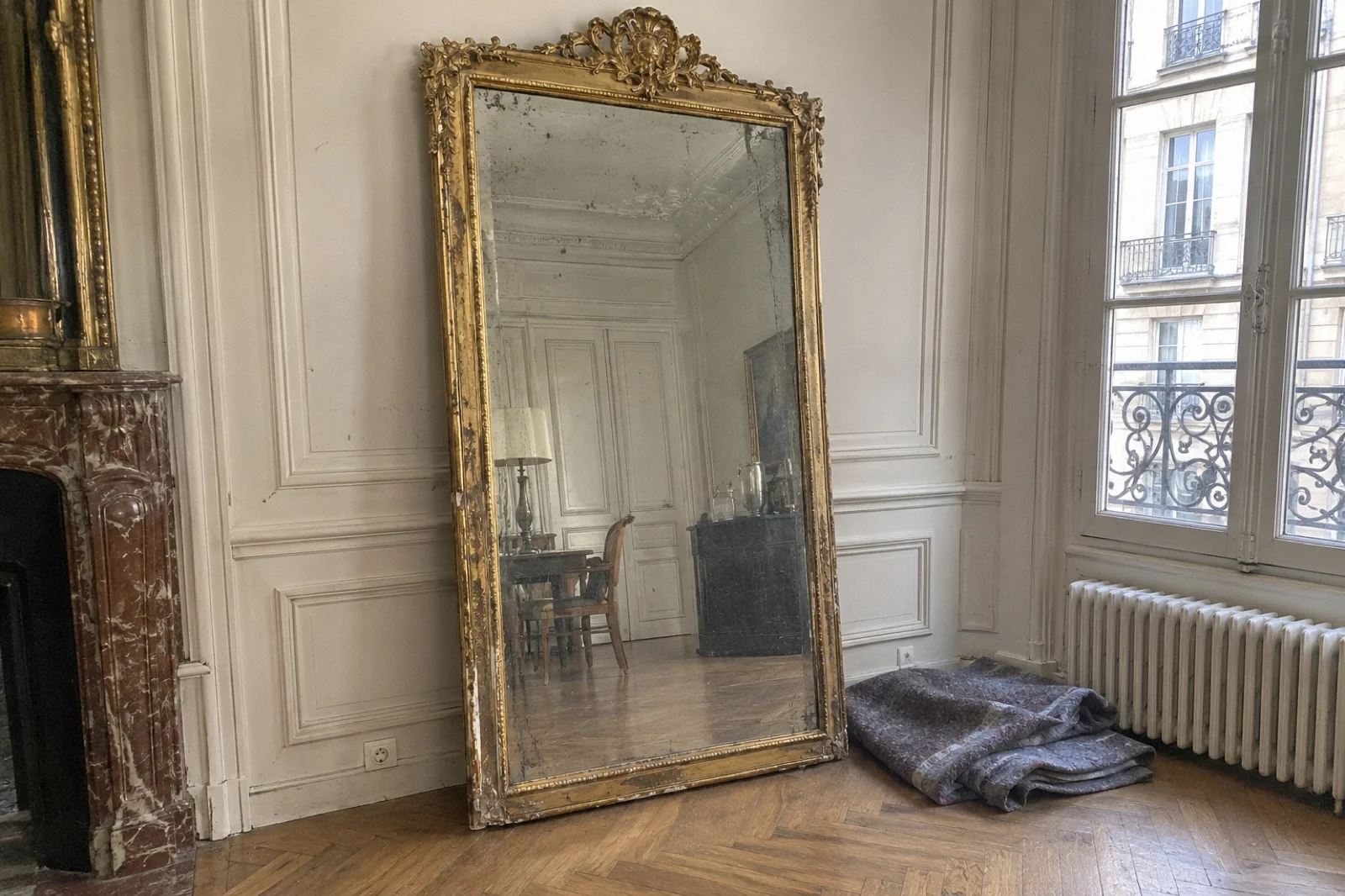
The value of an antique mirror comes first from its frame: carved wood, original gilding, quality of the decoration and period. Then come the glass, the size, the condition and any restorations. So there is no single value. Some mirrors are fine period pieces, others are more common decorative items, often from the 19th century. To know where yours stands, a few specific points need to be checked.
What gives an antique mirror its value?
We look at the piece as a whole, never at a single element. These are the criteria that matter most:
- period and style: an 18th-century mirror does not hold the same place as a Louis XVI style mirror made in the 19th century;
- quality of the frame: fineness of the carving, regularity of the motifs, presence of a pediment or worked decoration;
- the gilding: original or redone, well preserved or badly damaged;
- the glass: old or replaced, in a single piece or in several;
- the dimensions: a large mirror is impressive, but it also needs a suitable wall;
- overall condition: losses, cracks, restorations, touch-ups;
- current demand: some styles are sought after more than others.
A mirror is not valuable simply because it is old. It is valuable when several of these criteria come together.
How do you recognise a period mirror?
Three places almost always give clues: the back, the frame and the glass.
What should you look at on the back of the mirror?
Turn the mirror over carefully, preferably with two people. On the back of an antique mirror, you will usually find aged wooden boards, old nails, signs of use and sometimes labels or inventory numbers.
By contrast, a fibreboard panel, modern screws or staples often point to recent manufacture, or at least to a replaced back.
What should you look at on the frame?
The frame is the first element we examine. A few pointers:
- carving in the wood has slightly lively edges, with small irregularities made by hand;
- moulded composition decoration is more uniform, and its motifs repeat identically;
- natural wear appears where the frame is touched: corners, lower edge, projecting parts;
- the joints of the frame should look consistent with its age.
Moulded composition is not a flaw in itself, but it is not valued like high-quality carved wood.
What should you look at on the glass?
Old glass is not perfectly flat. Its reflection can ripple slightly, and it sometimes shows a hand-cut bevel. Very clear, perfectly even glass with intact silvering has often been replaced. That does not ruin a mirror, but it changes how its value is read.
How do you recognise mercury glass?
For a long time, mirrors were made with a silvering based on tin and mercury, before silver coating took over during the 19th century. We therefore speak of mercury glass for silvering of the old type.
The signs that set it apart:
- a softer reflection, slightly greyish, sometimes a little dark;
- spots and uneven marks, often more numerous towards the edges;
- silvering that is flaking or oxidised when you look at the back of the glass;
- a surface that is not perfectly uniform.
These signs are clues, not proof. A more recent mirror can also develop spots over time. It is always better to cross-check with the frame, the back and the style. Never scratch the silvering to test it, and do not rub the marks.
Original gilding or regilding: what is the difference?
On an old frame, the gilding is often done with gold leaf laid over a preparation. Over the years it wears and leaves duller areas showing. This wear is normal.
Original gilding, even a little tired, is generally preferred to regilding. Recent regilding is often shinier and more uniform, and it can clog the details of the carving. Hence our advice: do not have a mirror regilded before having it valued.
What are the main types of antique mirror?
These are the families you meet most often:
- The trumeau: a large panel of glass, often placed above a fireplace or between two windows, sometimes topped with a painting;
- The mirror with beaded glazing strips (parecloses): the glass is made of several pieces held by small wooden strips, typical of the 18th century;
- The pedimented mirror: a gilded frame with carved decoration at the top, very common in Louis XVI style;
- The cheval mirror (psyché): a large standing mirror that can be tilted, very fashionable in the 19th century.
A style name on a label does not tell the whole story. A mirror "in Louis XVI style" can date from the 18th century or from the 20th. Examining the object settles it.
Does a spotted, stained or cracked mirror have less value?
Spots in the silvering are normal on old glass. On their own they do not take away the interest of a mirror, and some collectors even look for them because of the patina they give.
What weighs more:
- a crack or chip in the glass;
- significant losses in the carving of the frame;
- repairs that are poorly done or visible touch-ups;
- a frame that is warped or weakened by damp;
- glass replaced in an original frame, or the other way round.
A damaged mirror is not necessarily without interest. It can be restored, or sold as it is to someone who will know how to bring it back to its best.
What should you do before selling an antique mirror?
The most common mistakes are easy to avoid:
- do not clean the glass with harsh products, which can attack the silvering from the edges;
- do not repaint or regild the frame;
- do not hang a large mirror on a fragile hook: in the meantime, stand it on the floor, propped against a wall;
- keep labels, papers and anything that can tell the story of the mirror.
How can you have an antique mirror valued?
A serious valuation starts with good photos. If you can, send us:
- the whole mirror, from the front, well lit, without flash glare;
- a close-up of the corners and the upper part of the frame;
- the back of the mirror, in full and then in detail;
- the glass, especially the spotted or damaged areas;
- the dimensions: height and width.
With these details, we can give you a first opinion. For more important pieces, we can also come to your home: our home valuation is free and without obligation. For a mirror that belongs to a set of furniture, our page on period furniture valuation explains how we proceed. If you wish to sell, we can also buy your mirror with immediate payment by bank transfer.
What if the mirror is part of an estate?
In a family house, a large mirror has often hung in the same place forever, and nobody thinks of looking at it closely. Our article on what to do with the furniture and objects of an estate helps you organise things without rushing.
A free valuation for your mirror
Do you have an antique mirror and want to know its value? Call us on 06 24 56 38 58 (+33 6 24 56 38 58 from abroad), or send us a few photos on WhatsApp at the same number. You will receive a first opinion, free and without obligation.